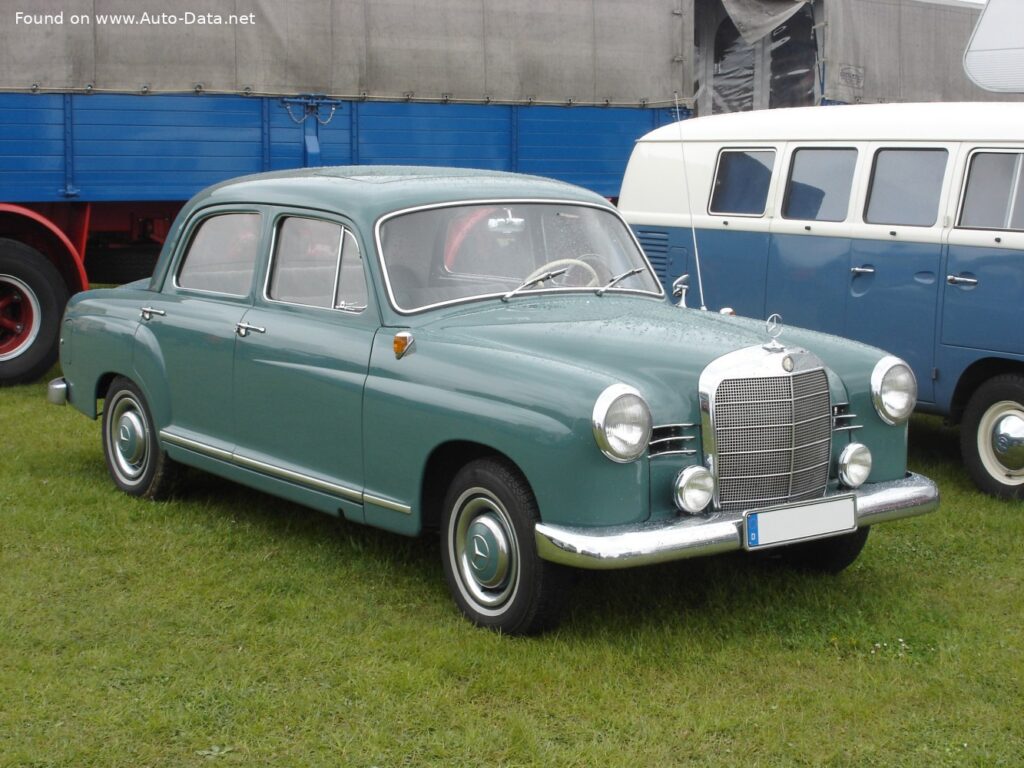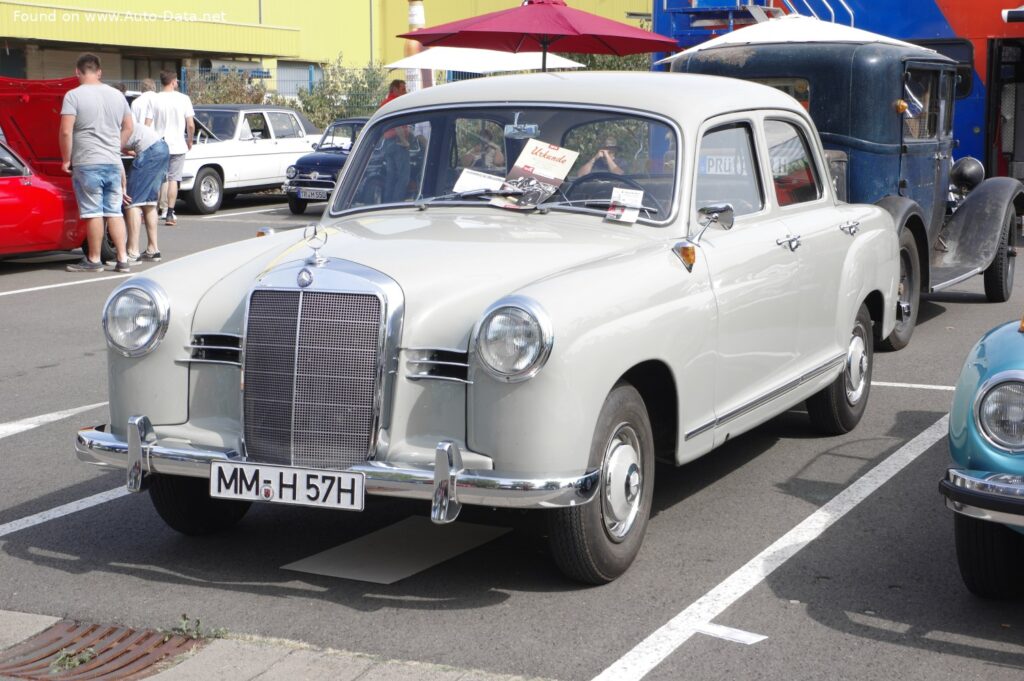
The Mercedes-Benz W120 Sedan, commonly known as the Ponton, represents a pivotal moment in the post-war recovery of German automotive engineering. Produced from 1953 to 1955, the 180 D variant, powered by a modest 40 horsepower diesel engine, was a significant offering in a market transitioning towards personal mobility. The “Ponton” name, meaning “pontoon” in German, derived from its unibody construction – a departure from the separate chassis and body designs prevalent before the war – giving the car a lower profile and more modern appearance. This model was primarily sold in Europe and served as a crucial stepping stone for Mercedes-Benz in establishing itself as a manufacturer of accessible, yet high-quality, automobiles.
Mercedes-Benz W120 Sedan 180 D: A Post-War Icon
The W120 series marked a deliberate shift for Mercedes-Benz. Prior to the war, the brand was largely associated with luxury vehicles. The Ponton aimed to broaden the company’s appeal by offering a practical and relatively affordable family car. The 180 D, specifically, was designed to cater to the demand for fuel-efficient transportation in a post-war Europe still grappling with economic constraints. While not a performance vehicle by modern standards, the 180 D offered a level of comfort and engineering refinement that set it apart from many of its contemporaries.
Engine & Performance
The heart of the 180 D is its 1.8-liter (1767 cm3) inline-four cylinder diesel engine, designated OM 636 VII / 636.930. This engine produced 40 horsepower at 3200 rpm and 101 Nm (74.49 lb.-ft.) of torque at 2000 rpm. The engine employed precombustion chamber injection, a common diesel technology of the era, and featured an overhead valve (OHV) valvetrain with two valves per cylinder. While the power output seems low by today’s standards, the diesel engine provided excellent fuel economy – 6.3 l/100 km (37.3 US mpg, 44.8 UK mpg, 15.9 km/l) – a crucial advantage in the 1950s. Acceleration from 0 to 100 km/h (0-62 mph) took approximately 39 seconds, and 0 to 60 mph was achieved in around 37.1 seconds. The top speed was limited to 110 km/h (68.35 mph). The engine’s longitudinal front-engine layout and rear-wheel drive configuration were typical for the period.
Design & Features
The W120 Sedan’s design was a significant departure from the pre-war Mercedes-Benz aesthetic. The unibody construction allowed for a lower roofline and a more integrated appearance. The car featured a three-box design with clearly defined front, passenger compartment, and trunk sections. The Ponton’s styling was characterized by its rounded fenders, prominent grille, and relatively simple, yet elegant, lines. Inside, the 180 D offered seating for five passengers and provided a comfortable, if spartan, interior. Features were limited by the era and the car’s positioning as a relatively affordable model. Safety features were rudimentary by modern standards, consisting primarily of robust construction and reliable braking systems. The car utilized drum brakes on all four wheels and a cone worm with recirculation balls steering system. The suspension consisted of a double wishbone setup with a transverse stabilizer at the front and a trailing arm arrangement at the rear.
Technical Specifications
| Brand | Mercedes-Benz |
| Model | Ponton |
| Generation | W120 Sedan |
| Type (Engine) | 180 D (40 Hp) |
| Start of production | October, 1953 |
| End of production | September, 1955 |
| Powertrain Architecture | Internal Combustion engine |
| Body type | Sedan |
| Seats | 5 |
| Doors | 4 |
| Fuel consumption (combined) | 6.3 l/100 km (37.3 US mpg, 44.8 UK mpg, 15.9 km/l) |
| Fuel Type | Diesel |
| Acceleration 0 – 100 km/h | 39 sec |
| Acceleration 0 – 62 mph | 39 sec |
| Acceleration 0 – 60 mph | 37.1 sec |
| Maximum speed | 110 km/h (68.35 mph) |
| Weight-to-power ratio | 30 kg/Hp |
| Weight-to-torque ratio | 11.9 kg/Nm |
| Power | 40 Hp @ 3200 rpm |
| Power per litre | 22.6 Hp/l |
| Torque | 101 Nm @ 2000 rpm (74.49 lb.-ft. @ 2000 rpm) |
| Engine layout | Front, Longitudinal |
| Engine Model/Code | OM 636 VII / 636.930 |
| Engine displacement | 1767 cm3 (107.83 cu. in.) |
| Number of cylinders | 4 |
| Engine configuration | Inline |
| Cylinder Bore | 75 mm (2.95 in.) |
| Piston Stroke | 100 mm (3.94 in.) |
| Compression ratio | 19:1 |
| Number of valves per cylinder | 2 |
| Fuel injection system | Precombustion chamber injection |
| Engine aspiration | Naturally aspirated engine |
| Valvetrain | OHV |
| Engine oil capacity | 4 l (4.23 US qt | 3.52 UK qt) |
| Kerb Weight | 1200 kg (2645.55 lbs.) |
| Max. weight | 1650 kg (3637.63 lbs.) |
| Max load | 450 kg (992.08 lbs.) |
| Fuel tank capacity | 56 l (14.79 US gal | 12.32 UK gal) |
| Length | 4460 mm (175.59 in.) |
| Width | 1740 mm (68.5 in.) |
| Height | 1560 mm (61.42 in.) |
| Wheelbase | 2650 mm (104.33 in.) |
| Front track | 1420 mm (55.91 in.) |
| Rear track | 1450 mm (57.09 in.) |
| Drivetrain Architecture | Rear wheel drive |
| Number of gears and type of gearbox | 4 gears, manual transmission |
| Front suspension | Double wishbone, Transverse stabilizer |
| Rear suspension | Trailing arm |
| Front brakes | Drum |
| Rear brakes | Drum |
| Steering type | Cone worm with recirculation balls |
The Mercedes-Benz W120 Sedan 180 D, while not a high-performance machine, holds a significant place in automotive history. It represented a crucial step in making the Mercedes-Benz brand accessible to a wider audience and demonstrated the company’s commitment to innovation and quality in the post-war era. Its robust construction, fuel efficiency, and comfortable ride made it a popular choice for families and individuals seeking reliable transportation during a period of rebuilding and economic recovery.