
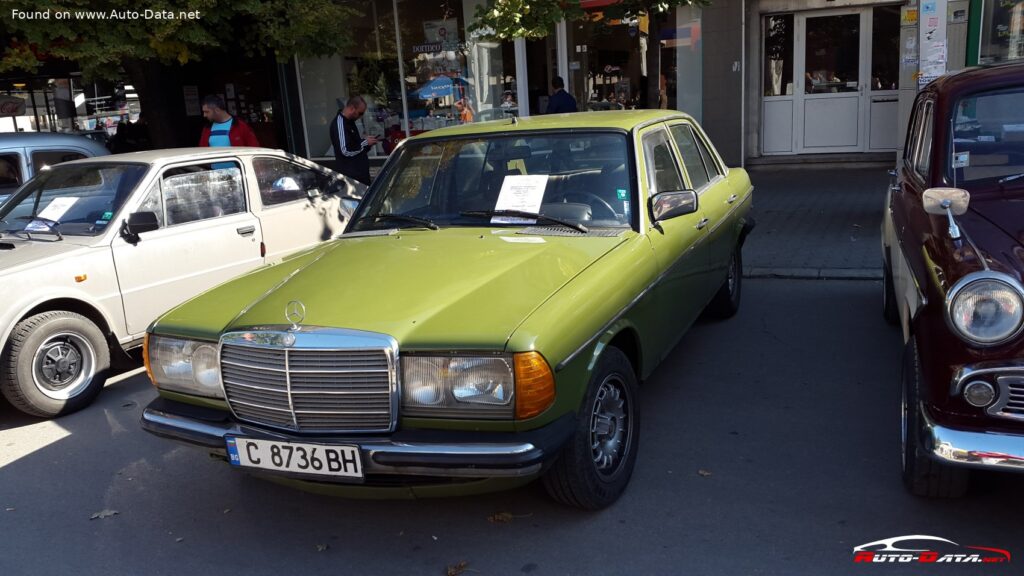
The Mercedes-Benz W123 represents a pivotal era for the German automaker, produced from October 1979 to November 1985. As the successor to the W114 and W115, the W123 established new benchmarks for safety, build quality, and comfort in the mid-size executive car segment. While sold globally, the W123 found significant success in Europe and North America, becoming synonymous with understated luxury and engineering excellence. The 200 model, powered by a 2.0-liter engine producing 109 horsepower, served as the entry point to the W123 range, offering a balance of efficiency and the renowned Mercedes-Benz driving experience.
Mercedes-Benz W123 200: A Legacy of Engineering
The W123 was more than just a replacement for its predecessors; it was a comprehensive redesign. It introduced advancements in aerodynamics, passenger safety, and overall refinement. The 200 model, specifically, was designed to appeal to buyers seeking a practical and reliable vehicle with the prestige of the three-pointed star. It represented a significant step forward in terms of corrosion protection compared to earlier Mercedes-Benz models, a crucial factor in its longevity and enduring popularity. The W123’s robust construction and relatively simple mechanicals have made it a favorite among classic car enthusiasts and restorers.
Engine & Performance
The heart of the W123 200 is the M102 V 20 engine, a 1,997 cc (121.86 cu. in.) inline-four cylinder powerplant. This naturally aspirated engine delivers 109 horsepower at 5,200 rpm and 170 Nm (125.39 lb.-ft.) of torque at 3,000 rpm. While not a performance-oriented engine, it provides adequate power for comfortable cruising and everyday driving. Fuel delivery is managed by a carburetor, a common feature for the era. The engine’s longitudinal front-engine layout contributes to balanced handling. Acceleration from 0 to 60 mph takes approximately 13.7 seconds, and it achieves a top speed of 168 km/h (104.39 mph). Fuel economy is rated at 12.4 l/100 km (19 US mpg) in urban conditions and 7.9 l/100 km (29.8 US mpg) on the open road. The weight-to-power ratio stands at 12.4 kg/Hp, and the weight-to-torque ratio is 7.9 kg/Nm.
Design & Features
The W123 is instantly recognizable for its elegant, understated design. The sedan body style, with its four doors and five-seat configuration, was the most popular variant. The car’s clean lines and relatively boxy shape were typical of late 1970s and early 1980s automotive design. Inside, the W123 200 offered a comfortable and well-appointed cabin, although features were relatively modest compared to higher-trim models. Safety was a key consideration in the W123’s design, with features like crumple zones and a robust passenger cell. The car’s suspension – double wishbone at the front and a trailing arm setup at the rear – provided a comfortable ride. Braking is handled by disc brakes on all four wheels. The steering system utilizes a cone worm with recirculation balls. Wheel rims are 5.5J x 14 inches on both the front and rear axles.
Technical Specifications
| Brand | Mercedes-Benz |
| Model | W123 |
| Generation | W123 |
| Type (Engine) | 200 (109 Hp) |
| Start of production | October, 1979 |
| End of production | November, 1985 |
| Powertrain Architecture | Internal Combustion engine |
| Body type | Sedan |
| Seats | 5 |
| Doors | 4 |
| Fuel consumption (urban) | 12.4 l/100 km (19 US mpg) |
| Fuel consumption (extra urban) | 7.9 l/100 km (29.8 US mpg) |
| Fuel Type | Petrol (Gasoline) |
| Acceleration 0 – 100 km/h | 14.4 sec |
| Acceleration 0 – 62 mph | 14.4 sec |
| Acceleration 0 – 60 mph | 13.7 sec |
| Maximum speed | 168 km/h (104.39 mph) |
| Weight-to-power ratio | 12.4 kg/Hp |
| Weight-to-torque ratio | 7.9 kg/Nm |
| Power | 109 Hp @ 5200 rpm |
| Torque | 170 Nm @ 3000 rpm (125.39 lb.-ft. @ 3000 rpm) |
| Engine layout | Front, Longitudinal |
| Engine Model/Code | M 102 V 20 / 102.920 |
| Engine displacement | 1997 cm3 (121.86 cu. in.) |
| Number of cylinders | 4 |
| Engine configuration | Inline |
| Cylinder Bore | 89 mm (3.5 in.) |
| Piston Stroke | 80.25 mm (3.16 in.) |
| Compression ratio | 9:1 |
| Number of valves per cylinder | 2 |
| Fuel injection system | Carburettor |
| Engine aspiration | Naturally aspirated |
| Valvetrain | SOHC |
| Engine oil capacity | 5 l (5.28 US qt | 4.4 UK qt) |
| Coolant capacity | 8.5 l (8.98 US qt | 7.48 UK qt) |
| Kerb Weight | 1350 kg (2976.24 lbs.) |
| Max. weight | 1870 kg (4122.64 lbs.) |
| Max load | 520 kg (1146.4 lbs.) |
| Fuel tank capacity | 65 l (17.17 US gal | 14.3 UK gal) |
| Length | 4725 mm (186.02 in.) |
| Width | 1786 mm (70.31 in.) |
| Height | 1438 mm (56.61 in.) |
| Wheelbase | 2795 mm (110.04 in.) |
| Front track | 1488 mm (58.58 in.) |
| Rear track | 1446 mm (56.93 in.) |
| Drivetrain | Rear wheel drive |
| Number of gears | 4 gears, manual transmission |
| Front suspension | Double wishbone |
| Rear suspension | Trailing arm |
| Front brakes | Disc |
| Rear brakes | Disc |
The Mercedes-Benz W123 200, while not the most powerful variant of the W123 range, remains a highly desirable classic car. Its combination of robust engineering, comfortable ride, and timeless design has ensured its enduring appeal to enthusiasts worldwide. It stands as a testament to Mercedes-Benz’s commitment to quality and innovation during a significant period in automotive history.
