
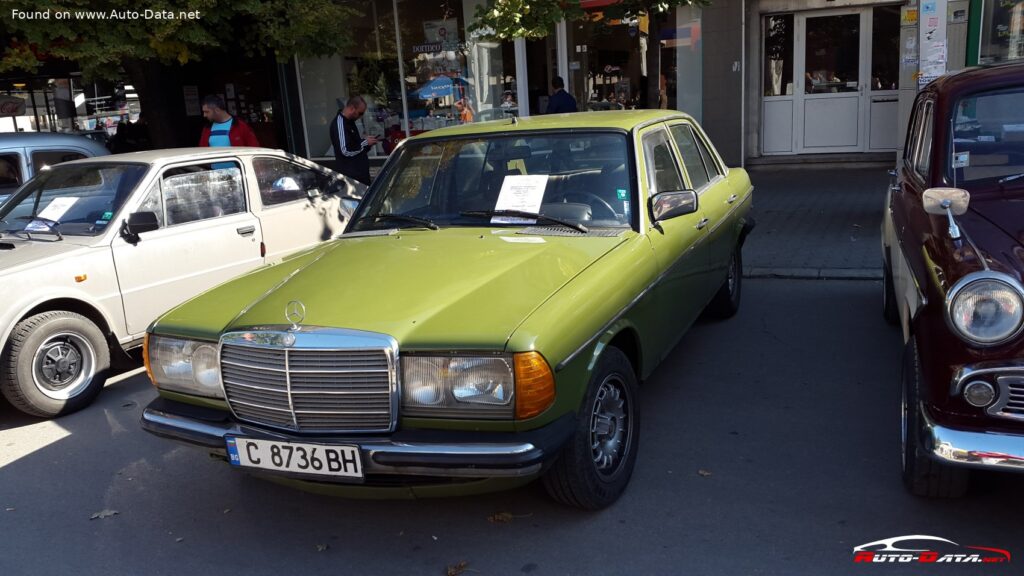
The Mercedes-Benz W123, produced from July 1975 to March 1979, represents a pivotal generation in the lineage of the iconic Mercedes-Benz E-Class. Positioned firmly in the mid-size luxury segment, the W123 was designed as a successor to the W114 and W115 models, offering a blend of refinement, durability, and understated elegance. The 220 D variant, powered by a 2.2-liter diesel engine producing 60 horsepower, was a popular choice, particularly in European markets where diesel fuel was more readily available and economically advantageous. This model cemented Mercedes-Benz’s reputation for building robust and long-lasting automobiles.
Mercedes-Benz W123 220 D: A Legacy of Engineering
The W123 series marked a significant step forward in automotive safety and engineering for Mercedes-Benz. It introduced advancements in crumple zone technology, improved side impact protection, and a more rigid passenger safety cell. While not initially conceived as a high-performance vehicle, the 220 D’s focus was on fuel efficiency and reliability, characteristics highly valued by its target demographic. The W123’s design language, characterized by clean lines and a relatively boxy silhouette, became synonymous with German automotive design of the era. It was a car built to last, and many examples remain on the road today, a testament to its build quality.
Engine & Performance
The heart of the W123 220 D is its OM 615 D 22 (615.941) 2.2-liter inline-four cylinder diesel engine. This naturally aspirated engine delivers 60 horsepower at 4200 rpm and 126 Nm (92.93 lb.-ft.) of torque at 2400 rpm. While the horsepower figure may seem modest by modern standards, the engine’s torque characteristics provide adequate performance for comfortable cruising. The engine utilizes precombustion chamber injection, a common diesel technology of the time, to improve combustion efficiency. Acceleration from 0 to 100 km/h (0-62 mph) takes approximately 28.1 seconds, and 0 to 60 mph is achieved in around 26.7 seconds. The top speed is rated at 135 km/h (83.89 mph). Fuel economy is a strong point, achieving approximately 9 liters per 100 kilometers (26.1 US mpg or 31.4 UK mpg). The engine’s longitudinal front-mounted layout contributes to balanced weight distribution.
Design & Features
The W123 220 D is a four-door sedan with a five-seat configuration. Its body style is a classic three-box design, emphasizing practicality and passenger comfort. The exterior design is characterized by its relatively simple, yet elegant lines, and the prominent Mercedes-Benz grille. Inside, the W123 offered a comfortable and well-appointed cabin for its time. Features included comfortable seating, a straightforward dashboard layout, and a focus on durability. Safety features, while limited by the standards of the 1970s, included disc brakes on all four wheels and the aforementioned advancements in body structure design. The W123 was available with a four-speed manual transmission, contributing to its relatively simple and robust mechanical design. The car’s dimensions are 4725 mm (186.02 in.) in length, 1786 mm (70.31 in.) in width, and 1438 mm (56.61 in.) in height, with a wheelbase of 2795 mm (110.04 in.).
Technical Specifications
| Brand | Mercedes-Benz |
| Model | W123 |
| Generation | W123 |
| Type (Engine) | 220 D (60 Hp) |
| Start of production | July, 1975 |
| End of production | March, 1979 |
| Powertrain Architecture | Internal Combustion engine |
| Body type | Sedan |
| Seats | 5 |
| Doors | 4 |
| Fuel consumption (combined) | 9 l/100 km (26.1 US mpg, 31.4 UK mpg, 11.1 km/l) |
| Fuel Type | Diesel |
| Acceleration 0 – 100 km/h | 28.1 sec |
| Acceleration 0 – 62 mph | 28.1 sec |
| Acceleration 0 – 60 mph | 26.7 sec |
| Maximum speed | 135 km/h (83.89 mph) |
| Weight-to-power ratio | 23 kg/Hp |
| Weight-to-torque ratio | 11 kg/Nm |
| Power | 60 Hp @ 4200 rpm |
| Power per litre | 27.3 Hp/l |
| Torque | 126 Nm @ 2400 rpm (92.93 lb.-ft. @ 2400 rpm) |
| Engine layout | Front, Longitudinal |
| Engine Model/Code | OM 615 D 22 / 615.941 |
| Engine displacement | 2197 cm3 (134.07 cu. in.) |
| Number of cylinders | 4 |
| Engine configuration | Inline |
| Cylinder Bore | 87 mm (3.43 in.) |
| Piston Stroke | 92.4 mm (3.64 in.) |
| Compression ratio | 21.5:1 |
| Number of valves per cylinder | 2 |
| Fuel injection system | Precombustion chamber injection |
| Engine aspiration | Naturally aspirated engine |
| Valvetrain | SOHC |
| Engine oil capacity | 7.5 l (7.93 US qt | 6.6 UK qt) |
| Coolant | 10 l (10.57 US qt | 8.8 UK qt) |
| Kerb Weight | 1380 kg (3042.38 lbs.) |
| Max. weight | 1900 kg (4188.78 lbs.) |
| Max load | 520 kg (1146.4 lbs.) |
| Fuel tank capacity | 65 l (17.17 US gal | 14.3 UK gal) |
| Length | 4725 mm (186.02 in.) |
| Width | 1786 mm (70.31 in.) |
| Height | 1438 mm (56.61 in.) |
| Wheelbase | 2795 mm (110.04 in.) |
| Front track | 1488 mm (58.58 in.) |
| Rear track | 1446 mm (56.93 in.) |
| Drivetrain Architecture | Rear wheel drive |
| Number of gears and type of gearbox | 4 gears, manual transmission |
| Front suspension | Double wishbone |
| Rear suspension | Trailing arm |
| Front brakes | Disc |
| Rear brakes | Disc |
| Steering type | Cone worm with recirculation balls |
| Wheel rims size | Front wheel rims: 5.5J x 14 Rear wheel rims: 5.5J x 14 |
The Mercedes-Benz W123 220 D remains a highly regarded classic car, appreciated for its durability, fuel efficiency, and timeless design. It represents a significant chapter in Mercedes-Benz’s history, embodying the company’s commitment to engineering excellence and passenger safety.
