
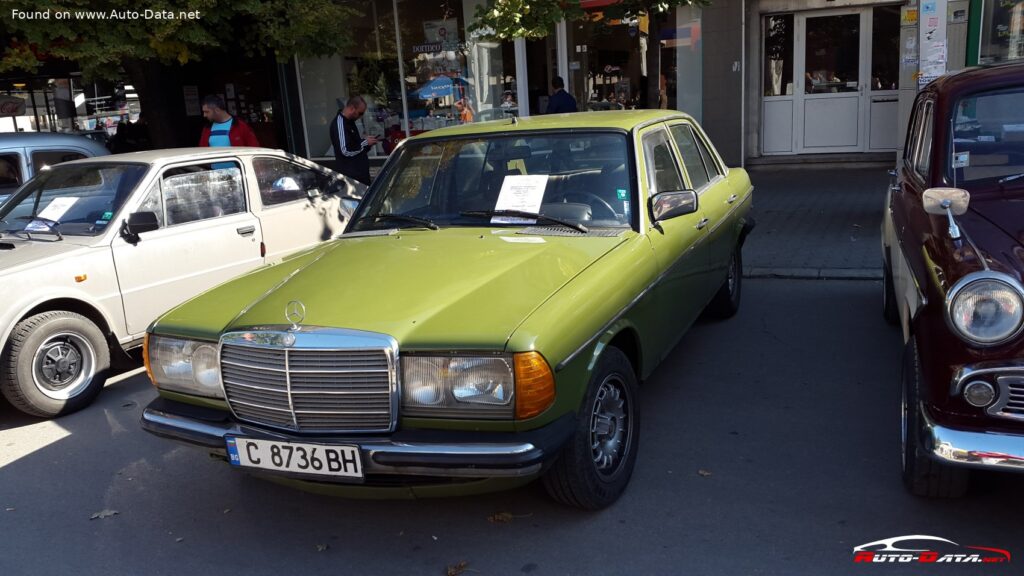
The Mercedes-Benz W123, produced from October 1979 to November 1985, represents a pivotal generation in the lineage of the Mercedes-Benz E-Class. Positioned as a mid-size executive car, the W123 succeeded the W114 and W115 models, and was itself superseded by the W201. Known for its robust engineering, build quality, and understated elegance, the W123 established a new benchmark for safety and refinement in its class. The 230 E variant, powered by a 2.3-liter inline-four engine producing 136 horsepower, was a popular choice, offering a balance of performance and fuel efficiency. The W123 was not initially sold in the United States, but later models were imported to meet growing demand for European luxury vehicles.
Mercedes-Benz W123 230 E: A Detailed Overview
The W123 series was a significant departure from its predecessors, incorporating advancements in safety technology and offering a wider range of models and options. It was available in sedan (saloon), coupe, and estate (wagon) body styles, catering to diverse customer needs. The 230 E, specifically, was designed to appeal to buyers seeking a comfortable and reliable vehicle for both daily commuting and long-distance travel. Its engine, a member of the M102 family, was renowned for its durability and smooth operation. The “E” designation indicated electronic fuel injection, a relatively new technology at the time that improved fuel economy and reduced emissions.
Engine & Performance
The heart of the W123 230 E is its 2.3-liter (2299 cm3) inline-four cylinder engine, designated M 102 E 23 / 102.980. This naturally aspirated engine produces 136 horsepower at 5100 rpm and 205 Nm (151.2 lb.-ft.) of torque at 3500 rpm. The engine features multi-port manifold fuel injection and a single overhead camshaft (SOHC) valvetrain with two valves per cylinder. This configuration delivers a power-to-liter ratio of 59.2 hp/l. Power is delivered to the rear wheels via a 4-speed manual transmission. Acceleration from 0 to 100 km/h (0-62 mph) takes 11.5 seconds, while 0 to 60 mph is achieved in 10.9 seconds. The vehicle boasts a maximum speed of 180 km/h (111.85 mph). The weight-to-power ratio is 10 kg/Hp, and the weight-to-torque ratio is 6.6 kg/Nm. Fuel consumption is rated at 12.9 l/100 km (18.2 US mpg) in urban driving and 8.1 l/100 km (29 US mpg) in extra-urban conditions.
Design & Features
The W123 230 E is a four-door sedan with a classic, understated design. Its body is characterized by clean lines, a relatively upright stance, and a prominent grille with the iconic Mercedes-Benz three-pointed star. The interior is spacious and well-appointed, offering comfortable seating for five passengers. The dashboard is functional and ergonomically designed, with clearly labeled controls. Safety was a key consideration in the W123’s design, and it featured reinforced passenger cell construction, crumple zones, and disc brakes on all four wheels. While not equipped with modern safety features like airbags, the W123 represented a significant improvement in crashworthiness compared to earlier vehicles. Standard features included power-assisted steering, a four-speed manual transmission, and a comprehensive instrument panel. The vehicle’s robust build quality and attention to detail contributed to its reputation for reliability and longevity. The fuel tank capacity is 65 liters (17.17 US gal).
Technical Specifications
| Brand | Mercedes-Benz |
| Model | W123 |
| Generation | W123 |
| Type (Engine) | 230 E (136 Hp) |
| Start of production | October, 1979 |
| End of production | November, 1985 |
| Powertrain Architecture | Internal Combustion engine |
| Body type | Sedan |
| Seats | 5 |
| Doors | 4 |
| Fuel consumption (urban) | 12.9 l/100 km (18.2 US mpg) |
| Fuel consumption (extra urban) | 8.1 l/100 km (29 US mpg) |
| Fuel Type | Petrol (Gasoline) |
| Acceleration 0 – 100 km/h | 11.5 sec |
| Acceleration 0 – 62 mph | 11.5 sec |
| Acceleration 0 – 60 mph | 10.9 sec |
| Maximum speed | 180 km/h (111.85 mph) |
| Weight-to-power ratio | 10 kg/Hp |
| Weight-to-torque ratio | 6.6 kg/Nm |
| Power | 136 Hp @ 5100 rpm |
| Torque | 205 Nm @ 3500 rpm (151.2 lb.-ft. @ 3500 rpm) |
| Engine layout | Front, Longitudinal |
| Engine Model/Code | M 102 E 23 / 102.980 |
| Engine displacement | 2299 cm3 (140.29 cu. in.) |
| Number of cylinders | 4 |
| Engine configuration | Inline |
| Cylinder Bore | 95.5 mm (3.76 in.) |
| Piston Stroke | 80.25 mm (3.16 in.) |
| Compression ratio | 9:1 |
| Number of valves per cylinder | 2 |
| Fuel injection system | Multi-port manifold injection |
| Engine aspiration | Naturally aspirated |
| Valvetrain | SOHC |
| Engine oil capacity | 5 l (5.28 US qt | 4.4 UK qt) |
| Coolant capacity | 8.5 l (8.98 US qt | 7.48 UK qt) |
| Kerb Weight | 1360 kg (2998.29 lbs.) |
| Max. weight | 1880 kg (4144.69 lbs.) |
| Max load | 520 kg (1146.4 lbs.) |
| Fuel tank capacity | 65 l (17.17 US gal | 14.3 UK gal) |
| Length | 4725 mm (186.02 in.) |
| Width | 1786 mm (70.31 in.) |
| Height | 1438 mm (56.61 in.) |
| Wheelbase | 2795 mm (110.04 in.) |
| Front track | 1488 mm (58.58 in.) |
| Rear track | 1446 mm (56.93 in.) |
| Drivetrain Architecture | Rear wheel drive |
| Number of gears | 4 gears, manual transmission |
| Front suspension | Double wishbone |
| Rear suspension | Trailing arm |
| Front brakes | Disc |
| Rear brakes | Disc |
| Steering type | Cone worm with recirculation balls |
| Wheel rims size | Front/Rear: 5.5J x 14 |
The Mercedes-Benz W123 230 E remains a highly sought-after classic car, appreciated for its timeless design, robust engineering, and comfortable driving experience. Its enduring popularity is a testament to the quality and craftsmanship that have long been associated with the Mercedes-Benz brand.
