
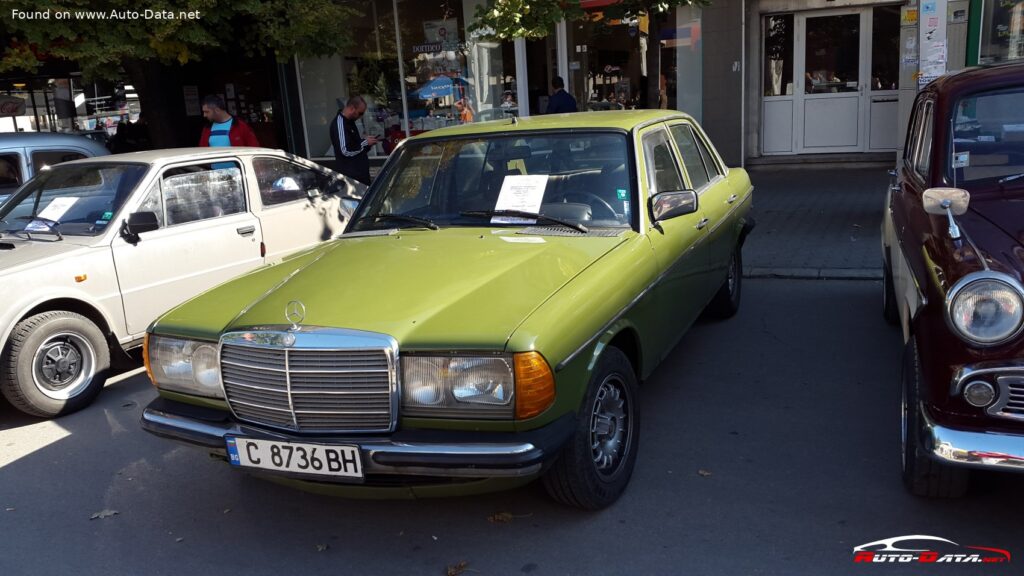
The Mercedes-Benz W123, produced from September 1978 to November 1985, represents a pivotal generation in the lineage of the Mercedes-Benz E-Class. Serving as the successor to the W114 and W115, the W123 established new benchmarks for safety, comfort, and engineering refinement in the mid-size executive car segment. While sold globally, the W123 found significant success in Europe and North America, becoming synonymous with German automotive quality and durability. The 300 D variant, powered by a robust five-cylinder diesel engine, was a particularly popular choice for those prioritizing fuel efficiency and longevity.
Mercedes-Benz W123 300 D: A Legacy of Engineering
The W123 series was a comprehensive redesign, moving away from the more rounded styling of its predecessors towards a more angular, modern aesthetic. This generation introduced numerous advancements in passive safety, including crumple zones, side-impact protection, and a reinforced passenger cell. The 300 D, specifically, was lauded for its exceptionally durable diesel engine and its ability to provide comfortable, reliable transportation over extended periods. It remains a highly sought-after classic car among enthusiasts today, prized for its build quality and understated elegance.
Engine & Performance
The heart of the W123 300 D is its OM 617 D 30 inline five-cylinder diesel engine, displacing 2,998 cubic centimeters (182.95 cubic inches). This naturally aspirated engine produces 88 horsepower at 4,400 rpm and 172 Newton-meters (126.86 lb.-ft.) of torque at 2,400 rpm. While not a performance-oriented vehicle, the 300 D offered ample torque for comfortable cruising and effortless highway driving. The engine featured precombustion chamber injection, a technology common in Mercedes-Benz diesels of the era, contributing to its efficiency and relatively quiet operation for a diesel. Power delivery is smooth and linear, prioritizing usability over outright speed. Acceleration from 0 to 100 km/h (0-62 mph) takes 17.8 seconds, and 0 to 60 mph is achieved in 16.9 seconds. The top speed is rated at 155 km/h (96.31 mph). Fuel economy is a strong point, achieving approximately 9.7 liters per 100 kilometers (24.2 US mpg) in urban driving and 7.8 liters per 100 kilometers (30.2 US mpg) on the open road.
Design & Features
The W123 300 D is a four-door sedan with a classic three-box design. Its exterior is characterized by clean lines, a relatively upright grille, and prominent headlights. The interior is spacious and well-appointed, offering seating for five passengers. The dashboard is functional and ergonomically designed, with a focus on durability and ease of use. Features included hydraulic power steering, disc brakes on all four wheels, and a four-speed manual transmission as standard. The W123 prioritized passenger safety, incorporating features like crumple zones and a robust safety cell. The vehicle’s build quality was exceptional, with attention paid to detail and the use of high-quality materials. The W123’s design was a significant departure from the more flamboyant styling of some contemporary vehicles, opting instead for a timeless and understated elegance that has aged remarkably well.
Technical Specifications
| Brand | Mercedes-Benz |
| Model | W123 |
| Generation | W123 |
| Type (Engine) | 300 D (88 Hp) |
| Start of production | September, 1978 |
| End of production | November, 1985 |
| Powertrain Architecture | Internal Combustion engine |
| Body type | Sedan |
| Seats | 5 |
| Doors | 4 |
| Fuel consumption (urban) | 9.7 l/100 km (24.2 US mpg) |
| Fuel consumption (extra urban) | 7.8 l/100 km (30.2 US mpg) |
| Fuel Type | Diesel |
| Acceleration 0 – 100 km/h | 17.8 sec |
| Acceleration 0 – 62 mph | 17.8 sec |
| Acceleration 0 – 60 mph | 16.9 sec |
| Maximum speed | 155 km/h (96.31 mph) |
| Weight-to-power ratio | 16.5 kg/Hp |
| Weight-to-torque ratio | 8.4 kg/Nm |
| Power | 88 Hp @ 4400 rpm |
| Torque | 172 Nm @ 2400 rpm (126.86 lb.-ft. @ 2400 rpm) |
| Engine layout | Front, Longitudinal |
| Engine Model/Code | OM 617 D 30 / 617.912 |
| Engine displacement | 2998 cm3 (182.95 cu. in.) |
| Number of cylinders | 5 |
| Engine configuration | Inline |
| Cylinder Bore | 90.9 mm (3.58 in.) |
| Piston Stroke | 92.4 mm (3.64 in.) |
| Compression ratio | 21.5:1 |
| Number of valves per cylinder | 2 |
| Fuel injection system | Precombustion chamber injection |
| Engine aspiration | Naturally aspirated |
| Valvetrain | SOHC |
| Engine oil capacity | 8 l (8.45 US qt | 7.04 UK qt) |
| Coolant capacity | 11 l (11.62 US qt | 9.68 UK qt) |
| Kerb Weight | 1450 kg (3196.7 lbs.) |
| Max. weight | 1970 kg (4343.11 lbs.) |
| Max load | 520 kg (1146.4 lbs.) |
| Fuel tank capacity | 65 l (17.17 US gal | 14.3 UK gal) |
| Length | 4725 mm (186.02 in.) |
| Width | 1786 mm (70.31 in.) |
| Height | 1438 mm (56.61 in.) |
| Wheelbase | 2795 mm (110.04 in.) |
| Front track | 1488 mm (58.58 in.) |
| Rear track | 1446 mm (56.93 in.) |
| Drivetrain | Rear wheel drive |
| Number of gears | 4 gears, manual transmission |
| Front suspension | Double wishbone |
| Rear suspension | Trailing arm |
| Front brakes | Disc |
| Rear brakes | Disc |
| Steering type | Cone worm with recirculation balls |
| Power steering | Hydraulic |
| Wheel rims size | Front/Rear: 5.5J x 14 |
The Mercedes-Benz W123 300 D remains a testament to the enduring qualities of German engineering. Its combination of reliability, comfort, and understated style has cemented its place as a classic, and it continues to be appreciated by enthusiasts worldwide.
