
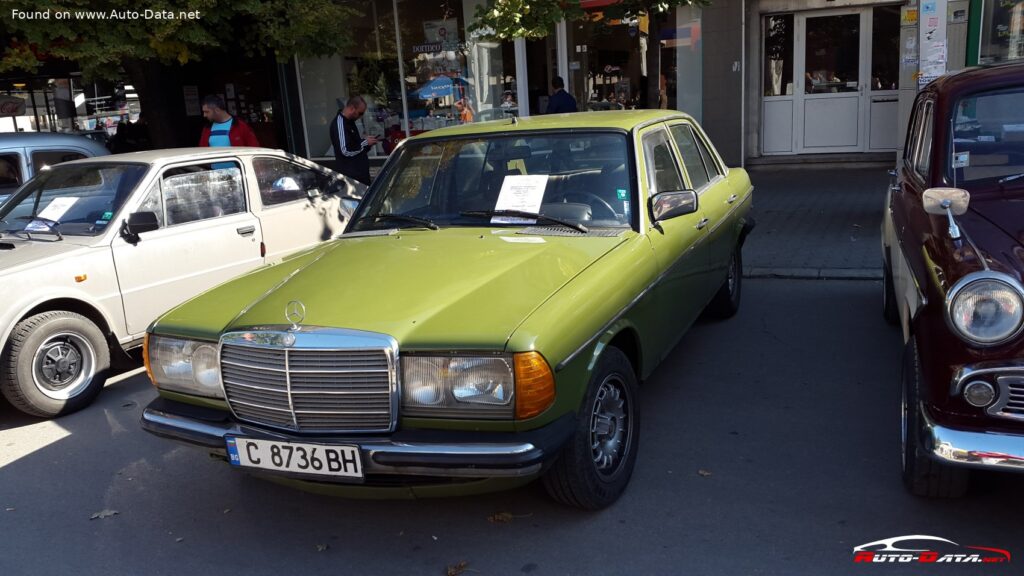
The Mercedes-Benz W123 300 D Turbodiesel represents a pivotal point in the evolution of the German automaker’s mid-size sedan. Produced between April 1981 and October 1982 for the US market, this variant of the W123 series combined the renowned build quality and engineering of Mercedes-Benz with the efficiency and durability of a turbocharged diesel engine. The W123, as a whole, was designed as a successor to the W114/W115, aiming to provide a more refined and modern experience while maintaining the brand’s reputation for reliability. The 300 D Turbodiesel specifically catered to American drivers seeking fuel economy without sacrificing the prestige associated with the three-pointed star.
The Mercedes-Benz W123 300 D Turbodiesel
The W123 series was a significant success for Mercedes-Benz, becoming synonymous with German engineering prowess and setting a benchmark for safety and comfort in its class. The introduction of the 300 D Turbodiesel in 1981 was a direct response to the growing demand for fuel-efficient vehicles, particularly in the wake of the energy crises of the 1970s. While diesel engines were already known for their economy, the addition of a turbocharger significantly boosted performance, making the 300 D a compelling option for those who didn’t want to compromise on power. This model was specifically adapted for the US market, adhering to emissions regulations and driver preferences of the time.
Engine & Performance
At the heart of the W123 300 D Turbodiesel lies the OM 617 D 30 A engine, a 3.0-liter inline-five cylinder diesel powerplant. This engine, designated as 617.952, produced 121 horsepower at 4350 rpm and 230 Nm (169.64 lb.-ft.) of torque at 2400 rpm. The turbocharger significantly enhanced the engine’s output, providing a noticeable improvement in acceleration compared to naturally aspirated diesel versions. The engine featured precombustion chamber injection, a common diesel technology of the era, and a single overhead camshaft (SOHC) valvetrain. The longitudinal engine layout and rear-wheel drive configuration were typical of Mercedes-Benz sedans of this period. Acceleration from 0 to 60 mph was achieved in approximately 13.3 seconds, while the top speed reached 165 km/h (102.53 mph). The weight-to-power ratio of 13.4 kg/Hp and weight-to-torque ratio of 7.1 kg/Nm reflected a balance between performance and efficiency.
Design & Features
The W123 300 D Turbodiesel was offered exclusively as a four-door sedan, seating five passengers. Its design was characterized by clean lines, a relatively boxy silhouette, and a focus on practicality. The exterior styling was understated yet elegant, embodying the classic Mercedes-Benz aesthetic. Inside, the cabin prioritized comfort and durability, with high-quality materials and a functional layout. Safety was a key consideration in the W123’s design, featuring crumple zones, reinforced passenger cell construction, and disc brakes on all four wheels. Hydraulic power steering was standard, enhancing maneuverability. The vehicle’s dimensions included a length of 4848 mm (190.87 in), a width of 1786 mm (70.31 in), and a height of 1438 mm (56.61 in), with a wheelbase of 2795 mm (110.04 in). The 80-liter (21.13 US gal) fuel tank provided a substantial driving range, further emphasizing the vehicle’s long-distance capabilities.
Technical Specifications
| Brand | Mercedes-Benz |
| Model | W123 |
| Generation | W123 |
| Type | 300 D Turbodiesel (121 Hp) Automatic (USA) |
| Start of production | April, 1981 |
| End of production | October, 1982 |
| Powertrain Architecture | Internal Combustion engine |
| Body type | Sedan |
| Seats | 5 |
| Doors | 4 |
| Fuel Type | Diesel |
| Acceleration 0 – 100 km/h | 14 sec |
| Acceleration 0 – 62 mph | 14 sec |
| Acceleration 0 – 60 mph | 13.3 sec |
| Maximum speed | 165 km/h (102.53 mph) |
| Weight-to-power ratio | 13.4 kg/Hp |
| Weight-to-torque ratio | 7.1 kg/Nm |
| Power | 121 Hp @ 4350 rpm |
| Power per litre | 40.4 Hp/l |
| Torque | 230 Nm @ 2400 rpm (169.64 lb.-ft. @ 2400 rpm) |
| Engine layout | Front, Longitudinal |
| Engine Model/Code | OM 617 D 30 A / 617.952 |
| Engine displacement | 2998 cm3 (182.95 cu. in.) |
| Number of cylinders | 5 |
| Engine configuration | Inline |
| Cylinder Bore | 90.9 mm (3.58 in.) |
| Piston Stroke | 92.4 mm (3.64 in.) |
| Compression ratio | 21.5:1 |
| Number of valves per cylinder | 2 |
| Fuel injection system | Precombustion chamber injection |
| Engine aspiration | Turbocharger |
| Valvetrain | SOHC |
| Engine oil capacity | 9.5 l (10.04 US qt | 8.36 UK qt) |
| Coolant | 11 l (11.62 US qt | 9.68 UK qt) |
| Kerb Weight | 1625 kg (3582.51 lbs.) |
| Max. weight | 2080 kg (4585.62 lbs.) |
| Max load | 455 kg (1003.1 lbs.) |
| Fuel tank capacity | 80 l (21.13 US gal | 17.6 UK gal) |
| Length | 4848 mm (190.87 in.) |
| Width | 1786 mm (70.31 in.) |
| Height | 1438 mm (56.61 in.) |
| Wheelbase | 2795 mm (110.04 in.) |
| Front track | 1488 mm (58.58 in.) |
| Rear (Back) track | 1446 mm (56.93 in.) |
| Drivetrain Architecture | The Internal combustion engine (ICE) drives the rear wheels of the vehicle. |
| Drive wheel | Rear wheel drive |
| Number of gears and type of gearbox | 4 gears, automatic transmission |
| Front suspension | Double wishbone |
| Rear suspension | Trailing arm |
| Front brakes | Disc |
| Rear brakes | Disc |
| Steering type | Cone worm with recirculation balls |
| Power steering | Hydraulic Steering |
| Tires size | Front wheel tires: 195/70 R14Rear wheel tires: 195/70 R14 |
| Wheel rims size | Front wheel rims: 6J x 14Rear wheel rims: 6J x 14 |
The Mercedes-Benz W123 300 D Turbodiesel remains a highly regarded vehicle among enthusiasts, celebrated for its durability, fuel efficiency, and classic Mercedes-Benz character. Its introduction marked a significant step in the acceptance of diesel technology in the American market and solidified the W123’s place as a landmark vehicle in automotive history.
