
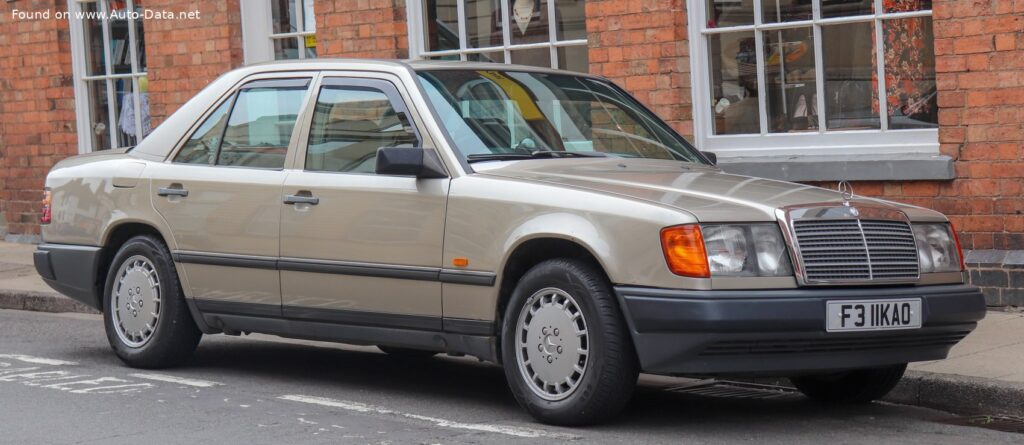
The Mercedes-Benz W124 200 D is a compact executive car produced by Mercedes-Benz between 1984 and 1989. Part of the W124 series, it represented a significant step forward in design and engineering for the German automaker, intended to replace the aging W201 (190E) and W116 models. The 200 D variant, powered by a 2.0-liter diesel engine, was particularly popular in Europe where fuel efficiency and durability were highly valued. While not officially sold in the United States during its production run, the W124 series as a whole gained a following among enthusiasts for its build quality and longevity, with later models being imported through grey market channels.
Mercedes-Benz W124 200 D: An Overview
The W124 was designed with a focus on safety, comfort, and reliability. It introduced several advancements in passive safety, including reinforced passenger cell construction and crumple zones. The 200 D model specifically targeted buyers seeking an economical and dependable vehicle for daily commuting and long-distance travel. Its diesel engine, while not known for high performance, offered excellent fuel economy and a reputation for lasting hundreds of thousands of miles with proper maintenance. The W124 series, including the 200 D, established Mercedes-Benz as a leader in the premium automotive segment.
Engine & Performance
The heart of the W124 200 D is its OM601 D 20 inline four-cylinder diesel engine, displacing 1997 cubic centimeters (121.86 cubic inches). This engine produces 72 horsepower at 4600 rpm and 123 Newton-meters (90.72 lb.-ft.) of torque at 2700 rpm. The engine utilizes precombustion chamber injection, a common diesel technology of the era, to improve combustion efficiency. Power is delivered to the rear wheels via a five-speed manual transmission. Acceleration from 0 to 100 km/h (0-62 mph) takes 18.5 seconds, and the vehicle has a top speed of 160 km/h (99.42 mph). While these figures are modest by modern standards, they were acceptable for a diesel-powered vehicle of its time, prioritizing fuel economy over outright speed. The weight-to-power ratio is 19.9 kg/Hp, and the weight-to-torque ratio is 11.6 kg/Nm, reflecting the engine’s focus on usability rather than performance.
Design & Features
The W124 200 D is a four-door sedan with a classic, understated design. Its body is characterized by clean lines, a relatively upright stance, and a focus on practicality. The interior is functional and well-built, with seating for five passengers. Features were relatively basic compared to modern vehicles, but included comfortable seating, a straightforward dashboard layout, and adequate ventilation. Safety features, for the time, were a key selling point, including the aforementioned reinforced passenger cell and crumple zones. The W124’s design emphasized durability and longevity, with high-quality materials used throughout the vehicle. The trunk offers a generous 520 liters (18.36 cubic feet) of space, providing ample room for luggage and other cargo. The vehicle’s dimensions are 4740 mm (186.61 in) in length, 1740 mm (68.5 in) in width, and 1425 mm (56.1 in) in height, making it a relatively compact executive car.
Technical Specifications
| Brand | Mercedes-Benz |
| Model | W124 |
| Generation | W124 |
| Type (Engine) | 200 D (72 Hp) |
| Start of production | May, 1984 |
| End of production | August, 1989 |
| Powertrain Architecture | Internal Combustion engine |
| Body type | Sedan |
| Seats | 5 |
| Doors | 4 |
| Fuel consumption (urban) | 8.4 l/100 km (28 US mpg, 33.6 UK mpg, 11.9 km/l) |
| Fuel consumption (extra urban) | 5.1 l/100 km (46.1 US mpg, 55.4 UK mpg, 19.6 km/l) |
| Fuel consumption (combined) | 6.7 l/100 km (35.1 US mpg, 42.2 UK mpg, 14.9 km/l) |
| Fuel Type | Diesel |
| Acceleration 0 – 100 km/h | 18.5 sec |
| Acceleration 0 – 62 mph | 18.5 sec |
| Acceleration 0 – 60 mph | 17.6 sec |
| Maximum speed | 160 km/h (99.42 mph) |
| Weight-to-power ratio | 19.9 kg/Hp |
| Weight-to-torque ratio | 11.6 kg/Nm |
| Power | 72 Hp @ 4600 rpm |
| Power per litre | 36.1 Hp/l |
| Torque | 123 Nm @ 2700 rpm (90.72 lb.-ft. @ 2700 rpm) |
| Engine layout | Front, Longitudinal |
| Engine Model/Code | OM 601 D 20 / 601.912 |
| Engine displacement | 1997 cm3 (121.86 cu. in.) |
| Number of cylinders | 4 |
| Engine configuration | Inline |
| Cylinder Bore | 87 mm (3.43 in.) |
| Piston Stroke | 84 mm (3.31 in.) |
| Compression ratio | 22:1 |
| Number of valves per cylinder | 2 |
| Fuel injection system | Precombustion chamber injection |
| Engine aspiration | Naturally aspirated engine |
| Valvetrain | OHC |
| Engine oil capacity | 6.5 l (6.87 US qt | 5.72 UK qt) |
| Coolant | 9 l (9.51 US qt | 7.92 UK qt) |
| Kerb Weight | 1430 kg (3152.61 lbs.) |
| Max. weight | 1930 kg (4254.92 lbs.) |
| Max load | 500 kg (1102.31 lbs.) |
| Trunk (boot) space – minimum | 520 l (18.36 cu. ft.) |
| Fuel tank capacity | 70 l (18.49 US gal | 15.4 UK gal) |
| Length | 4740 mm (186.61 in.) |
| Width | 1740 mm (68.5 in.) |
| Height | 1425 mm (56.1 in.) |
| Wheelbase | 2800 mm (110.24 in.) |
| Front track | 1501 mm (59.09 in.) |
| Rear (Back) track | 1491 mm (58.7 in.) |
| Drivetrain Architecture | Rear wheel drive |
| Number of gears and type of gearbox | 5 gears, manual transmission |
| Front suspension | Wishbone |
| Rear suspension | Independent multi-link suspension, Coil spring |
| Front brakes | Disc |
| Rear brakes | Disc |
| Steering type | Cone worm with recirculation balls |
| Power steering | Hydraulic Steering |
| Tires size | Front wheel tires: 185/65 R15Rear wheel tires: 185/65 R15 |
| Wheel rims size | Front wheel rims: 6J x 15Rear wheel rims: 6J x 15 |
The Mercedes-Benz W124 200 D remains a popular choice among classic car enthusiasts and those seeking a reliable and economical vehicle. Its robust construction, simple mechanicals, and readily available parts make it a relatively easy car to maintain and enjoy for years to come. It stands as a testament to Mercedes-Benz’s commitment to quality and engineering excellence during the 1980s.
