
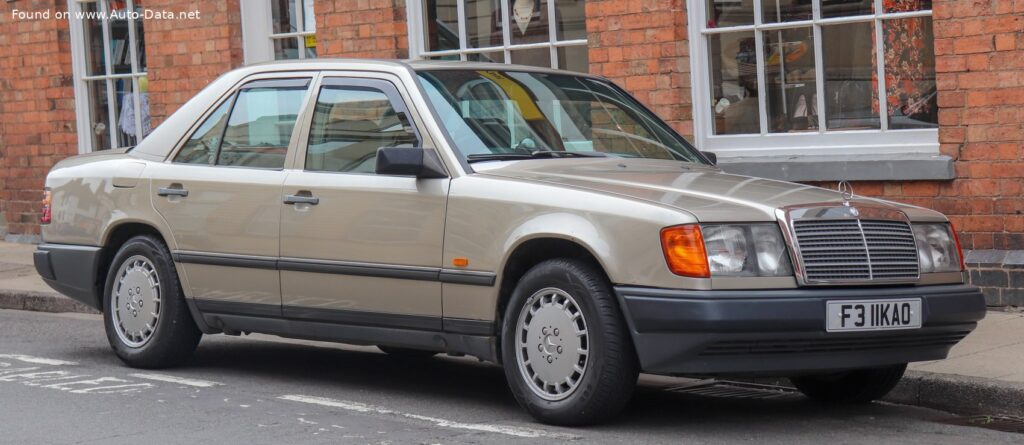
The Mercedes-Benz W124 300 D 4MATIC, produced from December 1985 to August 1989, represents a significant evolution in the mid-size luxury sedan segment. As part of the W124 series, it offered a blend of robust engineering, sophisticated technology for its time, and a commitment to passenger safety. While not initially a major seller in the United States (the W124 series was sold in the US from 1986-1993, but the 300 D 4MATIC was not officially imported), the 300 D 4MATIC was a popular and highly regarded model in European markets, particularly for those seeking a durable, all-wheel-drive vehicle capable of handling challenging weather conditions. It established a reputation for longevity and build quality that continues to define the Mercedes-Benz brand today.
Mercedes-Benz W124 300 D 4MATIC: A Detailed Overview
The W124 series, launched in 1985, was intended as a successor to the W201 (190E) and W123 models. It aimed to bridge the gap between these two lines, offering a more spacious and refined experience than the 190E while maintaining the renowned durability of the W123. The 300 D 4MATIC variant specifically added all-wheel drive capability, enhancing traction and stability, making it a practical choice for drivers in regions with inclement weather. The “D” designation signifies a diesel engine, a popular choice in Europe due to fuel efficiency and lower running costs.
Engine & Performance
The heart of the W124 300 D 4MATIC is its 3.0-liter inline-six cylinder diesel engine, designated OM 603 D 30 / 603.913. This naturally aspirated engine produces 109 horsepower at 5000 rpm and 210 Nm (154.89 lb.-ft.) of torque at 2200 rpm. While the horsepower figure may seem modest by modern standards, the engine’s strength lies in its robust torque delivery, providing ample pulling power for comfortable cruising and effortless acceleration. The engine utilizes precombustion chamber injection, a technology common in Mercedes-Benz diesels of the era, contributing to efficient combustion and reduced emissions for the time. Power is delivered to all four wheels via a 5-speed manual transmission. Acceleration from 0 to 100 km/h (0-62 mph) takes approximately 15 seconds, and it achieves a maximum speed of 183 km/h (113.71 mph). The weight-to-power ratio is 14.3 kg/Hp, and the weight-to-torque ratio is 7.4 kg/Nm.
Design & Features
The W124 300 D 4MATIC is a four-door sedan with a classic, understated Mercedes-Benz design. Its body is characterized by clean lines, a relatively upright stance, and a focus on functional elegance. The interior is spacious and well-appointed, offering comfortable seating for five passengers. Key features included hydraulic power steering, ventilated front disc brakes, and disc brakes on the rear axle. A significant advancement for its time was the inclusion of ABS (Anti-lock Braking System) as standard equipment, enhancing safety by preventing wheel lockup during hard braking. The 4MATIC all-wheel-drive system employs a permanent rear-wheel drive configuration with an electrically or mechanically operated clutch to engage the front wheels when needed, providing optimal traction in slippery conditions. Trunk space is a generous 520 liters (18.36 cu. ft.).
Technical Specifications
| Brand | Mercedes-Benz |
| Model | W124 |
| Generation | W124 |
| Type (Engine) | 300 D 4MATIC (109 Hp) |
| Start of production | December, 1985 |
| End of production | August, 1989 |
| Powertrain Architecture | Internal Combustion engine |
| Body type | Sedan |
| Seats | 5 |
| Doors | 4 |
| Fuel consumption (urban) | 10.6 l/100 km (22.2 US mpg, 26.6 UK mpg, 9.4 km/l) |
| Fuel consumption (extra urban) | 6.1 l/100 km (38.6 US mpg, 46.3 UK mpg, 16.4 km/l) |
| Fuel consumption (combined) | 7.4 l/100 km (31.8 US mpg, 38.2 UK mpg, 13.5 km/l) |
| Fuel Type | Diesel |
| Acceleration 0 – 100 km/h | 15 sec |
| Acceleration 0 – 62 mph | 15 sec |
| Acceleration 0 – 60 mph | 14.3 sec |
| Maximum speed | 183 km/h (113.71 mph) |
| Weight-to-power ratio | 14.3 kg/Hp |
| Weight-to-torque ratio | 7.4 kg/Nm |
| Power | 109 Hp @ 5000 rpm |
| Power per litre | 36.4 Hp/l |
| Torque | 210 Nm @ 2200 rpm (154.89 lb.-ft. @ 2200 rpm) |
| Engine layout | Front, Longitudinal |
| Engine Model/Code | OM 603 D 30 / 603.913 |
| Engine displacement | 2996 cm3 (182.83 cu. in.) |
| Number of cylinders | 6 |
| Engine configuration | Inline |
| Cylinder Bore | 87 mm (3.43 in.) |
| Piston Stroke | 84 mm (3.31 in.) |
| Compression ratio | 22:1 |
| Number of valves per cylinder | 2 |
| Fuel injection system | Precombustion chamber injection |
| Engine aspiration | Naturally aspirated engine |
| Valvetrain | SOHC |
| Engine oil capacity | 7.5 l (7.93 US qt | 6.6 UK qt) |
| Coolant | 9.5 l (10.04 US qt | 8.36 UK qt) |
| Kerb Weight | 1560 kg (3439.21 lbs.) |
| Max. weight | 2050 kg (4519.48 lbs.) |
| Max load | 490 kg (1080.27 lbs.) |
| Trunk (boot) space – minimum | 520 l (18.36 cu. ft.) |
| Fuel tank capacity | 70 l (18.49 US gal | 15.4 UK gal) |
| Length | 4740 mm (186.61 in.) |
| Width | 1740 mm (68.5 in.) |
| Height | 1431 mm (56.34 in.) |
| Wheelbase | 2800 mm (110.24 in.) |
| Front track | 1501 mm (59.09 in.) |
| Rear (Back) track | 1491 mm (58.7 in.) |
| Drivetrain Architecture | The Internal combustion engine (ICE) drives the rear wheels permanently, and the front wheels are driven through an electrically or mechanically operated clutch if necessary. |
| Drive wheel | All wheel drive (4×4) |
| Number of gears and type of gearbox | 5 gears, manual transmission |
| Front suspension | Wishbone |
| Rear suspension | Independent multi-link suspension, Coil spring |
| Front brakes | Ventilated discs |
| Rear brakes | Disc |
| Assisting systems | ABS (Anti-lock braking system) |
| Steering type | Cone worm with recirculation balls |
| Power steering | Hydraulic Steering |
| Tires size | Front wheel tires: 195/65 R15Rear wheel tires: 195/65 R15 |
| Wheel rims size | Front wheel rims: 6.5J x 15Rear wheel rims: 6.5J x 15 |
The Mercedes-Benz W124 300 D 4MATIC remains a sought-after vehicle among enthusiasts, prized for its durability, comfort, and all-weather capability. It represents a high point in Mercedes-Benz engineering and a testament to the brand’s commitment to building long-lasting, reliable automobiles.
