
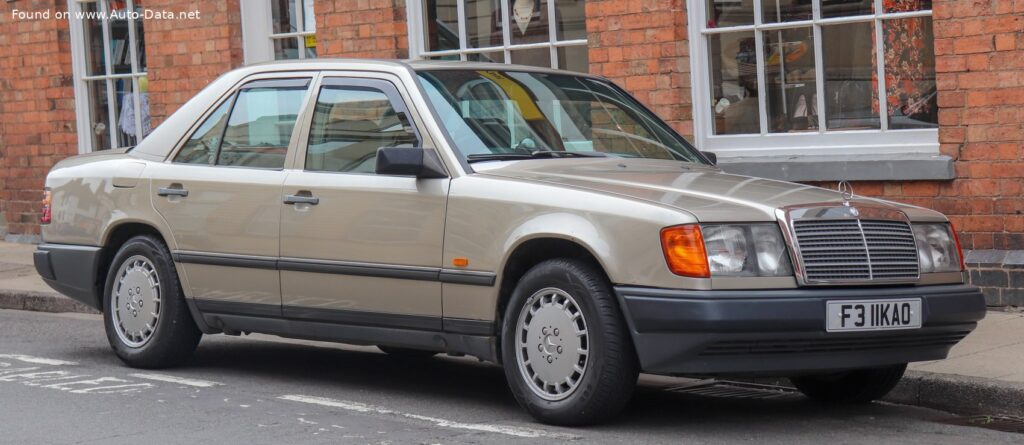
The Mercedes-Benz W124 300 D Turbo, produced from May 1985 to September 1988, represents a significant evolution in the lineage of Mercedes-Benz mid-size sedans. Part of the W124 series, it was designed to replace the W201 (190E) and W123 models, offering a blend of improved engineering, enhanced safety features, and a more refined driving experience. While primarily a European market vehicle, the W124 series, including the 300 D Turbo, gained a following among enthusiasts in other regions due to its robust build quality and diesel engine durability. The 300 D Turbo specifically aimed to provide a performance-oriented diesel option within the W124 range, appealing to drivers seeking efficiency without sacrificing power.
The Mercedes-Benz W124 300 D Turbo
The W124 series was a pivotal model for Mercedes-Benz, introducing advancements in body construction, chassis technology, and engine design. The 300 D Turbo, as the name suggests, utilized a turbocharged diesel engine to deliver increased horsepower and torque compared to naturally aspirated counterparts. This model occupied a space between the more economical diesel variants and the higher-performance gasoline-powered W124s, offering a compelling combination of fuel efficiency and respectable acceleration. It was a popular choice for long-distance drivers and those prioritizing reliability.
Engine & Performance
The heart of the W124 300 D Turbo is its 3.0-liter inline-six cylinder diesel engine, designated OM 603 D 30 A / 603.960. This engine produces 143 horsepower at 4600 rpm and 267 Nm (196.93 lb.-ft.) of torque at 2400 rpm. The addition of a turbocharger and intercooler significantly boosted performance, allowing for a 0-60 mph (0-100 km/h) acceleration time of approximately 10.4 seconds (10.9 seconds to 100 km/h). The engine features precombustion chamber injection, a technology common in Mercedes-Benz diesels of the era, contributing to efficient combustion and reduced emissions for its time. Power per liter is rated at 47.7 Hp/l. The engine is longitudinally mounted at the front of the vehicle, driving the rear wheels through a four-speed automatic transmission. Maximum speed is electronically limited to 202 km/h (125.52 mph). The weight-to-power ratio is 11 kg/Hp, and the weight-to-torque ratio is 5.9 kg/Nm.
Design & Features
The W124 300 D Turbo is a four-door sedan with a classic, understated Mercedes-Benz design. Its body style emphasizes practicality and durability, with a focus on passenger comfort and safety. The vehicle seats five occupants and offers a trunk capacity of 520 liters (18.36 cu. ft.). Key design features include a robust chassis, independent suspension on all four wheels (wishbone front, multi-link rear with coil springs), and ventilated disc brakes on the front wheels, with discs on the rear. The W124 series was known for its high build quality and attention to detail, with a focus on minimizing noise, vibration, and harshness. Safety features, while not as comprehensive as modern standards, included a reinforced passenger safety cell and available anti-lock braking system (ABS), representing a significant step forward in automotive safety during the mid-1980s. The steering system is a cone worm with recirculation balls and hydraulic power assistance.
Technical Specifications
| Brand | Mercedes-Benz |
| Model | W124 |
| Generation | W124 |
| Type (Engine) | 300 D Turbo (143 Hp) Automatic |
| Start of production | May, 1985 |
| End of production | September, 1988 |
| Powertrain Architecture | Internal Combustion engine |
| Body type | Sedan |
| Seats | 5 |
| Doors | 4 |
| Fuel consumption (urban) | 9.3 l/100 km (25.3 US mpg, 30.4 UK mpg, 10.8 km/l) |
| Fuel consumption (extra urban) | 6.2 l/100 km (37.9 US mpg, 45.6 UK mpg, 16.1 km/l) |
| Fuel consumption (combined) | 7.9 l/100 km (29.8 US mpg, 35.8 UK mpg, 12.7 km/l) |
| Fuel Type | Diesel |
| Acceleration 0 – 100 km/h | 10.9 sec |
| Acceleration 0 – 62 mph | 10.9 sec |
| Acceleration 0 – 60 mph | 10.4 sec |
| Maximum speed | 202 km/h (125.52 mph) |
| Weight-to-power ratio | 11 kg/Hp |
| Weight-to-torque ratio | 5.9 kg/Nm |
| Power | 143 Hp @ 4600 rpm |
| Torque | 267 Nm @ 2400 rpm (196.93 lb.-ft. @ 2400 rpm) |
| Engine layout | Front, Longitudinal |
| Engine Model/Code | OM 603 D 30 A / 603.960 |
| Engine displacement | 2996 cm3 (182.83 cu. in.) |
| Number of cylinders | 6 |
| Engine configuration | Inline |
| Cylinder Bore | 87 mm (3.43 in.) |
| Piston Stroke | 84 mm (3.31 in.) |
| Compression ratio | 22:1 |
| Number of valves per cylinder | 2 |
| Fuel injection system | Precombustion chamber injection |
| Engine aspiration | Turbocharger |
| Valvetrain | SOHC |
| Engine oil capacity | 7.5 l (7.93 US qt | 6.6 UK qt) |
| Coolant | 9.5 l (10.04 US qt | 8.36 UK qt) |
| Kerb Weight | 1580 kg (3483.3 lbs.) |
| Max. weight | 2050 kg (4519.48 lbs.) |
| Max load | 470 kg (1036.17 lbs.) |
| Trunk (boot) space – minimum | 520 l (18.36 cu. ft.) |
| Fuel tank capacity | 70 l (18.49 US gal | 15.4 UK gal) |
| Length | 4740 mm (186.61 in.) |
| Width | 1740 mm (68.5 in.) |
| Height | 1431 mm (56.34 in.) |
| Wheelbase | 2800 mm (110.24 in.) |
| Front track | 1501 mm (59.09 in.) |
| Rear (Back) track | 1491 mm (58.7 in.) |
| Drivetrain Architecture | Rear wheel drive |
| Number of gears and type of gearbox | 4 gears, automatic transmission |
| Front suspension | Wishbone |
| Rear suspension | Independent multi-link suspension, Coil spring |
| Front brakes | Ventilated discs |
| Rear brakes | Disc |
| Steering type | Cone worm with recirculation balls |
| Power steering | Hydraulic Steering |
| Tires size | Front wheel tires: 195/65 R15Rear wheel tires: 195/65 R15 |
| Wheel rims size | Front wheel rims: 6.5J x 15Rear wheel rims: 6.5J x 15 |
The Mercedes-Benz W124 300 D Turbo remains a sought-after classic, appreciated for its blend of performance, durability, and timeless design. It represents a high point in Mercedes-Benz diesel technology and continues to offer a refined driving experience for enthusiasts today.
