
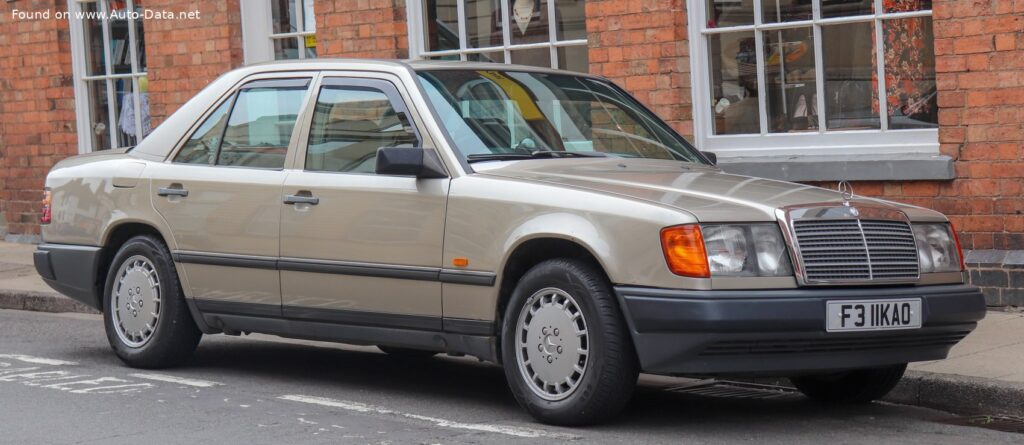
The Mercedes-Benz W124 300 D Turbo 4MATIC, produced from March 1988 to August 1989, represents a sophisticated evolution of the W124 series, renowned for its robust engineering and enduring quality. This model combined the fuel efficiency of a diesel engine with the performance enhancement of a turbocharger and the added security of all-wheel drive. Positioned as a premium sedan, the 300 D Turbo 4MATIC catered to buyers seeking a comfortable, capable, and technologically advanced vehicle. It was never officially sold in the United States, but the W124 series, in its various gasoline-powered forms, achieved significant popularity among American enthusiasts for its build quality and timeless design.
The Mercedes-Benz W124 300 D Turbo 4MATIC
The W124 series, launched in 1985, was intended as a successor to the W201 (190E) and W123 models. It represented a significant step forward in terms of safety, comfort, and technology. The 300 D Turbo 4MATIC specifically addressed the demand for a high-performance diesel sedan with all-weather capability. The 4MATIC system, Mercedes-Benz’s brand name for its all-wheel-drive technology, provided enhanced traction and stability, particularly valuable in challenging road conditions common in European climates. This model was primarily marketed in Europe, where diesel engines enjoyed widespread acceptance due to favorable taxation and fuel costs.
Engine & Performance
The heart of the W124 300 D Turbo 4MATIC is its 3.0-liter inline-six cylinder diesel engine, designated OM 603 D 30 A / 603.963. This engine produces 147 horsepower at 4600 rpm and 273 Nm (201.35 lb-ft) of torque at 2400 rpm. The turbocharger significantly boosts power output compared to naturally aspirated diesel engines of the time, providing improved acceleration and cruising ability. The engine utilizes precombustion chamber injection, a technology common in Mercedes-Benz diesels, for efficient combustion and reduced emissions. Power is delivered to all four wheels via a four-speed automatic transmission. Performance figures include a 0-100 km/h (0-62 mph) acceleration time of 11.8 seconds and a maximum speed of 198 km/h (123.03 mph). The weight-to-power ratio of 10.7 kg/Hp and weight-to-torque ratio of 5.8 kg/Nm demonstrate a reasonable balance between power and weight for a vehicle of its class and era.
Design & Features
The W124 300 D Turbo 4MATIC is a four-door sedan with a classic, understated Mercedes-Benz design. Its body is characterized by clean lines, a robust build, and a focus on aerodynamic efficiency. The interior is designed for comfort and practicality, offering seating for five passengers. Key features include a well-appointed cabin with high-quality materials, comfortable seating, and a functional dashboard layout. Safety features, considered advanced for the late 1980s, include an Anti-lock Braking System (ABS) to prevent wheel lockup during braking, enhancing stability and control. The 4MATIC all-wheel-drive system itself is a primary feature, providing superior traction in slippery conditions. The vehicle’s dimensions – 4740 mm (186.61 in) in length, 1740 mm (68.5 in) in width, and 1431 mm (56.34 in) in height – provide a spacious interior and a substantial presence on the road. Trunk space is a generous 520 liters (18.36 cu. ft.).
Technical Specifications
| Brand | Mercedes-Benz |
| Model | W124 |
| Generation | W124 |
| Type | 300 D Turbo (147 Hp) 4MATIC Automatic |
| Start of production | March, 1988 |
| End of production | August, 1989 |
| Powertrain Architecture | Internal Combustion engine |
| Body type | Sedan |
| Seats | 5 |
| Doors | 4 |
| Fuel consumption (urban) | 10.4 l/100 km (22.6 US mpg, 27.2 UK mpg, 9.6 km/l) |
| Fuel consumption (extra urban) | 7 l/100 km (33.6 US mpg, 40.4 UK mpg, 14.3 km/l) |
| Fuel consumption (combined) | 7.9 l/100 km (29.8 US mpg, 35.8 UK mpg, 12.7 km/l) |
| Fuel Type | Diesel |
| Acceleration 0 – 100 km/h | 11.8 sec |
| Acceleration 0 – 62 mph | 11.8 sec |
| Acceleration 0 – 60 mph | 11.2 sec |
| Maximum speed | 198 km/h (123.03 mph) |
| Weight-to-power ratio | 10.7 kg/Hp |
| Weight-to-torque ratio | 5.8 kg/Nm |
| Power | 147 Hp @ 4600 rpm |
| Power per litre | 49.1 Hp/l |
| Torque | 273 Nm @ 2400 rpm (201.35 lb.-ft. @ 2400 rpm) |
| Engine layout | Front, Longitudinal |
| Engine Model/Code | OM 603 D 30 A / 603.963 |
| Engine displacement | 2996 cm3 (182.83 cu. in.) |
| Number of cylinders | 6 |
| Engine configuration | Inline |
| Cylinder Bore | 87 mm (3.43 in.) |
| Piston Stroke | 84 mm (3.31 in.) |
| Compression ratio | 22:1 |
| Number of valves per cylinder | 2 |
| Fuel injection system | Precombustion chamber injection |
| Engine aspiration | Turbocharger |
| Valvetrain | SOHC |
| Engine oil capacity | 7.5 l (7.93 US qt | 6.6 UK qt) |
| Coolant | 9.5 l (10.04 US qt | 8.36 UK qt) |
| Kerb Weight | 1580 kg (3483.3 lbs.) |
| Max. weight | 2050 kg (4519.48 lbs.) |
| Max load | 470 kg (1036.17 lbs.) |
| Trunk (boot) space – minimum | 520 l (18.36 cu. ft.) |
| Fuel tank capacity | 70 l (18.49 US gal | 15.4 UK gal) |
| Length | 4740 mm (186.61 in.) |
| Width | 1740 mm (68.5 in.) |
| Height | 1431 mm (56.34 in.) |
| Wheelbase | 2800 mm (110.24 in.) |
| Front track | 1501 mm (59.09 in.) |
| Rear (Back) track | 1491 mm (58.7 in.) |
| Drivetrain Architecture | All wheel drive (4×4). ICE drives rear wheels, front wheels engaged via clutch. |
| Number of gears and type of gearbox | 4 gears, automatic transmission |
| Front suspension | Wishbone |
| Rear suspension | Independent multi-link suspension, Coil spring |
| Front brakes | Ventilated discs |
| Rear brakes | Disc |
| Assisting systems | ABS (Anti-lock braking system) |
| Steering type | Cone worm with recirculation balls |
| Power steering | Hydraulic Steering |
| Tires size | Front/Rear: 195/65 R15 |
| Wheel rims size | Front/Rear: 6.5J x 15 |
The Mercedes-Benz W124 300 D Turbo 4MATIC remains a highly regarded vehicle, celebrated for its durability, comfort, and advanced engineering. While not originally intended for the US market, its qualities have made it a sought-after classic among enthusiasts who appreciate its blend of performance, efficiency, and timeless design.
