
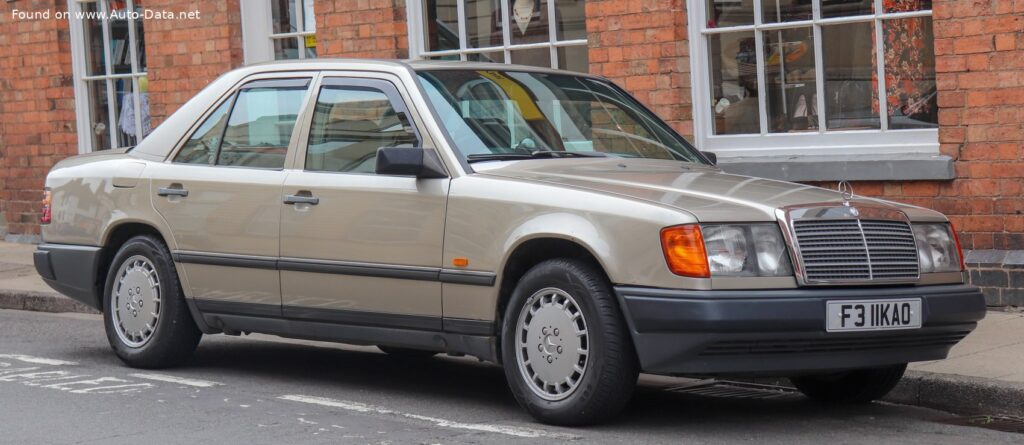
The Mercedes-Benz W124 300 E, produced from April 1984 to September 1985, represents a pivotal moment in the evolution of the mid-size executive sedan. As part of the W124 series, it was designed to succeed the W201 (190E) and W123 models, offering a blend of luxury, performance, and engineering that set a new standard for its class. The 300 E, specifically, was positioned as a premium offering within the range, boasting a larger engine and enhanced features compared to its lower-spec counterparts. While primarily a European market vehicle, the W124 series, including the 300 E, gained a following in North America for its build quality and sophisticated design.
The Mercedes-Benz W124 300 E: A Legacy of Engineering
The W124 series was a significant departure from previous Mercedes-Benz designs, emphasizing improved safety, durability, and a more modern aesthetic. The 300 E, with its 3.0-liter inline-six engine, was a flagship model, appealing to buyers seeking a refined driving experience and robust performance. It was a time when Mercedes-Benz was solidifying its reputation for over-engineering, and the W124 exemplified this philosophy. The car’s design focused on passenger safety, incorporating crumple zones and a robust chassis construction. The 300 E’s automatic transmission further enhanced its appeal to drivers prioritizing comfort and ease of use.
Engine & Performance
At the heart of the 300 E lies the M103 E 30 inline-six engine, a 2,962 cc (180.75 cu. in.) naturally aspirated powerplant. This engine produced 190 horsepower at 5,600 rpm and 260 Nm (191.77 lb.-ft.) of torque at 4,250 rpm. The engine featured multi-port manifold fuel injection and a single overhead camshaft (SOHC) valvetrain. This configuration delivered a smooth and responsive power delivery, characteristic of Mercedes-Benz six-cylinder engines of the era. Paired with a 4-speed automatic transmission, the 300 E could accelerate from 0 to 60 mph in approximately 7.9 seconds and achieve a maximum speed of 225 km/h (139.81 mph). The weight-to-power ratio of 7.1 kg/Hp and a weight-to-torque ratio of 5.2 kg/Nm contributed to its balanced performance. Fuel economy was rated at 11.9 l/100 km (19.8 US mpg) in urban conditions and 8 l/100 km (29.4 US mpg) on the open road.
Design & Features
The W124 300 E is a four-door sedan with a classic, understated design. Its body lines are characterized by clean surfaces and a relatively conservative aesthetic, reflecting the design sensibilities of the 1980s. The interior was designed with a focus on comfort and luxury, featuring high-quality materials and a spacious cabin. The 300 E offered seating for five passengers and provided 520 liters (18.36 cu. ft.) of trunk space. Safety features were a priority, and the 300 E was equipped with an Anti-lock Braking System (ABS) as standard, a relatively advanced feature for the time. The suspension system comprised a wishbone front suspension and an independent multi-link rear suspension with coil springs, providing a comfortable and controlled ride. Hydraulic power steering further enhanced the driving experience. The car rode on 195/65 R15 tires mounted on 6.5J x 15 inch wheel rims.
Technical Specifications
| Brand | Mercedes-Benz |
| Model | W124 |
| Generation | W124 |
| Type (Engine) | 300 E (190 Hp) Automatic |
| Start of production | April, 1984 |
| End of production | September, 1985 |
| Powertrain Architecture | Internal Combustion engine |
| Body type | Sedan |
| Seats | 5 |
| Doors | 4 |
| Fuel consumption (urban) | 11.9 l/100 km (19.8 US mpg) |
| Fuel consumption (extra urban) | 8 l/100 km (29.4 US mpg) |
| Fuel Type | Petrol (Gasoline) |
| Acceleration 0 – 100 km/h | 8.3 sec |
| Acceleration 0 – 62 mph | 8.3 sec |
| Acceleration 0 – 60 mph | 7.9 sec |
| Maximum speed | 225 km/h (139.81 mph) |
| Weight-to-power ratio | 7.1 kg/Hp |
| Weight-to-torque ratio | 5.2 kg/Nm |
| Power | 190 Hp @ 5600 rpm |
| Torque | 260 Nm @ 4250 rpm (191.77 lb.-ft. @ 4250 rpm) |
| Engine layout | Front, Longitudinal |
| Engine Model/Code | M 103 E 30 / 103.980 |
| Engine displacement | 2962 cm3 (180.75 cu. in.) |
| Number of cylinders | 6 |
| Engine configuration | Inline |
| Cylinder Bore | 88.5 mm (3.48 in.) |
| Piston Stroke | 80.25 mm (3.16 in.) |
| Compression ratio | 10:1 |
| Number of valves per cylinder | 2 |
| Fuel injection system | Multi-port manifold injection |
| Engine aspiration | Naturally aspirated engine |
| Valvetrain | SOHC |
| Engine oil capacity | 6.5 l (6.87 US qt | 5.72 UK qt) |
| Coolant capacity | 9.5 l (10.04 US qt | 8.36 UK qt) |
| Kerb Weight | 1340 kg (2954.19 lbs.) |
| Max. weight | 1860 kg (4100.6 lbs.) |
| Max load | 520 kg (1146.4 lbs.) |
| Trunk (boot) space – minimum | 520 l (18.36 cu. ft.) |
| Fuel tank capacity | 70 l (18.49 US gal | 15.4 UK gal) |
| Length | 4740 mm (186.61 in.) |
| Width | 1740 mm (68.5 in.) |
| Height | 1451 mm (57.13 in.) |
| Wheelbase | 2800 mm (110.24 in.) |
| Front track | 1501 mm (59.09 in.) |
| Rear (Back) track | 1485 mm (58.46 in.) |
| Drivetrain Architecture | Rear wheel drive |
| Number of gears and type of gearbox | 4 gears, automatic transmission |
| Front suspension | Wishbone |
| Rear suspension | Independent multi-link suspension, Coil spring |
| Front brakes | Ventilated discs |
| Rear brakes | Disc |
| Assisting systems | ABS (Anti-lock braking system) |
| Steering type | Cone worm with recirculation balls |
| Power steering | Hydraulic Steering |
| Tires size | Front/Rear: 195/65 R15 |
| Wheel rims size | Front/Rear: 6.5J x 15 |
The Mercedes-Benz W124 300 E remains a highly regarded classic car, appreciated for its build quality, engineering excellence, and timeless design. It represents a high point in Mercedes-Benz’s commitment to producing durable and refined automobiles, and continues to be a popular choice among enthusiasts and collectors.
