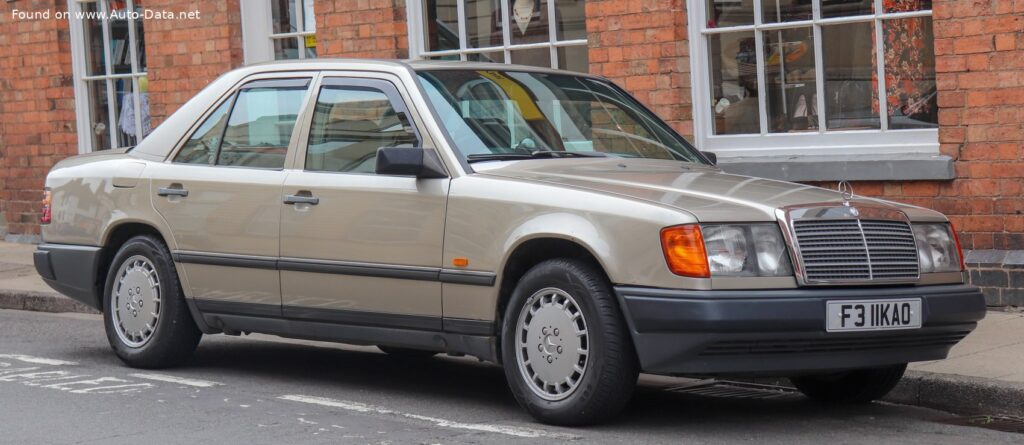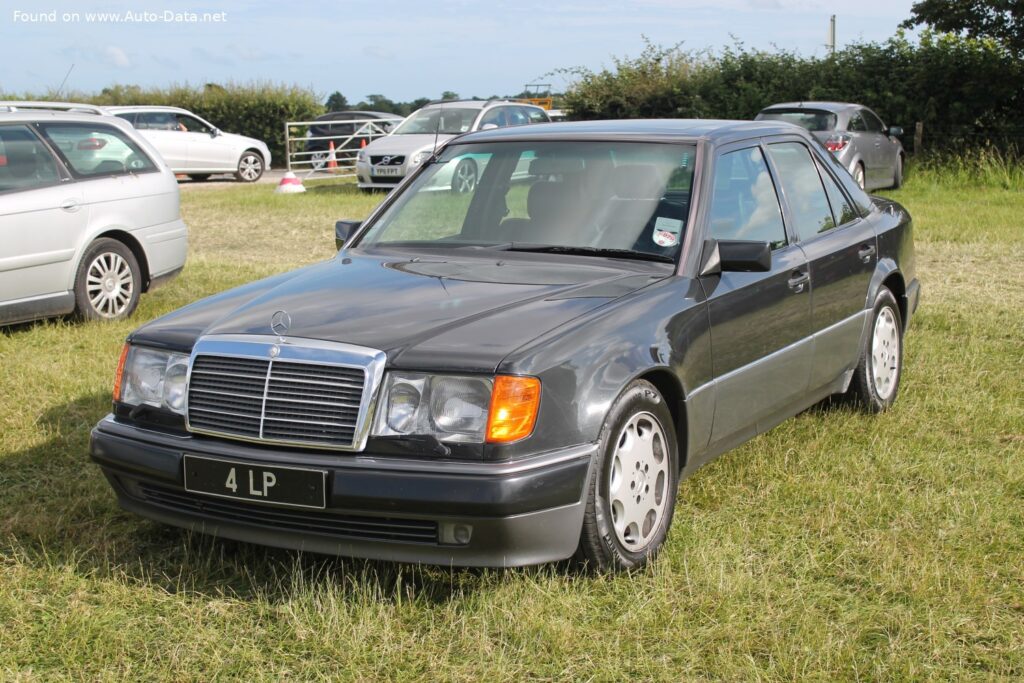
The Mercedes-Benz W124, produced from 1985 to 1996, represented a significant leap forward in mid-size executive car design and engineering. The facelifted version introduced in 1989, and specifically the 230 E model with its 132 horsepower engine and automatic transmission, solidified the W124’s reputation for quality, durability, and understated luxury. While not initially a large seller in the United States compared to its BMW rivals, the W124 became highly sought after for its robust construction and longevity, establishing a strong following among enthusiasts. The 230 E occupied a crucial position in the W124 lineup, offering a balance between performance and fuel efficiency.
The Mercedes-Benz W124 230 E: A Refined Sedan
The W124 series was designed as a successor to the W201 (190E) and W123 models, aiming to combine comfort, safety, and performance in a package that was both modern and timeless. The 1989 facelift brought subtle but important changes to the exterior styling, including revised grilles, bumpers, and interior trim. The 230 E, powered by a 2.3-liter inline-four engine, was positioned as an entry-level offering within the W124 range, appealing to buyers who desired the Mercedes-Benz experience without the higher price tag of the six-cylinder models. It was a popular choice in Europe, where fuel economy and taxation played a significant role in purchasing decisions.
Engine & Performance
The heart of the 230 E is the M102 E 23 engine, a 2.3-liter (2298 cm3 or 140.23 cu. in.) inline-four cylinder powerplant. This engine produced 132 horsepower at 5100 rpm and 198 Nm (146.04 lb.-ft.) of torque at 3500 rpm. While not overtly powerful by modern standards, the engine’s smooth operation and relatively high specific output (57.4 Hp/l) contributed to a refined driving experience. The engine featured multi-port manifold fuel injection and a single overhead camshaft (SOHC) valvetrain. Power is delivered to the rear wheels via a four-speed automatic transmission. Acceleration from 0 to 100 km/h (0-62 mph) takes 11.2 seconds, while 0 to 60 mph is achieved in 10.6 seconds. The 230 E has a top speed of 195 km/h (121.17 mph). The weight-to-power ratio of 10.3 kg/Hp and weight-to-torque ratio of 6.9 kg/Nm demonstrate a reasonable balance for its time.
Design & Features
The W124 230 E is a four-door sedan with a classic three-box design. Its styling is characterized by clean lines, a relatively upright stance, and a focus on functional elegance. The interior is well-appointed, with comfortable seating for five passengers. The 1989 facelift brought improvements to interior materials and ergonomics. Safety was a key consideration in the W124’s design, and the 230 E was equipped with Anti-lock Braking System (ABS) as standard, a relatively advanced feature for the time. Other notable features include hydraulic power steering and independent suspension on all four wheels – wishbone suspension at the front and a multi-link setup at the rear – providing a comfortable and controlled ride. The car rides on 195/65 R15 tires mounted on 6.5J x 15 inch wheels. The fuel tank capacity is 70 liters (18.49 US gal).
Technical Specifications
| Brand | Mercedes-Benz |
| Model | W124 |
| Generation | W124 (facelift 1989) |
| Type | 230 E (132 Hp) Automatic |
| Start of production | September, 1989 |
| End of production | October, 1992 |
| Powertrain Architecture | Internal Combustion engine |
| Body type | Sedan |
| Seats | 5 |
| Doors | 4 |
| Fuel consumption (urban) | 11.4 l/100 km (20.6 US mpg) |
| Fuel consumption (extra urban) | 7.8 l/100 km (30.2 US mpg) |
| Fuel Type | Petrol (Gasoline) |
| Acceleration 0 – 100 km/h | 11.2 sec |
| Acceleration 0 – 62 mph | 11.2 sec |
| Acceleration 0 – 60 mph | 10.6 sec |
| Maximum speed | 195 km/h (121.17 mph) |
| Weight-to-power ratio | 10.3 kg/Hp |
| Weight-to-torque ratio | 6.9 kg/Nm |
| Power | 132 Hp @ 5100 rpm |
| Torque | 198 Nm @ 3500 rpm (146.04 lb.-ft. @ 3500 rpm) |
| Engine layout | Front, Longitudinal |
| Engine Model/Code | M 102 E 23 / 102.982 |
| Engine displacement | 2298 cm3 (140.23 cu. in.) |
| Number of cylinders | 4 |
| Engine configuration | Inline |
| Cylinder Bore | 95.5 mm (3.76 in.) |
| Piston Stroke | 80.2 mm (3.16 in.) |
| Compression ratio | 9:1 |
| Number of valves per cylinder | 2 |
| Fuel injection system | Multi-port manifold injection |
| Engine aspiration | Naturally aspirated |
| Valvetrain | SOHC |
| Engine oil capacity | 5 l (5.28 US qt | 4.4 UK qt) |
| Coolant capacity | 8.5 l (8.98 US qt | 7.48 UK qt) |
| Kerb Weight | 1360 kg (2998.29 lbs.) |
| Max. weight | 1880 kg (4144.69 lbs.) |
| Max load | 520 kg (1146.4 lbs.) |
| Fuel tank capacity | 70 l (18.49 US gal | 15.4 UK gal) |
| Length | 4740 mm (186.61 in.) |
| Width | 1740 mm (68.5 in.) |
| Height | 1428 mm (56.22 in.) |
| Wheelbase | 2800 mm (110.24 in.) |
| Front track | 1501 mm (59.09 in.) |
| Rear track | 1491 mm (58.7 in.) |
| Drivetrain | Rear wheel drive |
| Number of gears | 4 |
| Gearbox type | Automatic transmission |
| Front suspension | Wishbone |
| Rear suspension | Independent multi-link |
| Front brakes | Ventilated discs |
| Rear brakes | Disc |
| Assisting systems | ABS |
| Steering type | Cone worm with recirculation balls |
| Power steering | Hydraulic |
| Tires size | 195/65 R15 |
| Wheel rims size | 6.5J x 15 |
The Mercedes-Benz W124 230 E, particularly the facelifted models, remains a highly regarded classic car. Its combination of build quality, comfort, and understated elegance continues to appeal to enthusiasts and collectors. The car’s robust engineering ensures that many examples remain on the road today, a testament to the enduring quality of Mercedes-Benz engineering.