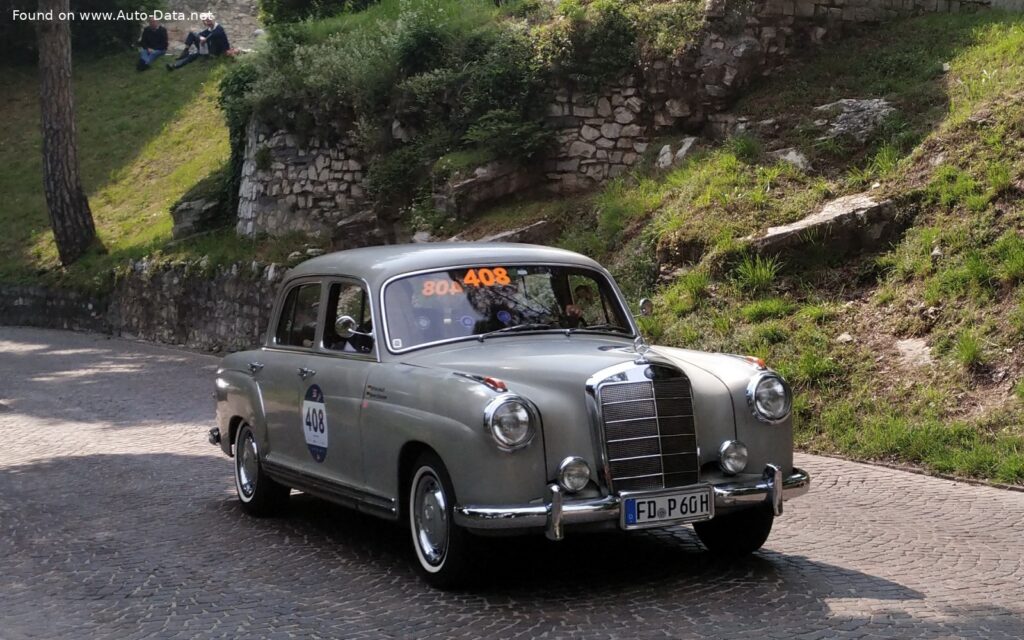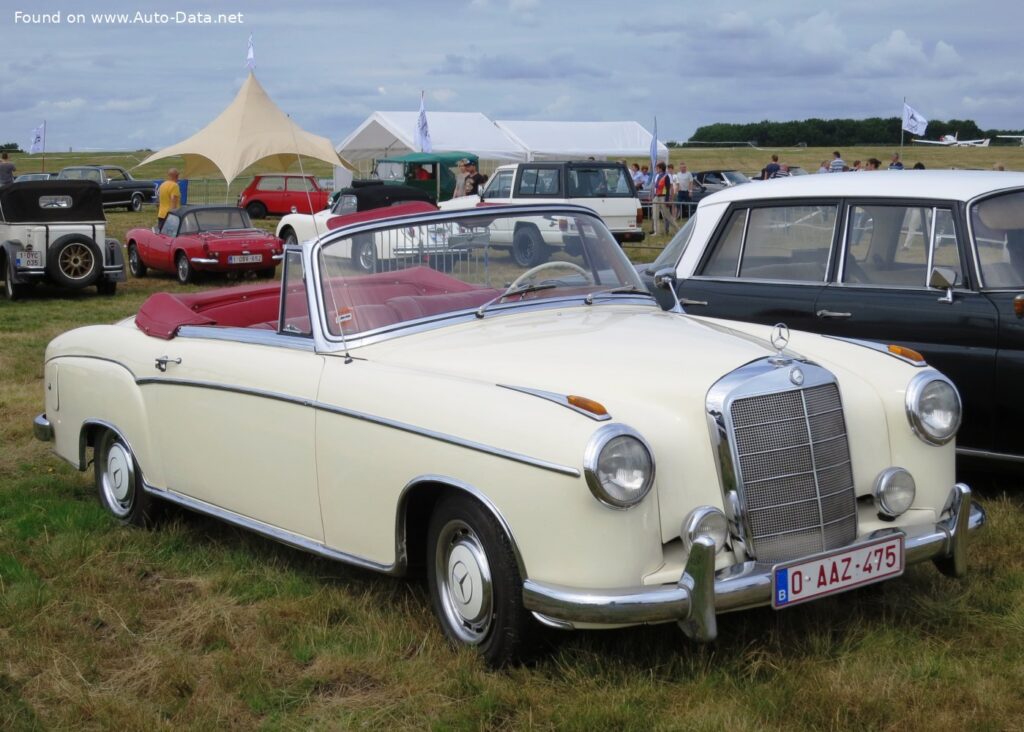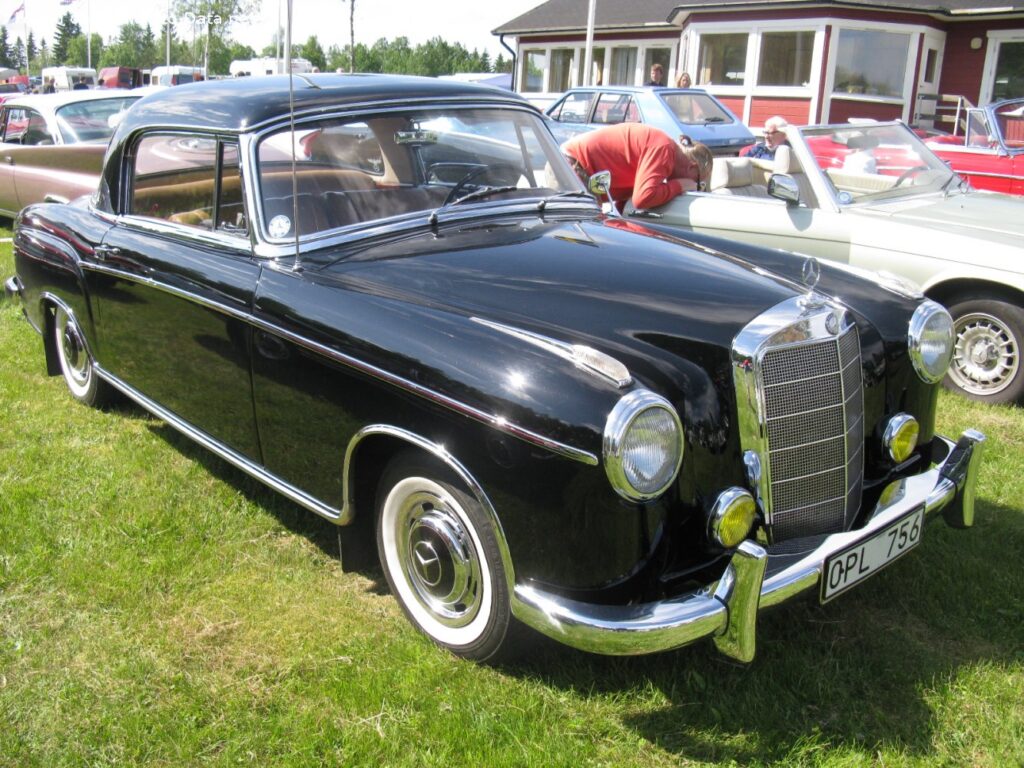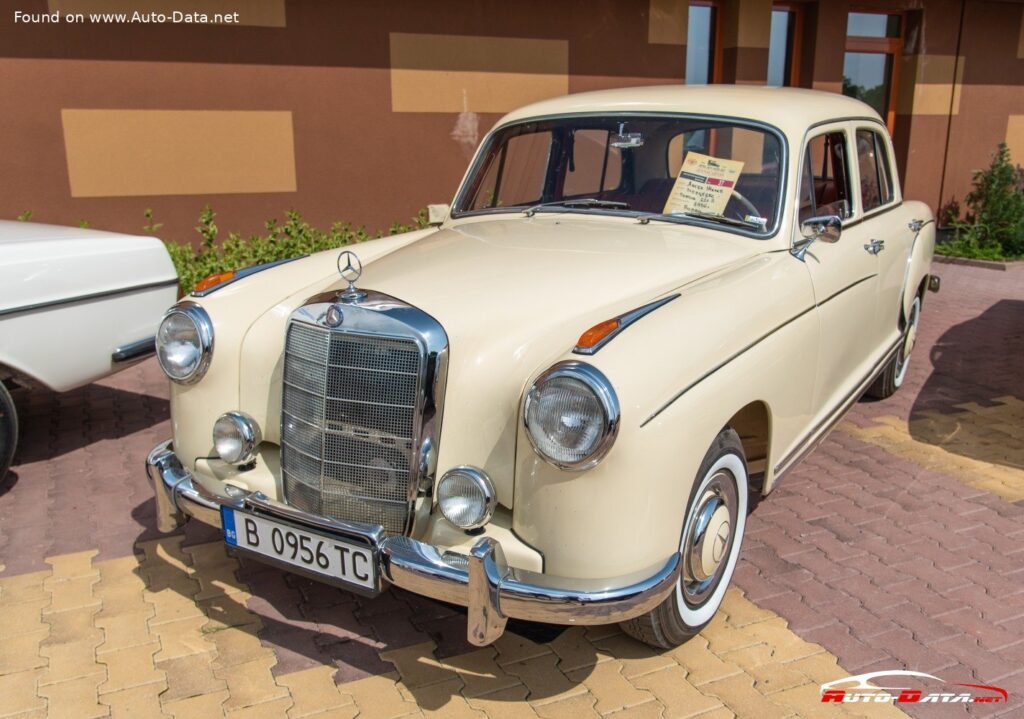
The Mercedes-Benz W180 II Sedan 220 S, produced between March 1956 and August 1957, represents a significant evolution in post-war Mercedes-Benz design and engineering. Part of the “Ponton” series – named for its pontoon-like, integrated body construction – the 220 S was positioned as a luxury sedan aimed at a growing market of affluent buyers. The W180 series as a whole marked a departure from the pre-war designs, embracing a more modern, streamlined aesthetic and incorporating advancements in comfort and safety. While not initially a major export to the United States, the Ponton series laid the groundwork for Mercedes-Benz’s eventual success in the American market, demonstrating the brand’s commitment to quality and innovation.
The Mercedes-Benz W180 II Sedan 220 S
The W180 series, encompassing the 180, 180D, and 220 models, was a pivotal point for Mercedes-Benz. It was the first all-new post-war design, moving away from the separate chassis and body construction of earlier models. The “Ponton” design, with its lower profile and integrated body panels, offered improved aerodynamics and a more contemporary appearance. The 220 S, as the top-of-the-line variant, featured a larger engine and more refined interior appointments, solidifying its position as a premium offering in the European automotive landscape.
Engine & Performance
The heart of the 220 S is its 2.2-liter (2195 cm3) inline-six cylinder engine, designated the M180 III / 180.924. This naturally aspirated engine produces 100 horsepower at 4800 rpm and 162 Nm (119.49 lb.-ft.) of torque at 3500 rpm. While these figures may seem modest by modern standards, they were competitive for a luxury sedan of the era. The engine features a single overhead camshaft (SOHC) valvetrain and a 7.6:1 compression ratio, fed by a carburetor. Power is delivered to the rear wheels through a four-speed manual transmission. Acceleration from 0 to 100 km/h (0-62 mph) takes approximately 17 seconds, and the vehicle reaches a top speed of 160 km/h (99.42 mph). The weight-to-power ratio of 13.3 kg/Hp and weight-to-torque ratio of 8.2 kg/Nm reflect the car’s substantial weight (1325 kg or 2921.12 lbs) relative to its output.
Design & Features
The 220 S is a four-door, five-seat sedan characterized by its elegant and understated styling. The Ponton body style features a unibody construction, contributing to increased rigidity and improved handling. The car’s design emphasizes horizontal lines and a relatively low roofline, giving it a sleek and modern appearance for its time. Inside, the 220 S offered a comfortable and well-appointed cabin, typical of a luxury vehicle. Features included comfortable seating, quality materials, and a spacious interior for passengers. Safety features, while limited by the standards of the 1950s, included robust construction and reliable braking systems. The steering system utilizes a cone worm with recirculation balls, providing a degree of precision for the era. The car’s dimensions – 4715 mm (185.63 in) in length, 1740 mm (68.5 in) in width, and 1560 mm (61.42 in) in height – positioned it as a substantial vehicle on the road.
Technical Specifications
| Brand | Mercedes-Benz |
| Model | Ponton |
| Generation | W180 II Sedan |
| Type (Engine) | 220 S (100 Hp) |
| Start of production | March, 1956 |
| End of production | August, 1957 |
| Powertrain Architecture | Internal Combustion engine |
| Body type | Sedan |
| Seats | 5 |
| Doors | 4 |
| Fuel consumption (combined) | 10.7 l/100 km |
| Fuel consumption (US mpg) | 22 US mpg |
| Fuel consumption (UK mpg) | 26.4 UK mpg |
| Fuel consumption (km/l) | 9.3 km/l |
| Fuel Type | Petrol (Gasoline) |
| Acceleration 0 – 100 km/h | 17 sec |
| Acceleration 0 – 62 mph | 17 sec |
| Acceleration 0 – 60 mph | 16.2 sec |
| Maximum speed | 160 km/h |
| Maximum speed (mph) | 99.42 mph |
| Weight-to-power ratio | 13.3 kg/Hp |
| Weight-to-torque ratio | 8.2 kg/Nm |
| Power | 100 Hp @ 4800 rpm |
| Power per litre | 45.6 Hp/l |
| Torque | 162 Nm @ 3500 rpm |
| Torque (lb.-ft.) | 119.49 lb.-ft. @ 3500 rpm |
| Engine layout | Front, Longitudinal |
| Engine Model/Code | M 180 III / 180.924 |
| Engine displacement | 2195 cm3 |
| Engine displacement (cu. in.) | 133.95 cu. in. |
| Number of cylinders | 6 |
| Engine configuration | Inline |
| Cylinder Bore | 80 mm |
| Cylinder Bore (in.) | 3.15 in. |
| Piston Stroke | 72.8 mm |
| Piston Stroke (in.) | 2.87 in. |
| Compression ratio | 7.6:1 |
| Number of valves per cylinder | 2 |
| Fuel injection system | Carburettor |
| Engine aspiration | Naturally aspirated engine |
| Valvetrain | SOHC |
| Engine oil capacity | 11.9 l |
| Engine oil capacity (US qt) | 12.57 US qt |
| Engine oil capacity (UK qt) | 10.47 UK qt |
| Coolant capacity | 11.4 l |
| Coolant capacity (US qt) | 12.05 US qt |
| Coolant capacity (UK qt) | 10.03 UK qt |
| Kerb Weight | 1325 kg |
| Kerb Weight (lbs) | 2921.12 lbs |
| Max. weight | 1790 kg |
| Max. weight (lbs) | 3946.27 lbs |
| Max load | 465 kg |
| Max load (lbs) | 1025.15 lbs |
| Fuel tank capacity | 64 l |
| Fuel tank capacity (US gal) | 16.91 US gal |
| Fuel tank capacity (UK gal) | 14.08 UK gal |
| Length | 4715 mm |
| Length (in.) | 185.63 in. |
| Width | 1740 mm |
| Width (in.) | 68.5 in. |
| Height | 1560 mm |
| Height (in.) | 61.42 in. |
| Wheelbase | 2820 mm |
| Wheelbase (in.) | 111.02 in. |
| Front track | 1430 mm |
| Front track (in.) | 56.3 in. |
| Rear track | 1470 mm |
| Rear track (in.) | 57.87 in. |
| Drivetrain Architecture | Rear wheel drive |
| Number of gears | 4 |
| Type of gearbox | manual transmission |
| Front suspension | Double wishbone, Transverse stabilizer |
| Rear suspension | Trailing arm |
| Front brakes | Drum |
| Rear brakes | Drum |
| Steering type | Cone worm with recirculation balls |
The Mercedes-Benz W180 II Sedan 220 S represents a crucial step in the evolution of the brand, bridging the gap between pre-war and modern automotive design. Its combination of elegant styling, robust engineering, and comfortable features made it a desirable vehicle in its time, and its legacy continues to influence Mercedes-Benz’s reputation for quality and innovation.