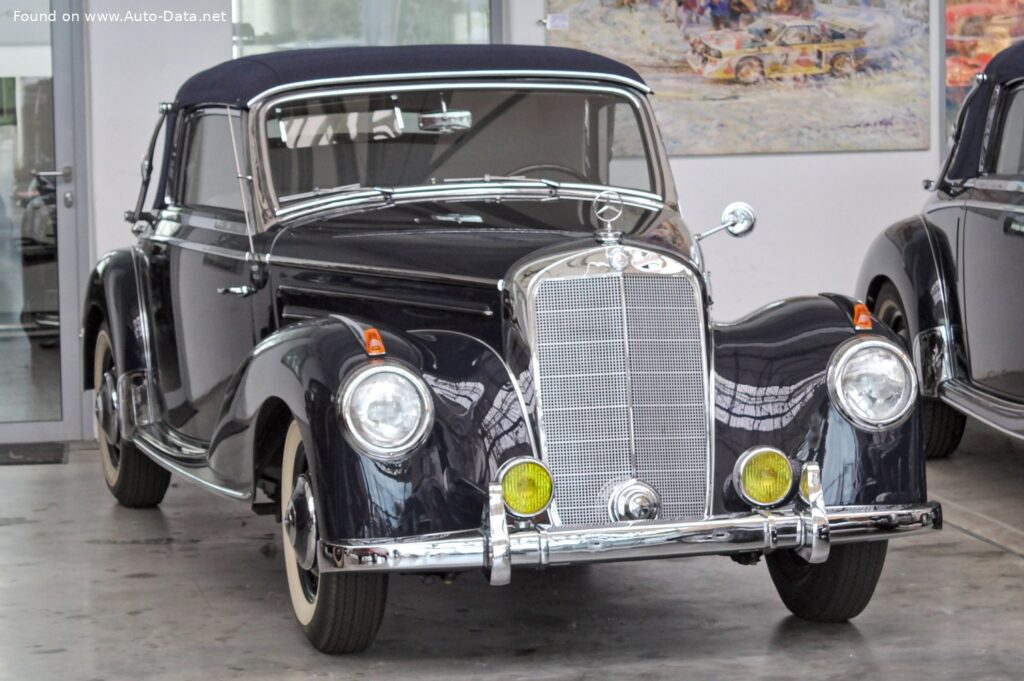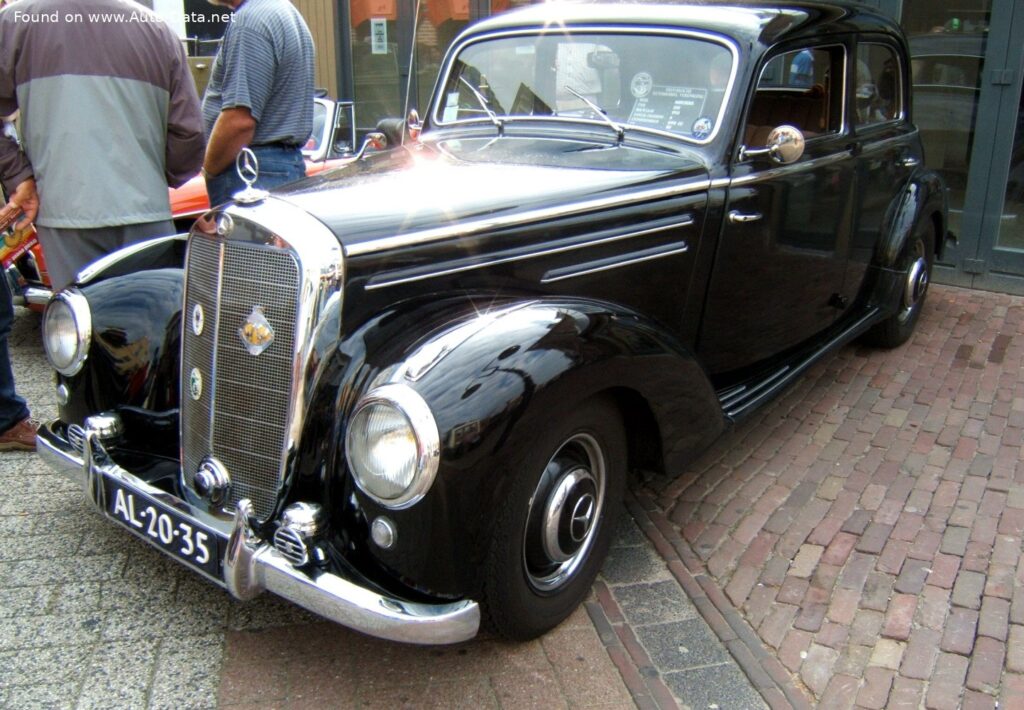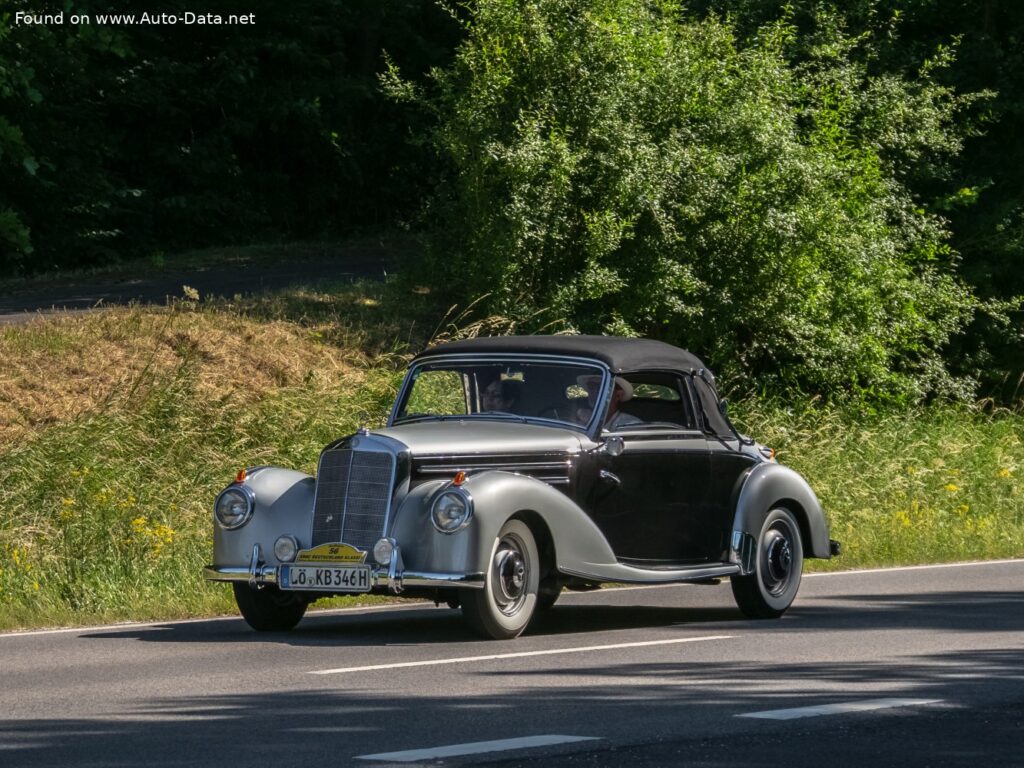
The Mercedes-Benz W187, specifically the Cabriolet A 220 model, represents a pivotal moment in the post-war recovery of German automotive engineering. Produced between April 1951 and April 1954, this vehicle was not merely a car; it was a symbol of renewed prosperity and a return to luxury for a nation rebuilding after the devastation of World War II. The W187 series, encompassing saloons, coupes, and cabriolets, was Mercedes-Benz’s first all-new design after the war, and it established many of the design cues and engineering principles that would define the brand for decades to come. While not widely exported to the United States at the time, the W187 holds a significant place in automotive history as a precursor to the modern Mercedes-Benz lineup.
Mercedes-Benz W187 Cabriolet A 220: A Post-War Icon
The W187 series was intended to bridge the gap between pre-war Mercedes-Benz traditions and the demands of a modernizing world. It was positioned in the upper-middle class, offering a level of comfort and sophistication that was largely absent during the austerity years following the war. The Cabriolet A 220, with its elegant open-top design, was the most luxurious and desirable variant, appealing to a clientele seeking both style and status. The car’s design reflected a conservative aesthetic, prioritizing solidity and refinement over radical innovation, a characteristic that resonated with the prevailing mood of the time.
Engine & Performance
The heart of the W187 Cabriolet A 220 is its 2.2-liter (2195 cm3) inline-six cylinder engine, designated the M180 I / 180.920. This naturally aspirated engine produced 80 horsepower at 4600 rpm and 142 Nm (104.73 lb.-ft.) of torque at 2500 rpm. While these figures may seem modest by modern standards, they were respectable for the early 1950s, providing the car with adequate performance for comfortable cruising. The engine featured a single overhead camshaft (SOHC) valvetrain and a 6.5:1 compression ratio, and utilized a carburetor for fuel delivery. Power per liter was a respectable 36.4 Hp/l. Acceleration from 0 to 100 km/h (0-62 mph) took approximately 21 seconds, and it could achieve a top speed of 145 km/h (90.1 mph). The engine’s longitudinal front-engine layout and rear-wheel drive configuration were typical for the era. The weight-to-power ratio of 17.8 kg/Hp and a weight-to-torque ratio of 10 kg/Nm indicate a balanced, if not particularly sporty, driving experience.
Design & Features
The W187 Cabriolet A 220 is a classic example of 1950s automotive design. Its body style is a traditional two-door cabriolet, capable of seating five passengers. The car’s exterior is characterized by flowing lines, a prominent grille, and rounded fenders. Chrome accents were used extensively, adding to the vehicle’s luxurious appearance. The interior was similarly appointed, with comfortable seating upholstered in high-quality materials, and a wood-trimmed dashboard.
Safety features, while rudimentary by today’s standards, were nonetheless significant for the time. The car featured drum brakes on all four wheels, providing adequate stopping power. Steering was accomplished via a worm-reduction unit. Suspension consisted of a double wishbone setup with a transverse stabilizer at the front, and a trailing arm arrangement at the rear, offering a reasonably comfortable ride. The fuel tank capacity of 42 liters (11.1 US gallons) provided a reasonable driving range, although fuel consumption was relatively high at 10.9 l/100 km (21.6 US mpg).
Technical Specifications
| Brand | Mercedes-Benz |
| Model | W187 |
| Generation | W187 Cabriolet A |
| Type (Engine) | 220 (80 Hp) |
| Start of production | April, 1951 |
| End of production | April, 1954 |
| Powertrain Architecture | Internal Combustion engine |
| Body type | Cabriolet |
| Seats | 5 |
| Doors | 2 |
| Fuel consumption (combined) | 10.9 l/100 km |
| Fuel consumption (US mpg) | 21.6 US mpg |
| Fuel consumption (UK mpg) | 25.9 UK mpg |
| Fuel consumption (km/l) | 9.2 km/l |
| Fuel Type | Petrol (Gasoline) |
| Acceleration 0 – 100 km/h | 21 sec |
| Acceleration 0 – 62 mph | 21 sec |
| Acceleration 0 – 60 mph | 20 sec |
| Maximum speed | 145 km/h |
| Maximum speed (mph) | 90.1 mph |
| Weight-to-power ratio | 17.8 kg/Hp |
| Weight-to-torque ratio | 10 kg/Nm |
| Power | 80 Hp @ 4600 rpm |
| Power per litre | 36.4 Hp/l |
| Torque | 142 Nm @ 2500 rpm |
| Torque (lb.-ft.) | 104.73 lb.-ft. @ 2500 rpm |
| Engine layout | Front, Longitudinal |
| Engine Model/Code | M 180 I / 180.920 |
| Engine displacement | 2195 cm3 |
| Engine displacement (cu. in.) | 133.95 cu. in. |
| Number of cylinders | 6 |
| Engine configuration | Inline |
| Cylinder Bore | 80 mm |
| Cylinder Bore (in.) | 3.15 in. |
| Piston Stroke | 72.8 mm |
| Piston Stroke (in.) | 2.87 in. |
| Compression ratio | 6.5:1 |
| Number of valves per cylinder | 2 |
| Fuel injection system | Carburettor |
| Engine aspiration | Naturally aspirated engine |
| Valvetrain | SOHC |
| Kerb Weight | 1420 kg |
| Kerb Weight (lbs.) | 3130.56 lbs. |
| Max. weight | 1680 kg |
| Max. weight (lbs.) | 3703.77 lbs. |
| Max load | 260 kg |
| Max load (lbs.) | 573.2 lbs. |
| Fuel tank capacity | 42 l |
| Fuel tank capacity (US gal) | 11.1 US gal |
| Fuel tank capacity (UK gal) | 9.24 UK gal |
| Length | 4540 mm |
| Length (in.) | 178.74 in. |
| Width | 1685 mm |
| Width (in.) | 66.34 in. |
| Height | 1560 mm |
| Height (in.) | 61.42 in. |
| Wheelbase | 2845 mm |
| Wheelbase (in.) | 112.01 in. |
| Front track | 1315 mm |
| Front track (in.) | 51.77 in. |
| Rear track | 1435 mm |
| Rear track (in.) | 56.5 in. |
| Drivetrain Architecture | Rear wheel drive |
| Number of gears | 4 |
| Gearbox type | manual transmission |
| Front suspension | Double wishbone, Transverse stabilizer |
| Rear suspension | Trailing arm |
| Front brakes | Drum |
| Rear brakes | Drum |
| Steering type | Worm-reduction unit |
The Mercedes-Benz W187 Cabriolet A 220 remains a highly sought-after classic car, representing a significant chapter in the history of Mercedes-Benz and a testament to the resilience and ingenuity of German engineering in the post-war era. Its combination of elegant styling, comfortable accommodations, and robust mechanicals ensures its continued appeal to collectors and enthusiasts worldwide.