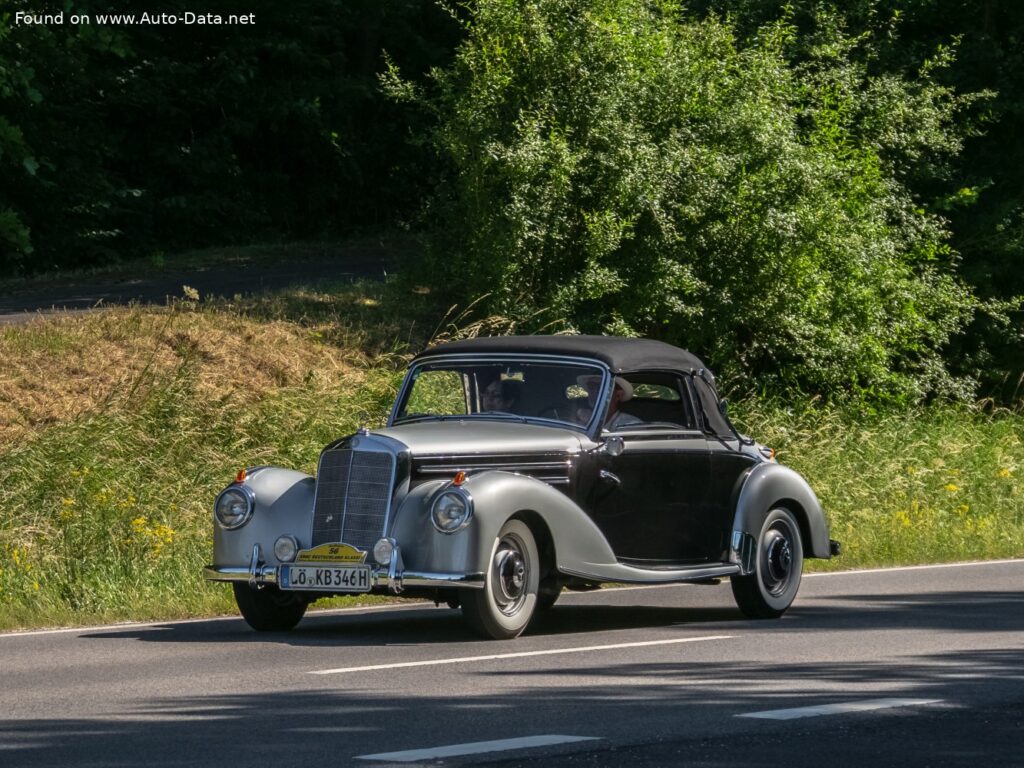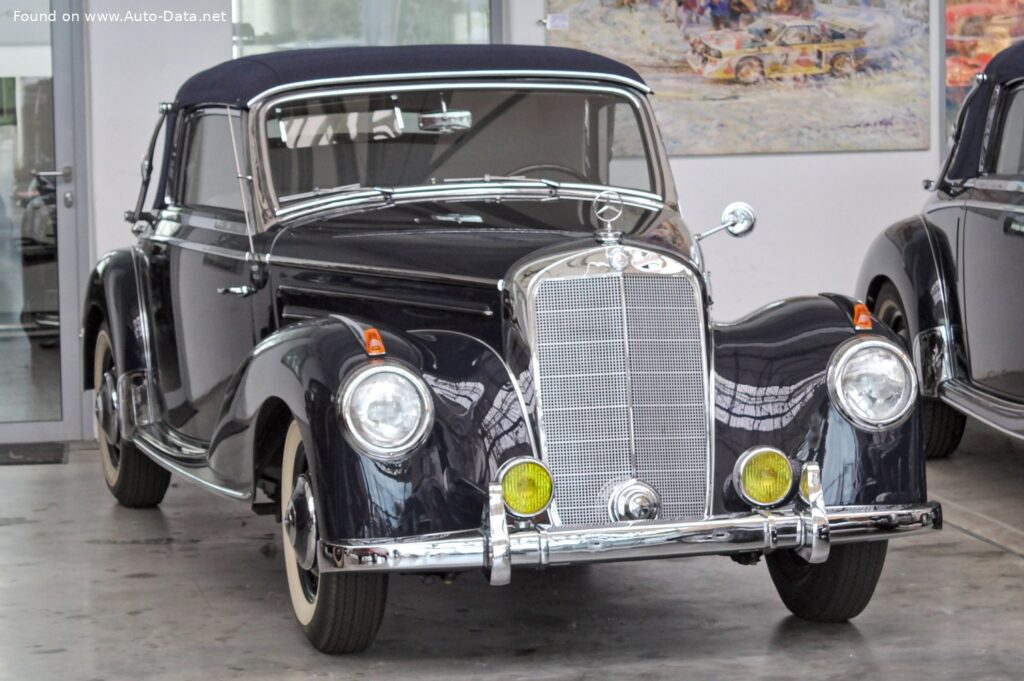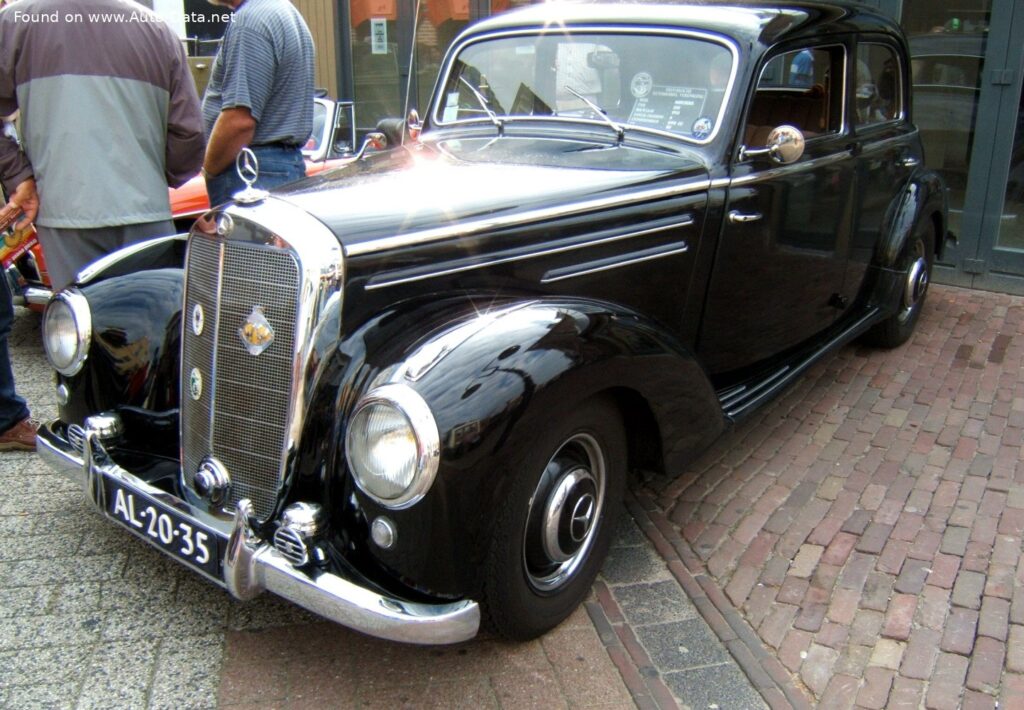
The Mercedes-Benz W187, specifically the 220 model, represents a pivotal moment in the post-war recovery of German automotive engineering. Produced between April 1951 and May 1954, the W187 was Mercedes-Benz’s first all-new design after World War II, and it signified a return to luxury car production. Positioned in the upper-middle class segment, the 220 aimed to re-establish the brand’s reputation for quality and engineering excellence. It served as a crucial stepping stone towards the more iconic “Fintail” models of the late 1950s and early 1960s. The W187 was not initially a large-volume seller, but it laid the groundwork for Mercedes-Benz’s subsequent success in the burgeoning post-war automotive market.
Mercedes-Benz W187 Sedan 220: A Post-War Rebirth
The W187 series, encompassing the 170S, 180, and 220 models, was a deliberate move away from the pre-war designs that had lingered in production immediately after the conflict. The 220, the top-of-the-line variant, featured a larger engine and more refined appointments. It was intended to appeal to a clientele seeking a comfortable and prestigious automobile, embodying the aspirations of a recovering Germany. While not as technologically advanced as some contemporary American cars, the W187 prioritized build quality, durability, and a smooth driving experience. The car’s design, though conservative by modern standards, was considered elegant and sophisticated for its time.
Engine & Performance
The heart of the W187 220 is its 2.2-liter (2195 cm3 or 133.95 cu. in.) inline-six cylinder engine, designated the M180 I / 180.920. This naturally aspirated engine produced 80 horsepower at 4600 rpm and 142 Nm (104.73 lb.-ft.) of torque at 2500 rpm. While these figures may seem modest today, they were respectable for the early 1950s. The engine’s power output translates to a power-to-liter ratio of 36.4 hp/l. Power is delivered to the rear wheels via a four-speed manual transmission. Acceleration from 0 to 100 km/h (0-62 mph) takes approximately 21 seconds, and 0 to 60 mph is achieved in around 20 seconds. The top speed is rated at 140 km/h (86.99 mph). Fuel consumption is rated at 10.9 l/100 km (21.6 US mpg, 25.9 UK mpg, or 9.2 km/l).
Design & Features
The W187 220 is a four-door, five-seat sedan with a traditional body-on-frame construction. Its styling is characterized by clean lines, a prominent grille, and rounded fenders. The interior is spacious and well-appointed for the era, featuring comfortable seating and a relatively uncluttered dashboard. While lacking many of the safety features found in modern vehicles, the W187 offered a level of refinement and comfort that was uncommon in its price range. The car’s suspension system utilizes a double wishbone setup with a transverse stabilizer at the front and a trailing arm arrangement at the rear, providing a reasonably comfortable ride. Braking is handled by drum brakes on all four wheels. The car’s dimensions are: length 4510 mm (177.56 in), width 1685 mm (66.34 in), height 1610 mm (63.39 in), and wheelbase 2845 mm (112.01 in). The kerb weight is 1325 kg (2921.12 lbs), with a maximum weight of 1690 kg (3725.81 lbs) and a maximum load capacity of 365 kg (804.69 lbs).
Technical Specifications
| Brand | Mercedes-Benz |
| Model | W187 |
| Generation | W187 Sedan |
| Type (Engine) | 220 (80 Hp) |
| Start of production | April, 1951 |
| End of production | May, 1954 |
| Powertrain Architecture | Internal Combustion engine |
| Body type | Sedan |
| Seats | 5 |
| Doors | 4 |
| Fuel consumption (combined) | 10.9 l/100 km |
| Fuel consumption (US mpg) | 21.6 US mpg |
| Fuel consumption (UK mpg) | 25.9 UK mpg |
| Fuel consumption (km/l) | 9.2 km/l |
| Fuel Type | Petrol (Gasoline) |
| Acceleration 0 – 100 km/h | 21 sec |
| Acceleration 0 – 62 mph | 21 sec |
| Acceleration 0 – 60 mph | 20 sec |
| Maximum speed | 140 km/h |
| Maximum speed (mph) | 86.99 mph |
| Weight-to-power ratio | 16.6 kg/Hp |
| Weight-to-torque ratio | 9.3 kg/Nm |
| Power | 80 Hp @ 4600 rpm |
| Power per litre | 36.4 Hp/l |
| Torque | 142 Nm @ 2500 rpm |
| Torque (lb.-ft.) | 104.73 lb.-ft. @ 2500 rpm |
| Engine layout | Front, Longitudinal |
| Engine Model/Code | M 180 I / 180.920 |
| Engine displacement | 2195 cm3 |
| Engine displacement (cu. in.) | 133.95 cu. in. |
| Number of cylinders | 6 |
| Engine configuration | Inline |
| Cylinder Bore | 80 mm |
| Cylinder Bore (in.) | 3.15 in. |
| Piston Stroke | 72.8 mm |
| Piston Stroke (in.) | 2.87 in. |
| Compression ratio | 6.5:1 |
| Number of valves per cylinder | 2 |
| Fuel injection system | Carburettor |
| Engine aspiration | Naturally aspirated engine |
| Valvetrain | SOHC |
| Kerb Weight | 1325 kg |
| Kerb Weight (lbs.) | 2921.12 lbs. |
| Max. weight | 1690 kg |
| Max. weight (lbs.) | 3725.81 lbs. |
| Max load | 365 kg |
| Max load (lbs.) | 804.69 lbs. |
| Fuel tank capacity | 48 l |
| Fuel tank capacity (US gal) | 12.68 US gal |
| Fuel tank capacity (UK gal) | 10.56 UK gal |
| Length | 4510 mm |
| Length (in.) | 177.56 in. |
| Width | 1685 mm |
| Width (in.) | 66.34 in. |
| Height | 1610 mm |
| Height (in.) | 63.39 in. |
| Wheelbase | 2845 mm |
| Wheelbase (in.) | 112.01 in. |
| Front track | 1315 mm |
| Front track (in.) | 51.77 in. |
| Rear track | 1435 mm |
| Rear track (in.) | 56.5 in. |
| Drivetrain Architecture | Rear wheel drive |
| Number of gears | 4 |
| Gearbox type | manual transmission |
| Front suspension | Double wishbone, Transverse stabilizer |
| Rear suspension | Trailing arm |
| Front brakes | Drum |
| Rear brakes | Drum |
| Steering type | Cone worm with recirculation balls |
The Mercedes-Benz W187 220, while not a revolutionary vehicle, holds a significant place in automotive history. It represents a crucial step in the revitalization of Mercedes-Benz after the war and established the foundation for the company’s future success. Today, the W187 is a sought-after classic car, appreciated by collectors for its elegant design, robust engineering, and historical significance.