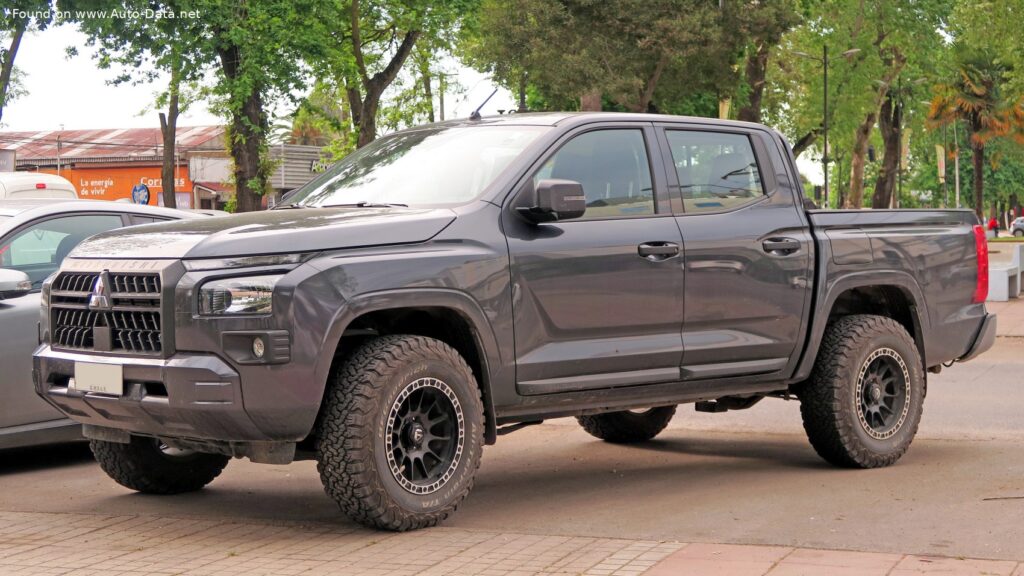
The 2023 Mitsubishi L200 VI Double Cab 2.4 MIVEC (150 Hp) 4WD: A Global Workhorse
The Mitsubishi L200, known as the Triton in many international markets, has long been a cornerstone of the global mid-size pickup truck segment. The sixth-generation model, introduced for the 2023 model year, continues this legacy, offering a blend of robust utility, enhanced performance, and modern features. The specific variant under review, the Mitsubishi L200 VI Double Cab 2.4 MIVEC (150 Hp) 4WD, represents a core offering in this lineup, designed to meet the diverse demands of both commercial and private users across Europe, Asia, Australia, and other regions where such versatile vehicles are indispensable.
As a four-door, five-seat pickup, the L200 VI Double Cab is engineered for practicality, comfort, and formidable off-road capability. While not directly sold in the United States, its design philosophy and technical specifications reflect the global trends in the pickup truck market, emphasizing durability, towing capacity, and fuel efficiency. This generation builds upon Mitsubishi’s extensive experience in developing tough, reliable 4×4 vehicles, integrating advanced powertrain technology and a sturdy chassis to deliver a compelling package for its target markets.
Engine and Performance: The 2.4 MIVEC Heart of the Mitsubishi L200 VI Double Cab
At the core of the Mitsubishi L200 VI Double Cab 2.4 MIVEC (150 Hp) 4WD lies its 2.4-liter MIVEC (Mitsubishi Innovative Valve timing Electronic Control) diesel engine, designated as the 4N16. This inline four-cylinder unit is a testament to Mitsubishi’s commitment to efficiency and robust power delivery in its commercial vehicles. With a displacement of 2442 cm3 (149.02 cu. in.), the engine produces a respectable 150 horsepower at 3500 rpm. This power output, combined with the engine’s advanced common rail fuel injection system and a turbocharger with an intercooler, ensures strong performance for both daily driving and demanding tasks.
Perhaps more critical for a pickup truck is its torque output, and the 2.4 MIVEC engine delivers impressively here. It generates 330 Nm (243.4 lb.-ft.) of torque across a broad and usable range, from 1500 to 3000 rpm. This wide torque band is crucial for hauling heavy loads, towing trailers, and navigating challenging off-road terrain, providing ample pulling power right from low engine speeds. The engine’s design, featuring a DOHC valvetrain and four valves per cylinder, contributes to its efficiency and responsiveness, while a high compression ratio of 15.2:1 optimizes diesel combustion.
Power is routed through a durable 6-speed manual transmission, offering the driver precise control and maximizing the engine’s performance across various driving conditions. The L200 VI Double Cab features an all-wheel-drive (4×4) powertrain architecture, which is a hallmark of Mitsubishi’s robust off-road capability. This system typically operates with the internal combustion engine driving the rear wheels permanently, with the front wheels engaged as needed via an electrically or mechanically operated clutch. This selectable 4WD system provides enhanced traction and control, making the L200 a reliable companion in adverse weather or challenging landscapes.
Design and Features: Utility Meets Modernity
The design of the Mitsubishi L200 VI Double Cab 2.4 MIVEC (150 Hp) 4WD emphasizes both rugged functionality and a contemporary aesthetic. As a double cab pickup, it offers the versatility of a five-seat passenger cabin combined with a practical open cargo bed. The vehicle’s dimensions are substantial, with a length of 5320 mm (209.45 in.), a width of 1865 mm (73.43 in.), and a height ranging from 1775-1795 mm (69.88 – 70.67 in.). These proportions contribute to a commanding road presence and provide ample interior space for occupants.
The L200’s chassis is built for durability, featuring a robust ladder frame construction. The front suspension employs a double wishbone setup with independent coil springs and a transverse stabilizer, designed to provide a comfortable ride and precise steering. The rear, critical for load-carrying capability, utilizes a rigid axle suspension with leaf springs, a proven configuration for heavy-duty applications. This combination allows the L200 to handle a substantial maximum load capacity of 1075-1100 kg (2369.97 – 2425.08 lbs.), with a gross vehicle weight of 3000 kg (6613.87 lbs.).
Off-road prowess is further highlighted by its impressive ground clearance, which varies between 203-228 mm (7.99 – 8.98 in.), along with favorable approach (28.9-30.4°), departure (21.9-22.8°), and ramp-over (23.4°) angles. These figures ensure the L200 can confidently traverse uneven terrain. Braking is handled by ventilated discs at the front (290 mm) and sturdy drum brakes at the rear (295 mm), complemented by an Anti-lock Braking System (ABS) for enhanced safety and control during emergency stops. The hydraulic power steering, featuring a steering rack and pinion, provides direct feedback and manageable effort. The vehicle comes equipped with tire sizes ranging from 205/80 R16 to 265/70 R16, mounted on 16-inch wheel rims (6J x 16 or 7.5J x 16), offering a balance of on-road stability and off-road grip.
Technical Specifications
| General Information | |
|---|---|
| Brand | Mitsubishi |
| Model | L200 |
| Generation | L200 VI Double Cab |
| Type (Engine) | 2.4 MIVEC (150 Hp) 4WD |
| Start of Production | 2023 year |
| Powertrain Architecture | Internal Combustion engine |
| Body type | Pick-up |
| Seats | 5 |
| Doors | 4 |
| Performance Specs | |
| Fuel Type | Diesel |
| Weight-to-power ratio | 12.7 kg/Hp, 78.9 Hp/tonne |
| Weight-to-torque ratio | 5.8 kg/Nm, 173.7 Nm/tonne |
| Engine Specs | |
| Power | 150 Hp @ 3500 rpm. |
| Power per liter | 61.4 Hp/l |
| Torque | 330 Nm @ 1500-3000 rpm. (243.4 lb.-ft. @ 1500-3000 rpm.) |
| Engine layout | Front, Longitudinal |
| Engine Model/Code | 4N16 |
| Engine displacement | 2442 cm3 (149.02 cu. in.) |
| Number of cylinders | 4 |
| Engine configuration | Inline |
| Cylinder Bore | 86 mm (3.39 in.) |
| Piston Stroke | 105.1 mm (4.14 in.) |
| Compression ratio | 15.2:1 |
| Number of valves per cylinder | 4 |
| Fuel injection system | Diesel Commonrail |
| Engine aspiration | Turbocharger, Intercooler |
| Valvetrain | DOHC |
| Engine oil capacity | 6.7 l (7.08 US qt | 5.9 UK qt) |
| Coolant | 7.7 l (8.14 US qt | 6.78 UK qt) |
| Space, Volume and Weights | |
| Kerb Weight | 1900-1925 kg (4188.78 – 4243.9 lbs.) |
| Max. weight | 3000 kg (6613.87 lbs.) |
| Max load | 1075-1100 kg (2369.97 – 2425.08 lbs.) |
| Fuel tank capacity | 75 l (19.81 US gal | 16.5 UK gal) |
| Dimensions | |
| Length | 5320 mm (209.45 in.) |
| Width | 1865 mm (73.43 in.) |
| Height | 1775-1795 mm (69.88 – 70.67 in.) |
| Wheelbase | 3130 mm (123.23 in.) |
| Front track | 1570 mm (61.81 in.) |
| Rear (Back) track | 1565 mm (61.61 in.) |
| Front overhang | 890 mm (35.04 in.) |
| Rear overhang | 1300 mm (51.18 in.) |
| Ride height (ground clearance) | 203-228 mm (7.99 – 8.98 in.) |
| Minimum turning circle (turning diameter) | 12.4 m (40.68 ft.) |
| Approach angle | 28.9-30.4° |
| Departure angle | 21.9-22.8° |
| Ramp-over (brakeover) angle | 23.4° |
| Drivetrain, Brakes and Suspension Specs | |
| Drivetrain Architecture | The Internal combustion engine (ICE) drives the rear wheels permanently, and the front wheels are driven through an electrically or mechanically operated clutch if necessary. |
| Drive wheel | All-wheel drive (4×4) |
| Number of gears and type of gearbox | 6 gears, manual transmission |
| Front suspension | Double wishbone, Independent coil spring, Transverse stabilizer |
| Rear suspension | Rigid axle suspension, Leaf spring |
| Front brakes | Ventilated discs, 290 mm |
| Rear brakes | Drum, 295 mm |
| Assisting systems | ABS (Anti-lock braking system) |
| Steering type | Steering rack and pinion |
| Power steering | Hydraulic Steering |
| Tires size | 205/80 R16; 265/70 R16 |
| Wheel rims size | 6J x 16; 7.5J x 16 |
Legacy and Market Impact
The Mitsubishi L200, or Triton as it’s known in many markets, has cultivated a formidable reputation over several decades as a go-to vehicle for reliability, durability, and off-road capability. The sixth-generation Mitsubishi L200 VI Double Cab 2.4 MIVEC (150 Hp) 4WD continues this tradition, cementing its position as a highly competitive offering in the mid-size pickup segment outside of North America. Its primary markets, including Southeast Asia, Australia, New Zealand, Europe, and parts of Africa and South America, value pickups for their versatility as both family transporters and rugged work tools.
In these regions, the L200 faces stiff competition from established rivals such as the Toyota Hilux, Ford Ranger, Isuzu D-Max, and Nissan Navara. To stand out, Mitsubishi has consistently focused on delivering strong mechanical performance, a robust 4WD system, and a value proposition that resonates with practical buyers. The 2023 model, with its refreshed design and MIVEC diesel engine, aims to maintain its competitive edge by offering a balance of power, fuel efficiency, and a comfortable ride, without compromising its core utility.
The historical significance of the L200 lies in its contribution to making capable 4×4 vehicles accessible to a wide audience globally. It has been instrumental in supporting various industries, from agriculture and construction to mining and recreation. Its enduring popularity is a testament to Mitsubishi’s engineering prowess in creating vehicles that can withstand harsh conditions and heavy use. The L200’s impact extends beyond mere sales figures; it has shaped perceptions of what a dependable, multi-purpose pickup truck should be, influencing design and feature trends in its segment.
With the 2023 iteration, Mitsubishi continues to evolve the L200, incorporating modern safety features and interior refinements while staying true to its rugged roots. Its ability to serve as a reliable daily driver, a weekend adventure vehicle, and a steadfast work companion ensures its legacy will continue for years to come in the diverse global markets it serves. The Mitsubishi L200 VI Double Cab 2.4 MIVEC (150 Hp) 4WD is more than just a truck; it is a symbol of endurance and adaptability, a true global automotive icon.