The Mitsubishi Lancer Evolution V: A Rally Icon Refined
The Mitsubishi Lancer Evolution V, produced from 1998 to 1999, stands as a pivotal chapter in the illustrious history of Mitsubishi’s rally-bred performance sedan. Building upon the formidable foundation of its predecessors, the Evolution V further honed the aggressive styling, advanced powertrain, and sophisticated all-wheel-drive system that had made the Lancer Evolution series a legend in motorsport and among automotive enthusiasts worldwide. This generation was a direct result of Mitsubishi’s relentless pursuit of dominance in the World Rally Championship (WRC), necessitating continuous evolution to meet homologation requirements and push the boundaries of performance.
Primarily targeted at the Japanese Domestic Market (JDM) and select international markets, the Lancer Evolution V was not officially sold in the United States during its initial production run, contributing to its mystique and desirability among enthusiasts who sought to import these high-performance machines. It represented a significant leap in design and engineering, offering a blend of raw power and track-focused handling within a practical four-door sedan body. This iteration cemented the Evolution’s reputation as a street-legal rally car, capable of exhilarating performance on both tarmac and loose surfaces.
Engine and Performance of the Mitsubishi Lancer Evolution V
At the heart of the Mitsubishi Lancer Evolution V was the legendary 4G63T engine, a 2.0-liter (1997 cm3 or 121.86 cu. in.) inline-four, DOHC powerplant. This turbocharged and intercooled unit was a marvel of engineering, renowned for its robustness and tuning potential. In its Evolution V guise, it delivered an impressive 280 horsepower at 6500 rpm. This output adhered to the “gentlemen’s agreement” among Japanese automakers regarding maximum horsepower figures for domestic models at the time, though it was widely believed that the engine’s true potential was significantly higher. The specific power output per liter was a remarkable 140.2 horsepower per liter, underscoring its high-performance nature.
Torque delivery was equally impressive, with 282.49 lb.-ft. (383 Nm) available at a relatively low 3500 rpm, providing a broad and accessible powerband. This made the Evolution V incredibly responsive and potent across various driving conditions. The engine featured a multi-port manifold injection system and a turbocharger, ensuring efficient fuel delivery and forced induction for maximum power. With an 8.8:1 compression ratio, four valves per cylinder, an 85 mm (3.35 in.) bore, and an 88 mm (3.46 in.) piston stroke, the 4G63T was engineered for high-revving performance and durability.
Power was sent to all four wheels via an advanced All-Wheel Drive (4×4) system, a hallmark of the Lancer Evolution series. Interestingly, the specific variant detailed here was equipped with a 4-speed automatic transmission, a less common but available option that offered a different driving experience compared to the more prevalent manual gearbox. Despite the automatic transmission, the Evolution V’s performance figures were still outstanding for its era. It could accelerate from 0 to 60 mph in a blistering 4.7 seconds (0-100 km/h in 4.9 seconds) and reach a top speed of 136.7 mph (220 km/h). The curb weight of 2777.82 lbs (1260 kg) contributed to an excellent weight-to-power ratio of 4.5 kg/Hp (222.2 Hp/tonne), highlighting its lightweight construction and power density.
Design and Features
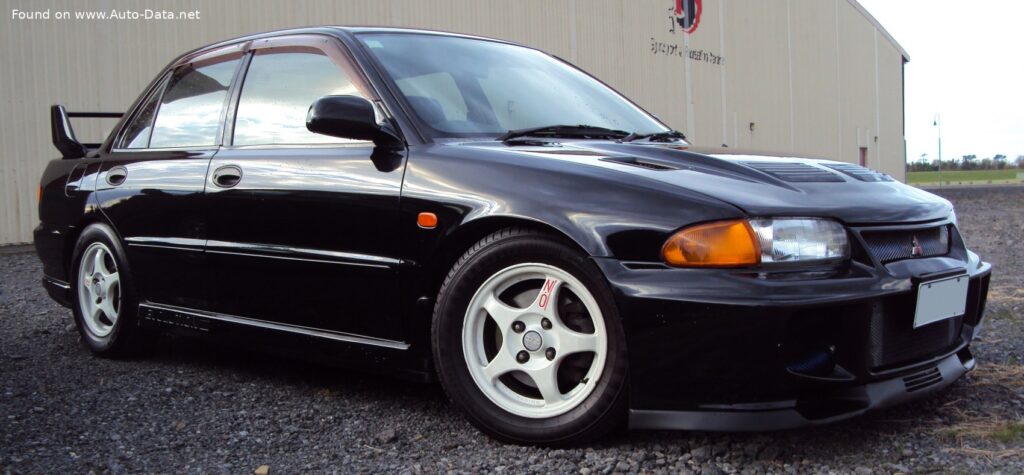
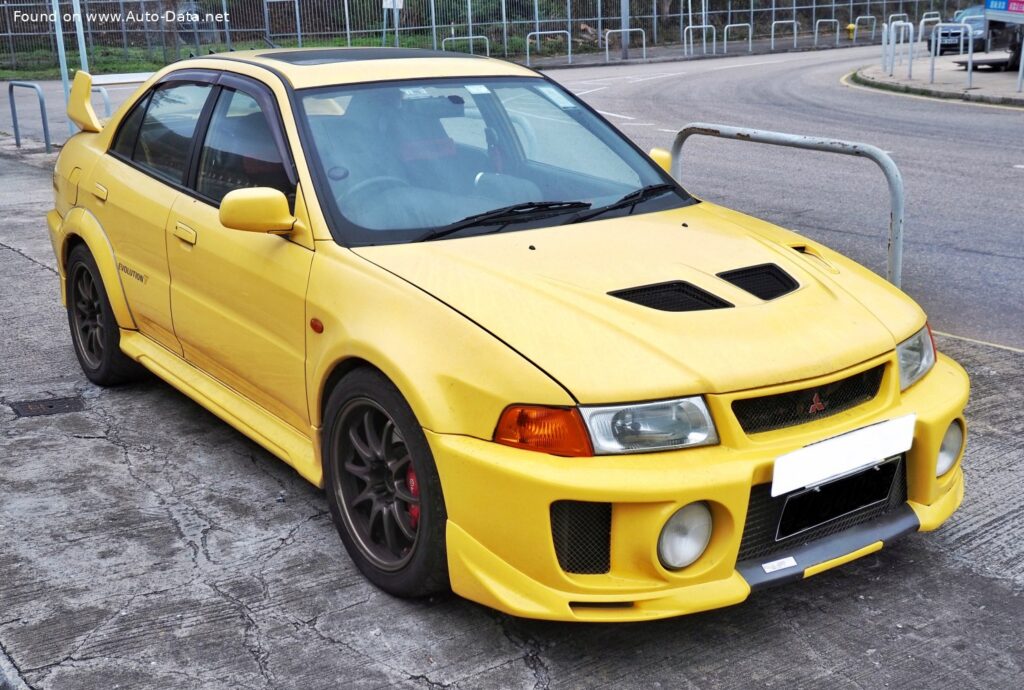
The Mitsubishi Lancer Evolution V maintained its aggressive, rally-inspired aesthetic, evolving the look of its predecessors with a more muscular and purposeful stance. It was offered exclusively as a four-door sedan, providing practical seating for five occupants while outwardly projecting its high-performance intentions. The body measured 171.26 inches (4350 mm) in length, 69.69 inches (1770 mm) in width, and 55.71 inches (1415 mm) in height, with a wheelbase of 98.82 inches (2510 mm). These dimensions, combined with a wider track (59.45 in. front, 59.25 in. rear), contributed to its enhanced stability and road presence.
Key design elements included flared wheel arches to accommodate wider tires, a large rear wing for aerodynamic downforce, and distinctive front and rear bumpers with integrated air intakes and diffusers. The exterior was not merely for show; every element served a functional purpose, from cooling the engine and brakes to improving high-speed stability.
Underneath its aggressive skin, the Evolution V featured a robust chassis designed for spirited driving. The suspension system utilized coil springs at both the front and rear, tuned for a firm yet communicative ride that was essential for rally performance. Braking power was provided by disc brakes on all four wheels, complemented by an Anti-lock Braking System (ABS) for enhanced safety and control during hard braking. The steering system was a hydraulic rack and pinion setup, offering direct feedback and precision, crucial for a car of this caliber. The vehicle rode on performance-oriented 225/45 ZR17 tires, providing ample grip.
Technical Specifications
| Category | Specification |
|---|---|
| General Information | |
| Brand | Mitsubishi |
| Model | Lancer Evolution V |
| Generation | Lancer Evolution V |
| Type (Engine) | 2.0 (280 Hp) 4WD |
| Start of Production | 1998 |
| End of Production | 1999 |
| Powertrain Architecture | Internal Combustion Engine |
| Body Type | Sedan |
| Seats | 5 |
| Doors | 4 |
| Performance Specs | |
| Fuel Type | Petrol (Gasoline) |
| Acceleration 0 – 60 mph | 4.7 seconds |
| Maximum Speed | 136.7 mph (220 km/h) |
| Weight-to-power ratio | 4.5 kg/Hp, 222.2 Hp/tonne |
| Weight-to-torque ratio | 3.3 kg/Nm, 304 Nm/tonne |
| Engine Specs | |
| Power | 280 Hp @ 6500 rpm |
| Power per liter | 140.2 Hp/l |
| Torque | 282.49 lb.-ft. (383 Nm) @ 3500 rpm |
| Engine Layout | Front, Transverse |
| Engine Displacement | 2.0 liters (1997 cm3 / 121.86 cu. in.) |
| Number of Cylinders | 4 |
| Engine Configuration | Inline |
| Cylinder Bore | 3.35 in. (85 mm) |
| Piston Stroke | 3.46 in. (88 mm) |
| Compression Ratio | 8.8:1 |
| Number of Valves per Cylinder | 4 |
| Fuel Injection System | Multi-port manifold injection |
| Engine Aspiration | Turbocharger |
| Valvetrain | DOHC |
| Space, Volume and Weights | |
| Curb Weight | 2777.82 lbs (1260 kg) |
| Fuel Tank Capacity | 13.21 US gal (50 l) |
| Dimensions | |
| Length | 171.26 in. (4350 mm) |
| Width | 69.69 in. (1770 mm) |
| Height | 55.71 in. (1415 mm) |
| Wheelbase | 98.82 in. (2510 mm) |
| Front Track | 59.45 in. (1510 mm) |
| Rear Track | 59.25 in. (1505 mm) |
| Drivetrain, Brakes and Suspension Specs | |
| Drive Wheel | All-wheel drive (4×4) |
| Number of Gears and Gearbox Type | 4 gears, automatic transmission |
| Front Suspension | Coil spring |
| Rear Suspension | Coil spring |
| Front Brakes | Disc |
| Rear Brakes | Disc |
| Assisting Systems | ABS (Anti-lock braking system) |
| Steering Type | Steering rack and pinion |
| Power Steering | Hydraulic Steering |
| Tire Size | 225/45 ZR17 |
Legacy and Market Impact of the Mitsubishi Lancer Evolution V
The Mitsubishi Lancer Evolution V holds a significant place in automotive history, particularly within the realm of performance cars and rally racing. Its brief production run from 1998 to 1999 was a period of intense competition in the World Rally Championship, where the Evolution series, driven by legendary figures like Tommi Mäkinen, secured multiple drivers’ and manufacturers’ titles. The Evolution V’s improvements in chassis rigidity, wider track, and enhanced aerodynamics were directly aimed at homologation requirements, ensuring Mitsubishi’s continued success on the global rally stage.
In its primary market, Japan, the Evolution V was revered as a top-tier performance sedan, offering supercar-rivalling acceleration and handling in a more accessible package. Its direct competitor was, invariably, the Subaru Impreza WRX STI, leading to one of the most celebrated rivalries in automotive history. Both vehicles pushed each other to new heights of performance, offering distinct driving characteristics but sharing a common rally heritage and all-wheel-drive philosophy. The Evolution V was often praised for its sharper, more aggressive handling and its robust, highly tunable 4G63T engine.
Globally, the Evolution V, like its brethren, cultivated a cult following. Its unavailability in the American market during its prime only amplified its desirability, leading to a strong grey market for imports and a significant presence in video games and popular culture. This contributed to its iconic status and established the Lancer Evolution as a benchmark for performance sedans. The V’s combination of a potent turbocharged engine, sophisticated all-wheel-drive system, and aggressive styling made it a dream car for many enthusiasts.
Today, the Mitsubishi Lancer Evolution V is considered a highly collectible classic, particularly sought after by JDM enthusiasts and those who appreciate its raw, analogue driving experience. Its impact extends beyond its rally successes; it helped define an era of Japanese performance cars, demonstrating that a four-door sedan could deliver track-ready performance without sacrificing practicality. The Evolution V’s engineering prowess and motorsport pedigree ensure its continued legacy as a true automotive icon.