The Mitsubishi Lancer Evolution VIII: A Rally Legend for the Road
The Mitsubishi Lancer Evolution VIII, produced from 2003 to 2005, represents a pivotal chapter in the storied history of Mitsubishi’s high-performance Lancer variant. Building upon a formidable rally heritage, the Evolution VIII was designed as a homologation special, bringing World Rally Championship (WRC) technology and performance to public roads. As the eighth iteration of the iconic “Evo” series, it refined the formula of a compact, all-wheel-drive sedan with a potent turbocharged engine, establishing itself as a formidable competitor in the performance car segment.
For enthusiasts in markets like Europe, Japan, and notably, the United States (where the Evo VIII marked its official debut), this generation solidified the Evolution’s reputation as a raw, driver-focused machine. It offered an unparalleled blend of everyday usability with track-ready performance, making it a darling among tuners and driving purists alike. The 2.0 (265 Hp) 4WD variant, in particular, was celebrated for its balanced power delivery, tenacious grip, and engaging driving dynamics, embodying the very essence of Mitsubishi’s engineering prowess during the early 2000s.
Powertrain and Performance Dynamics of the Mitsubishi Lancer Evolution VIII
At the heart of the Mitsubishi Lancer Evolution VIII 2.0 (265 Hp) 4WD lay the legendary 4G63T engine. This 2.0-liter (121.86 cubic inch) inline-four, DOHC powerplant was a masterpiece of turbocharged engineering, boasting a robust cast-iron block and an aluminum cylinder head. Equipped with a turbocharger and an intercooler, it produced a formidable 265 horsepower at 6500 rpm and 261.83 lb.-ft. of torque at 3500 rpm. This power delivery was characterized by a strong mid-range punch, making the Evo VIII incredibly responsive and thrilling to drive on both winding roads and open stretches. The engine’s high power-per-liter output of 132.7 Hp/l underscored its advanced design and performance capabilities.
Power was meticulously managed and distributed through a precise 5-speed manual transmission, offering a direct and engaging connection between the driver and the drivetrain. The Evolution VIII’s signature feature was its sophisticated all-wheel-drive (AWD) system, which ensured exceptional traction and stability under various driving conditions. This permanent AWD system, coupled with advanced differentials, allowed the car to put its power down efficiently, translating into blistering acceleration and confidence-inspiring cornering. The vehicle could sprint from 0 to 60 mph in a mere 5.8 seconds, reaching a top speed of 152.24 mph, figures that firmly placed it in the realm of serious performance cars of its era.
Despite its high-performance orientation, Mitsubishi engineers also considered efficiency, albeit within the context of a rally-bred machine. The combined fuel economy was rated at 21.6 US mpg, with urban consumption at 15.3 US mpg and extra-urban at 28.3 US mpg. While not class-leading in terms of fuel efficiency, these figures were acceptable for a vehicle of its performance caliber, reflecting the balance struck between power and practicality. The engine’s architecture, including its multi-port manifold injection and DOHC valvetrain, contributed to its reliability and tunability, making it a favorite among aftermarket modifiers.
Design Philosophy and Key Features
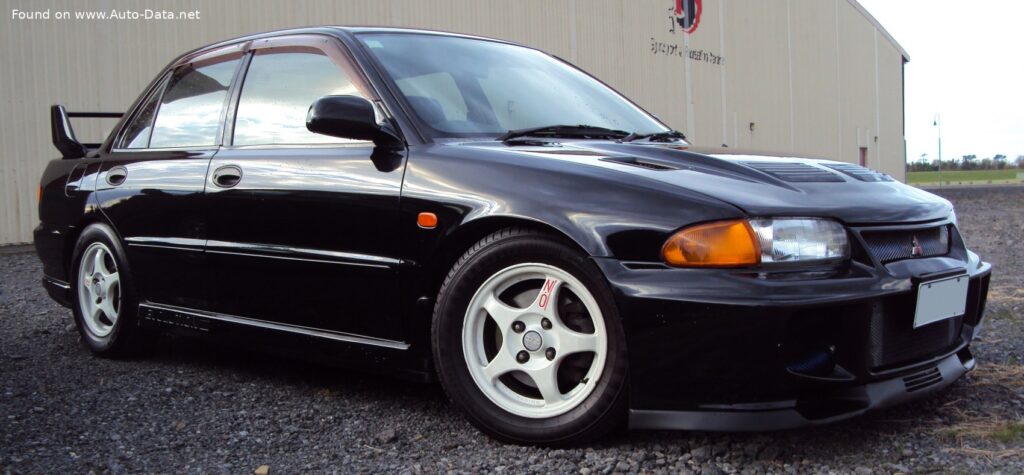
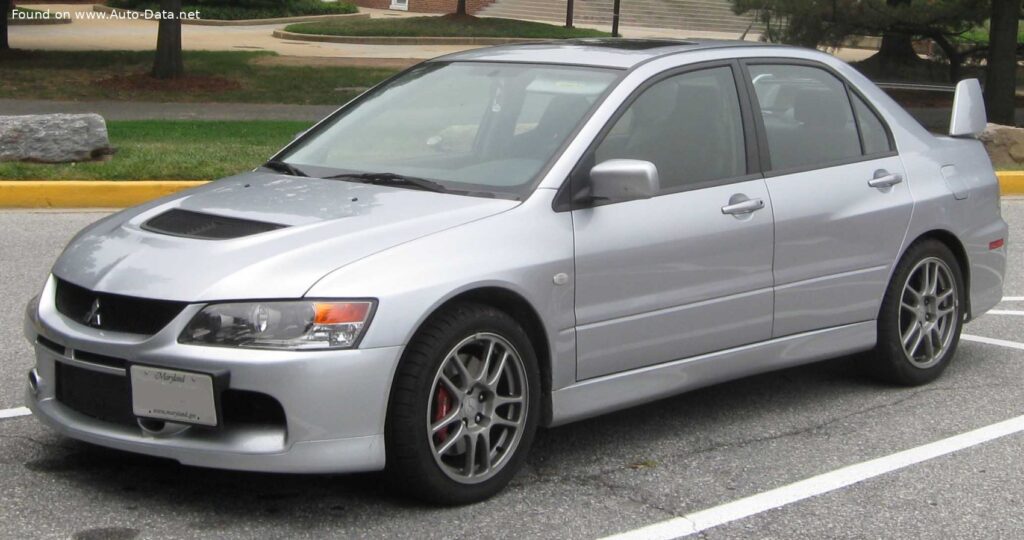
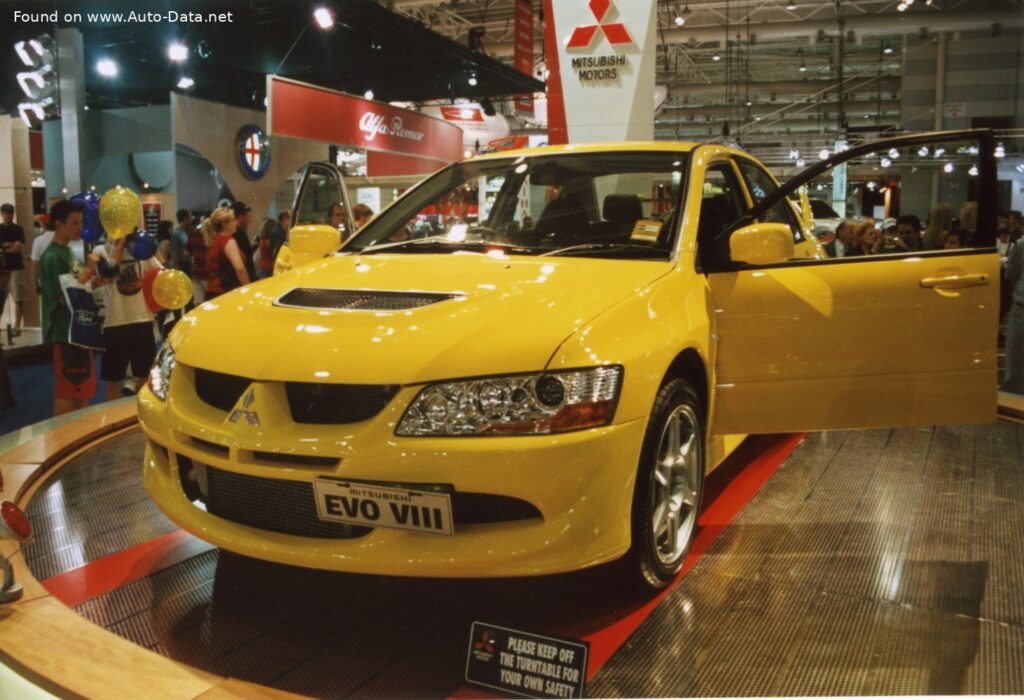
The design of the Mitsubishi Lancer Evolution VIII was a clear reflection of its rally pedigree: aggressive, functional, and unmistakably purposeful. As a 4-door, 5-seat sedan, it offered a degree of practicality, but its exterior styling left no doubt about its performance intentions. The car featured a distinctive front fascia with large air intakes for cooling, flared wheel arches to accommodate wider tires, and an iconic, towering rear wing that provided significant downforce at high speeds. These elements were not merely aesthetic; they were integral to the car’s aerodynamic efficiency and handling characteristics.
Underneath its muscular skin, the Evolution VIII boasted a highly tuned chassis. The front suspension utilized an independent McPherson strut setup with a transverse stabilizer, while the rear featured an independent multi-link suspension, also with a transverse stabilizer. This configuration, combined with a stiffened body structure, delivered exceptional handling precision and minimal body roll. Stopping power was equally impressive, with large ventilated disc brakes at both the front and rear, complemented by an Anti-lock Braking System (ABS) for enhanced safety and control under hard braking. The hydraulic rack and pinion steering provided direct feedback, allowing the driver to feel intimately connected to the road.
The interior of the Evolution VIII was driver-centric, prioritizing functionality over luxury. Performance-oriented seating, often from Recaro, provided excellent lateral support during spirited driving. While amenities were relatively sparse compared to more luxury-focused sedans, the cabin was well-appointed with all the necessary instrumentation for performance monitoring. Standard features included power steering, and the overall fit and finish were robust, designed to withstand the rigors of performance driving. The vehicle rode on 235/45 R17 tires mounted on 8J x 17-inch wheel rims, providing ample grip and a visually aggressive stance. With a curb weight of 3185.68 lbs. and a maximum load capacity of 970.03 lbs., the Evo VIII was a lightweight yet sturdy platform for its performance capabilities.
Technical Specifications: Mitsubishi Lancer Evolution VIII 2.0 (265 Hp) 4WD
| Category | Specification | Value |
|---|---|---|
| General Information | Brand | Mitsubishi |
| Model | Lancer Evolution | |
| Generation | Lancer Evolution VIII | |
| Type (Engine) | 2.0 (265 Hp) 4WD | |
| Start of Production | 2003 year | |
| End of Production | 2005 year | |
| Powertrain Architecture | Internal Combustion engine | |
| Body type | Sedan | |
| Seats | 5 | |
| Doors | 4 | |
| Performance Specs | Fuel consumption (economy) – urban | 15.4 l/100 km (15.3 US mpg) |
| Fuel consumption (economy) – extra urban | 8.3 l/100 km (28.3 US mpg) | |
| Fuel consumption (economy) – combined | 10.9 l/100 km (21.6 US mpg) | |
| CO2 emissions | 258 g/km | |
| Fuel Type | Petrol (Gasoline) | |
| Acceleration 0 – 60 mph | 5.8 sec | |
| Maximum speed | 245 km/h (152.24 mph) | |
| Weight-to-power ratio | 5.5 kg/Hp (183.4 Hp/tonne) | |
| Weight-to-torque ratio | 4.1 kg/Nm (245.7 Nm/tonne) | |
| Engine Specs | Power | 265 Hp @ 6500 rpm |
| Power per liter | 132.7 Hp/l | |
| Torque | 355 Nm @ 3500 rpm (261.83 lb.-ft. @ 3500 rpm) | |
| Engine layout | Front, Transverse | |
| Engine Model/Code | 4G63T | |
| Engine displacement | 1997 cm3 (121.86 cu. in.) | |
| Number of cylinders | 4 | |
| Engine configuration | Inline | |
| Cylinder Bore | 85 mm (3.35 in.) | |
| Piston Stroke | 88 mm (3.46 in.) | |
| Compression ratio | 8.8:1 | |
| Number of valves per cylinder | 4 | |
| Fuel injection system | Multi-port manifold injection | |
| Engine aspiration | Turbocharger, Intercooler | |
| Valvetrain | DOHC | |
| Engine oil capacity | 5.1 l (5.39 US qt) | |
| Coolant | 6 l (6.34 US qt) | |
| Dimensions, Volume, and Weights | Kerb Weight | 1445 kg (3185.68 lbs.) |
| Max. weight | 1885 kg (4155.71 lbs.) | |
| Max load | 440 kg (970.03 lbs.) | |
| Trunk (boot) space – minimum | 430 l (15.19 cu. ft.) | |
| Fuel tank capacity | 55 l (14.53 US gal) | |
| Max. roof load | 60 kg (132.28 lbs.) | |
| Length | 4490 mm (176.77 in.) | |
| Width | 1770 mm (69.69 in.) | |
| Height | 1450 mm (57.09 in.) | |
| Wheelbase | 2625 mm (103.35 in.) | |
| Front track | 1515 mm (59.65 in.) | |
| Rear (Back) track | 1515 mm (59.65 in.) | |
| Front overhang | 930 mm (36.61 in.) | |
| Rear overhang | 935 mm (36.81 in.) | |
| Ride height (ground clearance) | 140 mm (5.51 in.) | |
| Minimum turning circle (turning diameter) | 11.8 m (38.71 ft.) | |
| Drivetrain, Brakes, and Suspension | Drivetrain Architecture | Internal combustion engine (ICE) drives permanently the four wheels. |
| Drive wheel | All wheel drive (4×4) | |
| Number of gears and type of gearbox | 5 gears, manual transmission | |
| Front suspension | Independent type McPherson, Transverse stabilizer | |
| Rear suspension | Independent multi-link suspension, Transverse stabilizer | |
| Front brakes | Ventilated discs | |
| Rear brakes | Ventilated discs | |
| Assisting systems | ABS (Anti-lock braking system) | |
| Steering type | Steering rack and pinion | |
| Power steering | Hydraulic Steering | |
| Tires size | 235/45 R17 | |
| Wheel rims size | 8J x 17 |
Legacy and Market Influence
The Mitsubishi Lancer Evolution VIII carved out a significant niche in the global automotive landscape, particularly in the performance and tuner communities. Its reputation was intrinsically linked to Mitsubishi’s success in the World Rally Championship, where the Lancer Evolution series had dominated for years. The Evo VIII brought this rally-bred performance directly to consumers, making advanced AWD technology and turbocharged power accessible in a relatively affordable package.
In its primary markets of Japan and Europe, the Evo VIII was a continuation of a highly successful lineage, revered for its uncompromising performance and exceptional handling. However, its official introduction to the North American market with the Evo VIII was a game-changer. It instantly became a cult icon, challenging established performance cars and igniting a fierce rivalry with its arch-nemesis, the Subaru Impreza WRX STI. This rivalry fueled innovation and competition, benefiting enthusiasts who sought high-performance, all-weather capable vehicles.
The Evo VIII’s impact extended beyond just sales figures; it profoundly influenced car culture. Its robust 4G63T engine was known for its immense tunability, allowing enthusiasts to extract significantly more power with aftermarket modifications. This made it a staple in drag racing, time attack, and street performance scenes. The car’s raw, mechanical feel, combined with its precise steering and communicative chassis, offered a visceral driving experience that modern, more digitally-enhanced cars often struggle to replicate.
Today, the Mitsubishi Lancer Evolution VIII is regarded as a modern classic and a highly sought-after collector’s item. Its blend of rally heritage, formidable performance, and distinctive styling has ensured its enduring appeal. It stands as a testament to an era when performance cars were less about luxury and more about pure, unadulterated driving excitement, leaving an indelible mark on automotive history and cementing Mitsubishi’s legacy as a purveyor of true driver’s machines.