The Mitsubishi Lancer Evolution VIII: A Rally Legend’s Evolution
The Mitsubishi Lancer Evolution VIII, produced from 2003 to 2005, represents a pivotal chapter in the storied history of Mitsubishi’s rally-bred performance sedan. Building upon a lineage forged in the crucible of the World Rally Championship (WRC), the Evolution VIII, particularly the 2.0 (280 Hp) 4WD variant, continued to set benchmarks for attainable high-performance and sophisticated all-wheel-drive dynamics. While the 280 horsepower version was primarily a response to the “gentlemen’s agreement” in the Japanese domestic market (JDM) limiting advertised horsepower, its underlying capabilities and technological prowess made it a formidable competitor on global stages, including a significant presence in the United States market, albeit with slightly different power figures due to regional regulations. This generation solidified the Evolution’s reputation as a street-legal rally car, offering enthusiasts a direct connection to professional motorsport.
Engine and Performance of the Mitsubishi Lancer Evolution VIII
At the heart of the Mitsubishi Lancer Evolution VIII 2.0 (280 Hp) 4WD lies the legendary 4G63T engine, a turbocharged and intercooled 2.0-liter (1997 cm3 or 121.86 cu. in.) inline-four powerplant. This DOHC (Double Overhead Camshaft) engine, with its 16 valves (4 per cylinder), was renowned for its robust construction and immense tuning potential. In its factory specification for the JDM market, it produced a formidable 280 horsepower at 6500 rpm and a substantial 282.49 lb.-ft. of torque at a relatively low 3500 rpm. This impressive output translated into exhilarating performance figures, with the Evolution VIII capable of rocketing from 0 to 60 mph in a mere 5.6 seconds, and reaching a top speed of 155.34 mph (250 km/h).
The engine’s front, transverse layout, combined with a relatively high compression ratio of 8.8:1 for a turbocharged unit, allowed for quick spooling of the turbocharger, minimizing lag and providing immediate throttle response. Power per liter stood at an impressive 140.2 Hp/l, showcasing the engine’s efficiency in generating power from its displacement. Fuel delivery was handled by a multi-port manifold injection system, ensuring precise fuel metering for optimal combustion.
Crucially, the Evolution VIII’s performance wasn’t solely about raw engine power. Its sophisticated powertrain architecture featured a permanent all-wheel-drive (AWD) system, ensuring that every ounce of power was effectively transferred to the pavement, regardless of conditions. This system, coupled with a precise 6-speed manual transmission, provided exceptional grip and handling dynamics, making the Evo VIII a true driver’s car. The car’s weight-to-power ratio of 4.7 kg/Hp (212.1 Hp/tonne) further underscored its high-performance credentials.
Design and Features
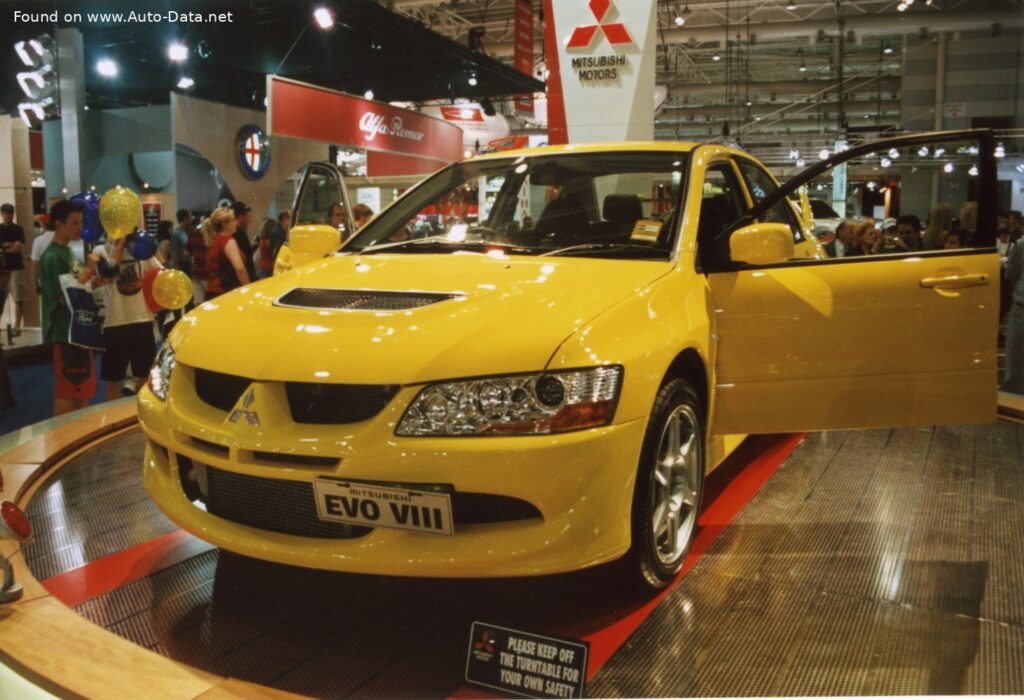
The Mitsubishi Lancer Evolution VIII retained the aggressive, functional aesthetic that had become a hallmark of the Evo series. As a four-door sedan with seating for five, it blended practicality with uncompromised performance styling. The exterior design was dictated by aerodynamic efficiency and cooling requirements, featuring a prominent front grille, large air intakes, a vented hood, and an iconic, often substantial, rear wing. These elements were not merely cosmetic; they served to enhance engine cooling, reduce lift, and improve high-speed stability, directly reflecting its rally heritage.
Inside, the Evolution VIII offered a driver-focused cockpit. While not luxurious, the interior was purposeful, featuring supportive sport seats, a clear instrument cluster, and all the essential controls within easy reach. The emphasis was on functionality and driver engagement, with materials chosen for durability and a no-nonsense aesthetic. Safety features for its era included an Anti-lock Braking System (ABS), which was crucial for managing its powerful braking system comprising ventilated discs at both the front and rear.
The chassis and suspension setup were equally integral to the Evolution VIII’s legendary handling. It utilized an independent McPherson type front suspension with a transverse stabilizer, and an independent multi-link rear suspension, also with a transverse stabilizer. This configuration, combined with the permanent AWD system, provided exceptional stability, precise steering feedback via its hydraulic power steering rack and pinion system, and remarkable cornering capabilities. The vehicle rode on 235/45 R17 tires mounted on 8J x 17-inch wheel rims, providing ample grip and a balanced contact patch.
Technical Specifications: Mitsubishi Lancer Evolution VIII 2.0 (280 Hp) 4WD
| Category | Specification | Value |
|---|---|---|
| General Information | ||
| Brand | Mitsubishi | |
| Model | Lancer Evolution | |
| Generation | Lancer Evolution VIII | |
| Type (Engine) | 2.0 (280 Hp) 4WD | |
| Start of production | 2003 year | |
| End of production | 2005 year | |
| Powertrain Architecture | Internal Combustion engine | |
| Body type | Sedan | |
| Seats | 5 | |
| Doors | 4 | |
| Performance Specs | ||
| Fuel consumption (economy) – urban | 15.4 l/100 km (15.3 US mpg / 18.3 UK mpg) | |
| Fuel consumption (economy) – extra urban | 8.3 l/100 km (28.3 US mpg / 34 UK mpg) | |
| Fuel consumption (economy) – combined | 10.9 l/100 km (21.6 US mpg / 25.9 UK mpg) | |
| Fuel Type | Petrol (Gasoline) | |
| Acceleration 0 – 60 mph | 5.6 sec | |
| Acceleration 0 – 100 km/h | 5.9 sec | |
| Maximum speed | 250 km/h (155.34 mph) | |
| Weight-to-power ratio | 4.7 kg/Hp (212.1 Hp/tonne) | |
| Weight-to-torque ratio | 3.4 kg/Nm (290.2 Nm/tonne) | |
| Engine Specs | ||
| Power | 280 Hp @ 6500 rpm | |
| Power per liter | 140.2 Hp/l | |
| Torque | 383 Nm @ 3500 rpm (282.49 lb.-ft. @ 3500 rpm) | |
| Engine layout | Front, Transverse | |
| Engine Model/Code | 4G63T | |
| Engine displacement | 1997 cm3 (121.86 cu. in.) | |
| Number of cylinders | 4 | |
| Engine configuration | Inline | |
| Cylinder Bore | 85 mm (3.35 in.) | |
| Piston Stroke | 88 mm (3.46 in.) | |
| Compression ratio | 8.8:1 | |
| Number of valves per cylinder | 4 | |
| Fuel injection system | Multi-port manifold injection | |
| Engine aspiration | Turbocharger, Intercooler | |
| Valvetrain | DOHC | |
| Engine oil capacity | 5.1 l (5.39 US qt / 4.49 UK qt) | |
| Coolant | 6 l (6.34 US qt / 5.28 UK qt) | |
| Space, Volume and Weights | ||
| Kerb Weight | 1320 kg (2910.1 lbs.) | |
| Trunk (boot) space – minimum | 430 l (15.19 cu. ft.) | |
| Fuel tank capacity | 55 l (14.53 US gal / 12.1 UK gal) | |
| Dimensions | ||
| Length | 4490 mm (176.77 in.) | |
| Width | 1770 mm (69.69 in.) | |
| Height | 1450 mm (57.09 in.) | |
| Wheelbase | 2625 mm (103.35 in.) | |
| Front track | 1515 mm (59.65 in.) | |
| Rear (Back) track | 1515 mm (59.65 in.) | |
| Front overhang | 930 mm (36.61 in.) | |
| Rear overhang | 935 mm (36.81 in.) | |
| Ride height (ground clearance) | 140 mm (5.51 in.) | |
| Minimum turning circle (turning diameter) | 11.8 m (38.71 ft.) | |
| Drivetrain, Brakes and Suspension Specs | ||
| Drivetrain Architecture | The Internal combustion engine (ICE) drives permanently the four wheels of the vehicle. | |
| Drive wheel | All wheel drive (4×4) | |
| Number of gears and type of gearbox | 6 gears, manual transmission | |
| Front suspension | Independent type McPherson, Transverse stabilizer | |
| Rear suspension | Independent multi-link suspension, Transverse stabilizer | |
| Front brakes | Ventilated discs | |
| Rear brakes | Ventilated discs | |
| Assisting systems | ABS (Anti-lock braking system) | |
| Steering type | Steering rack and pinion | |
| Power steering | Hydraulic Steering | |
| Tires size | 235/45 R17 | |
| Wheel rims size | 8J x 17 | |
Legacy and Market Impact
The Mitsubishi Lancer Evolution VIII played a crucial role in cementing the Evolution’s reputation as a performance icon, particularly in the early 2000s. Its direct competition, primarily the Subaru Impreza WRX STI, fueled an intense rivalry that pushed both manufacturers to continuously innovate, benefiting enthusiasts with increasingly capable and technologically advanced vehicles. The Evo VIII, with its aggressive styling, rally-bred performance, and advanced AWD system, captured the imagination of a generation of car enthusiasts worldwide.
In its primary market, Japan, the 280 Hp version was a testament to the engineering prowess within the constraints of the “gentlemen’s agreement” on horsepower limits. However, its true impact resonated globally. When it arrived in the North American market, albeit with slightly different specifications and power figures to comply with local regulations, it was met with overwhelming enthusiasm. It offered a raw, unfiltered driving experience that was distinct from many other performance cars of its time, appealing to those who valued mechanical grip, precise handling, and a direct connection to the road.
The Evolution VIII’s historical significance lies in its blend of everyday usability with track-day readiness and rally-stage capability. It demonstrated that a compact sedan could deliver supercar-baiting performance without sacrificing practicality. Its robust 4G63T engine became a legend in the tuning community, known for its ability to handle significant power increases, further extending the car’s appeal and longevity in the aftermarket scene. The car’s presence in popular culture, from video games to movies, further solidified its status as a definitive performance machine of its era. Today, the Mitsubishi Lancer Evolution VIII is regarded as a modern classic, highly sought after by collectors and enthusiasts who appreciate its pure, unadulterated performance and rich motorsport heritage.