Mitsubishi Lancer Evolution X 2.0 MIVEC (295 Hp) S-AWC TC-SST
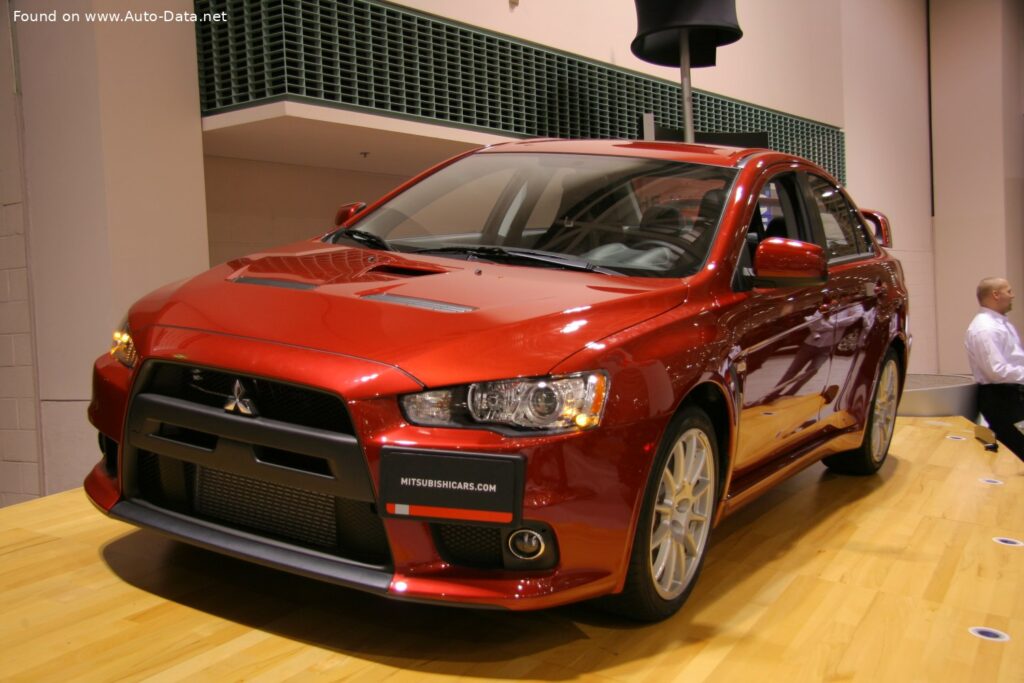
The Mitsubishi Lancer Evolution X 2.0 MIVEC (295 Hp) S-AWC TC-SST represents the tenth and final generation of Mitsubishi’s iconic high-performance sport sedan, the Lancer Evolution. Produced from 2010 to 2014, this iteration marked a significant evolution (pun intended) for the series, moving away from the previous generation’s powertrain and introducing advanced technologies aimed at enhancing both performance and daily drivability. Positioned squarely in the compact executive sports sedan segment, the Evolution X continued the legacy of its rally-bred predecessors, offering blistering acceleration, sophisticated all-wheel-drive dynamics, and an aggressive aesthetic that cemented its status as a legend among automotive enthusiasts worldwide, including a dedicated following in the United States.
This specific variant, featuring the 2.0-liter MIVEC engine delivering 295 horsepower and paired with the innovative Super All-Wheel Control (S-AWC) system and Twin Clutch Sportronic Shift Transmission (TC-SST), aimed to blend raw power with refined control. It was designed to excel in diverse driving conditions, from track days to challenging road rallies, embodying Mitsubishi’s commitment to performance engineering derived from decades of motorsport success.
Engine and Performance of the Mitsubishi Lancer Evolution X
At the heart of the Mitsubishi Lancer Evolution X lies the all-new 4B11T engine, a 2.0-liter (1998 cm³ or 121.93 cu. in.) inline four-cylinder powerplant, replacing the venerable 4G63 engine that had powered previous Evolution models. This new aluminum-block engine featured Mitsubishi Innovative Valve timing Electronic Control (MIVEC) on both intake and exhaust camshafts, contributing to a broader powerband and improved efficiency. Bolstered by a robust turbocharger and an intercooler, the 4B11T produced a formidable 295 horsepower at 6500 rpm and 269.95 lb.-ft. of torque at a relatively low 3500 rpm. This power delivery ensured immediate response and strong pull across the rev range, characteristic of a high-performance, turbocharged engine.
The powertrain architecture saw the engine mounted transversely at the front, driving all four wheels through Mitsubishi’s acclaimed Super All-Wheel Control (S-AWC) system. This advanced drivetrain integrated Active Yaw Control (AYC), Active Center Differential (ACD), Sport ABS, and Active Stability Control (ASC) to precisely distribute torque to each wheel, optimizing traction and handling in various conditions. The S-AWC system offered selectable modes (Tarmac, Gravel, Snow), allowing the driver to tailor the car’s dynamics to the prevailing surface.
A significant technological advancement for the Evolution X was the introduction of the 6-speed Twin Clutch Sportronic Shift Transmission (TC-SST). This dual-clutch automatic transmission provided lightning-fast gear changes, either automatically or via paddle shifters, contributing to the car’s impressive acceleration figures. The Mitsubishi Lancer Evolution X 2.0 MIVEC (295 Hp) S-AWC TC-SST could sprint from 0 to 60 mph in a mere 5.3 seconds (calculated) and reach 0 to 62 mph (100 km/h) in 5.6 seconds. Its top speed was electronically limited to 150.37 mph (242 km/h), showcasing its potent performance capabilities. Despite its focus on performance, the Evolution X managed a combined fuel economy of 22.6 US mpg (10.4 l/100 km), achieving an extra-urban economy of 29 US mpg (8.1 l/100 km), a respectable figure for a car of its caliber and era.
Design and Features
The Lancer Evolution X maintained the aggressive, rally-inspired aesthetic that defined its predecessors, yet introduced a more contemporary and sophisticated design language. As a four-door sedan, it offered practical seating for five, making it a surprisingly versatile performance vehicle. The body featured prominent flared wheel arches, a large rear wing (though a more subtle lip spoiler was also available in some markets), functional hood vents, and a distinctive “shark nose” front fascia with a large grille, all contributing to its unmistakable presence. The design was not merely for show; it was optimized for aerodynamics and cooling, essential for a car of its performance pedigree.
Inside, the Evolution X offered a driver-focused cockpit. While the interior shared elements with the standard Lancer, it was elevated with performance-oriented touches such as heavily bolstered Recaro sports seats, a sport steering wheel, and bespoke instrumentation. The vehicle also came equipped with standard features appropriate for its time, including automatic climate control, power windows, and a premium audio system. Safety features were comprehensive for the era, including ABS (Anti-lock Braking System) as standard, complementing the inherent stability provided by the S-AWC system and the robust chassis.
The chassis itself was a significant upgrade, featuring a wider track and longer wheelbase compared to the previous generation, improving stability and handling. The suspension setup comprised an independent McPherson strut system at the front and an independent multi-link suspension at the rear, both with coil springs and transverse stabilizers, ensuring precise control and minimal body roll. Stopping power was provided by large ventilated disc brakes, 350 mm at the front and 330 mm at the rear, offering exceptional fade resistance and strong braking performance. The car rode on 245/40 R18 tires mounted on 8.5J x 18-inch wheel rims, providing ample grip and a distinctive stance.
Technical Specifications
| Category | Specification |
|---|---|
| General Information | |
| Brand | Mitsubishi |
| Model | Lancer Evolution |
| Generation | Lancer Evolution X |
| Type (Engine) | 2.0 MIVEC (295 Hp) S-AWC TC-SST |
| Start of Production | 2010 year |
| End of Production | 2014 year |
| Powertrain Architecture | Internal Combustion Engine |
| Body Type | Sedan |
| Seats | 5 |
| Doors | 4 |
| Performance Specs | |
| Fuel Consumption (Urban, NEDC) | 16.3 US mpg (14.4 l/100 km) |
| Fuel Consumption (Extra Urban, NEDC) | 29 US mpg (8.1 l/100 km) |
| Fuel Consumption (Combined, NEDC) | 22.6 US mpg (10.4 l/100 km) |
| CO2 Emissions (NEDC) | 240 g/km |
| Fuel Type | Petrol (Gasoline) |
| Acceleration 0 – 60 mph | 5.3 sec (Calculated) |
| Acceleration 0 – 62 mph (0 – 100 km/h) | 5.6 sec |
| Maximum Speed | 150.37 mph (242 km/h) |
| Emission Standard | Euro 5 |
| Weight-to-Power Ratio | 5.4 kg/Hp, 185.5 Hp/tonne |
| Weight-to-Torque Ratio | 4.3 kg/Nm, 230.2 Nm/tonne |
| Engine Specs | |
| Power | 295 Hp @ 6500 rpm |
| Power per Liter | 147.6 Hp/l |
| Torque | 269.95 lb.-ft. @ 3500 rpm (366 Nm) |
| Engine Layout | Front, Transverse |
| Engine Model/Code | 4B11T |
| Engine Displacement | 121.93 cu. in. (1998 cm³) |
| Number of Cylinders | 4 |
| Engine Configuration | Inline |
| Cylinder Bore | 3.39 in. (86 mm) |
| Piston Stroke | 3.39 in. (86 mm) |
| Compression Ratio | 9:1 |
| Number of Valves per Cylinder | 4 |
| Fuel Injection System | Multi-port manifold injection |
| Engine Aspiration | Turbocharger, Intercooler |
| Valvetrain | DOHC |
| Engine Oil Capacity | 5.92 US qt (5.6 l) |
| Coolant Capacity | 7.93 US qt (7.5 l) |
| Space, Volume and Weights | |
| Kerb Weight | 3505.35 lbs. (1590 kg) |
| Max. Weight | 4497.43 lbs. (2040 kg) |
| Max Load | 992.08 lbs. (450 kg) |
| Trunk (Boot) Space – Minimum | 10.17 cu. ft. (288 l) |
| Fuel Tank Capacity | 14.53 US gal (55 l) |
| Dimensions | |
| Length | 177.36 in. (4505 mm) |
| Width | 71.26 in. (1810 mm) |
| Height | 58.27 in. (1480 mm) |
| Wheelbase | 104.33 in. (2650 mm) |
| Front Track | 60.83 in. (1545 mm) |
| Rear (Back) Track | 60.83 in. (1545 mm) |
| Front Overhang | 36.22 in. (920 mm) |
| Rear Overhang | 36.81 in. (935 mm) |
| Ride Height (Ground Clearance) | 5.31 in. (135 mm) |
| Minimum Turning Circle (Turning Diameter) | 38.71 ft. (11.8 m) |
| Drivetrain, Brakes and Suspension Specs | |
| Drivetrain Architecture | The Internal Combustion Engine (ICE) drives permanently the four wheels of the vehicle. |
| Drive Wheel | All Wheel Drive (4×4) |
| Number of Gears and Type of Gearbox | 6 gears, automatic transmission TC-SST |
| Front Suspension | Coil spring, Independent type McPherson, Transverse stabilizer |
| Rear Suspension | Independent multi-link suspension, Transverse stabilizer, Coil spring |
| Front Brakes | Ventilated discs, 350 mm |
| Rear Brakes | Ventilated discs, 330 mm |
| Assisting Systems | ABS (Anti-lock braking system) |
| Steering Type | Steering rack and pinion |
| Power Steering | Hydraulic Steering |
| Tires Size | 245/40 R18 |
| Wheel Rims Size | 8.5J x 18 |
Legacy and Market Impact of the Mitsubishi Lancer Evolution X
The Mitsubishi Lancer Evolution X 2.0 MIVEC (295 Hp) S-AWC TC-SST holds a unique and significant place in automotive history as the final chapter of the legendary Evolution series. When it debuted, it faced stiff competition, primarily from its long-standing rival, the Subaru WRX STI, which also offered a rally-bred, all-wheel-drive performance sedan. However, the Evo X distinguished itself with its more advanced S-AWC system and the sophisticated TC-SST dual-clutch transmission, which offered a more technologically driven performance experience compared to the STI’s more traditional mechanical approach.
The Evolution X was lauded for its exceptional handling, precise steering, and the incredible grip provided by its S-AWC system, allowing drivers to confidently push the limits on various road surfaces. Its aggressive styling resonated with enthusiasts who appreciated its motorsport heritage and no-nonsense performance focus. While some purists initially missed the raw, analog feel of earlier Evos and the iconic 4G63 engine, the 4B11T proved to be a highly tunable and capable powerplant, and the TC-SST offered a new level of performance and convenience.
In the North American market, the Lancer Evolution X enjoyed a strong cult following. It was a car that offered supercar-baiting performance at a fraction of the price, making it accessible to a broader range of performance enthusiasts. Its reputation for reliability and robust engineering, inherited from its rally roots, also contributed to its appeal. The car’s impact extended beyond performance figures; it fostered a vibrant aftermarket community and became a staple in car culture, frequently appearing in video games, movies, and tuning shows.
The decision by Mitsubishi to discontinue the Evolution series after the X generation marked the end of an era for many fans. This final model, therefore, carries a special significance, representing the culmination of decades of development in high-performance, all-wheel-drive technology. Today, the Mitsubishi Lancer Evolution X is considered a modern classic, highly sought after by collectors and enthusiasts who appreciate its blend of cutting-edge technology, rally heritage, and raw driving excitement. Its legacy continues to influence the design and engineering of performance sedans, solidifying its place as one of the most iconic Japanese sports cars ever produced.