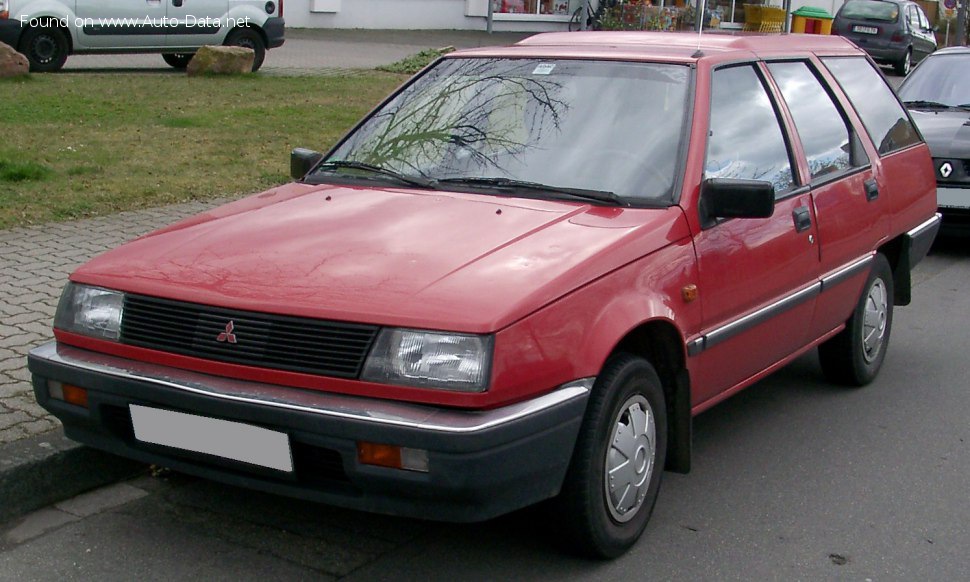
The Mitsubishi Lancer III Wagon 1.5 (C12V) (75 Hp) Automatic: A Global Workhorse of the Mid-1980s
The Mitsubishi Lancer III Wagon, specifically the 1.5 (C12V) (75 Hp) Automatic variant, represents a significant chapter in Mitsubishi’s history as a producer of dependable and economical family vehicles. Produced between 1985 and 1987, this generation of the Lancer wagon, known internally by its C10-series chassis codes, carved out a niche in various international markets, particularly in Europe, Asia, and Australia, where its practicality and affordability were highly valued. While not a common sight on American roads, where the Lancer nameplate would later gain prominence through its performance-oriented Evolution models, this iteration was a quintessential example of a compact, front-wheel-drive station wagon designed for everyday utility and family transport.
The Mitsubishi Lancer III Wagon embodied the engineering philosophies of its time: straightforward design, reliable mechanics, and a focus on maximizing interior space within a relatively compact footprint. It was a no-frills machine built to serve its owners dutifully, offering a blend of efficiency and versatility that appealed to a broad demographic seeking a practical alternative to sedans.
Engine and Performance of the Mitsubishi Lancer III Wagon
Under the hood of the Mitsubishi Lancer III Wagon 1.5 (C12V) Automatic lay a modest but efficient 1.5-liter (1468 cm3 or 89.58 cu. in.) naturally aspirated inline four-cylinder engine. This powerplant, designated C12V, was designed for smooth operation and fuel economy rather than outright speed. It featured a single overhead camshaft (OHC) valvetrain with three valves per cylinder, a configuration that aimed to balance performance with efficiency. Fuel was delivered via a multi-port manifold injection system, a relatively modern feature for an economy car of the mid-1980s, ensuring precise fuel delivery and cleaner emissions compared to older carbureted systems.
The engine produced a respectable 75 horsepower at 6000 rpm, which translated to a power-per-liter output of 51.1 horsepower per liter. Torque figures stood at 102 Newton-meters, or 75.23 lb.-ft., available at 4000 rpm. While these numbers might seem modest by today’s standards, they were perfectly adequate for propelling the lightweight Lancer Wagon in urban environments and on highways, especially considering its intended purpose as a family hauler. The engine’s layout was front, transverse, driving the front wheels, a common and efficient powertrain architecture for compact cars of the era.
Power was transferred to the front wheels via a 4-speed automatic transmission. This gearbox, while lacking the numerous ratios of modern automatics, provided a smooth and convenient driving experience, particularly in stop-and-go traffic. The combination of the 1.5-liter engine and automatic transmission resulted in a vehicle that prioritized ease of use and reliability over blistering performance. Its weight-to-power ratio of 12 kg/Hp (approximately 83.3 Hp/tonne) and weight-to-torque ratio of 8.8 kg/Nm (approximately 113.3 Nm/tonne) underscored its role as an economical and practical transporter.
Design and Features
The Mitsubishi Lancer III Wagon adopted a functional and straightforward design, characteristic of compact station wagons of the mid-1980s. Its body type was a 5-door station wagon (often referred to as an estate in other markets), offering seating for five occupants. The exterior dimensions were compact, measuring 161.93 inches (4113 mm) in length, 64.37 inches (1635 mm) in width, and 55.71 inches (1415 mm) in height. A wheelbase of 93.7 inches (2380 mm) provided a stable ride while maintaining maneuverability in tight spaces. The front track measured 55.51 inches (1410 mm) and the rear track 52.76 inches (1340 mm).
Despite its compact exterior, the Lancer Wagon offered a practical interior. The minimum trunk (boot) space was 13.31 cu. ft. (377 liters), which was quite generous for its class, allowing for ample cargo capacity for groceries, luggage, or family essentials. The fuel tank capacity was 12.42 US gallons (47 liters), providing a decent range for extended journeys given the engine’s fuel efficiency.
The vehicle’s suspension system consisted of coil springs at both the front and rear, providing a comfortable ride tuned for everyday driving conditions. Braking was handled by disc brakes at the front and drum brakes at the rear, a common setup for economy cars of the period, offering adequate stopping power. Steering was managed by a responsive rack and pinion system, contributing to predictable handling. The Lancer III Wagon rode on 13-inch wheels fitted with 175/70 R13 tires, a standard size that balanced grip, ride comfort, and affordability.
The design philosophy emphasized utility and durability. The interior was simple and ergonomic, with controls placed intuitively. While luxury features were minimal, the focus was on robust materials and construction that could withstand the rigors of family life. Safety features, typical for the era, would have included basic seatbelts and a sturdy body structure, but without the advanced driver aids or multiple airbags found in modern vehicles.
Technical Specifications
| Specification | Value |
|---|---|
| Brand | Mitsubishi |
| Model | Lancer |
| Generation | Lancer III Wagon |
| Type (Engine) | 1.5 (C12V) (75 Hp) Automatic |
| Production Start | 1985 |
| Production End | 1987 |
| Powertrain Architecture | Internal Combustion Engine |
| Body Type | Station wagon (estate) |
| Seats | 5 |
| Doors | 5 |
| Fuel Type | Petrol (Gasoline) |
| Power | 75 Hp @ 6000 rpm |
| Power per Liter | 51.1 Hp/l |
| Torque | 102 Nm (75.23 lb.-ft.) @ 4000 rpm |
| Engine Layout | Front, Transverse |
| Engine Displacement | 1468 cm3 (89.58 cu. in.) |
| Number of Cylinders | 4 |
| Engine Configuration | Inline |
| Cylinder Bore | 75.5 mm (2.97 in.) |
| Piston Stroke | 82 mm (3.23 in.) |
| Compression Ratio | 9.5:1 |
| Valves per Cylinder | 3 |
| Fuel Injection System | Multi-port manifold injection |
| Engine Aspiration | Naturally aspirated engine |
| Valvetrain | OHC |
| Kerb Weight | 900 kg (1984.16 lbs) |
| Weight-to-Power Ratio | 12 kg/Hp (83.3 Hp/tonne) |
| Weight-to-Torque Ratio | 8.8 kg/Nm (113.3 Nm/tonne) |
| Trunk (boot) Space – Minimum | 377 l (13.31 cu. ft.) |
| Fuel Tank Capacity | 47 l (12.42 US gal) |
| Length | 4113 mm (161.93 in.) |
| Width | 1635 mm (64.37 in.) |
| Height | 1415 mm (55.71 in.) |
| Wheelbase | 2380 mm (93.7 in.) |
| Front Track | 1410 mm (55.51 in.) |
| Rear Track | 1340 mm (52.76 in.) |
| Drivetrain Architecture | Front-wheel drive (ICE drives front wheels) |
| Drive Wheel | Front wheel drive |
| Number of Gears & Type | 4 gears, automatic transmission |
| Front Suspension | Coil spring |
| Rear Suspension | Coil spring |
| Front Brakes | Disc |
| Rear Brakes | Drum |
| Steering Type | Steering rack and pinion |
| Tires Size | 175/70 R13 |
| Wheel Rims Size | 13 inches |
Legacy and Market Impact of the Mitsubishi Lancer III Wagon
The Mitsubishi Lancer III Wagon, particularly the 1.5 (C12V) (75 Hp) Automatic variant, played a crucial role in Mitsubishi’s global strategy during the mid-1980s. While the Lancer nameplate is perhaps best known in the United States for its high-performance Evolution models, the vast majority of Lancer vehicles sold worldwide, including this wagon, were designed for mass appeal as affordable, reliable, and practical transportation. This generation of the Lancer was instrumental in solidifying Mitsubishi’s reputation in various markets as a manufacturer of durable and economical vehicles.
In its primary markets, the Lancer III Wagon competed against a host of similar compact wagons from other Japanese and European manufacturers. Key rivals would have included models like the Toyota Corolla Wagon, Honda Civic Wagon, Nissan Sunny (Sentra) Wagon, and European offerings such as the Opel Kadett Caravan or Ford Escort Estate. What set the Lancer apart was its typical Japanese reliability, fuel efficiency, and a straightforward, unpretentious design that resonated with buyers looking for value and dependability.
The wagon’s practical body style, combined with its compact dimensions, made it an ideal choice for families in urban and suburban environments who needed more cargo space than a sedan could offer, without the bulk or higher running costs of larger vehicles. Its automatic transmission also enhanced its appeal in markets where ease of driving was a priority. The Lancer III Wagon, while not a revolutionary vehicle, was a solid evolutionary step that built upon Mitsubishi’s growing expertise in front-wheel-drive platforms and efficient powertrains.
Today, the Mitsubishi Lancer III Wagon is remembered as a testament to the era’s automotive engineering—a car built to last and to serve its purpose without fuss. Its legacy is that of a dependable workhorse that contributed significantly to Mitsubishi’s international sales and brand recognition. It paved the way for future Lancer generations, demonstrating the versatility of the Lancer platform and laying a foundation for the diverse range of vehicles that would carry the Lancer name into the 21st century.