The Mitsubishi Lancer IV 1.8 Diesel (60 Hp): A Global Workhorse
The Mitsubishi Lancer, a name synonymous with versatility and reliability across numerous generations, saw its fourth iteration (known internally as the C60/C70 series) introduced in 1988. This generation marked a significant evolution in design and engineering for Mitsubishi’s compact car lineup, aiming to solidify its presence in diverse international markets. Among the various powertrain options offered globally, the Mitsubishi Lancer IV 1.8 Diesel (60 Hp) sedan stood out as a particularly pragmatic choice, primarily targeting regions where fuel efficiency, robustness, and low running costs were paramount. Produced from 1988 to 1992, this specific diesel variant exemplified the era’s focus on utilitarian transport, offering a no-frills, dependable package for families, businesses, and taxi fleets alike, especially in European and Asian markets where diesel engines held a stronger foothold than in the United States.
Evolution of the Mitsubishi Lancer IV
The fourth-generation Lancer represented a more aerodynamically refined and structurally improved vehicle compared to its predecessors. While the Lancer nameplate is perhaps best known in the US for its high-performance Evolution models, the vast majority of Lancers sold worldwide, including this 1.8 Diesel variant, were designed for everyday practicality. This generation introduced a sleeker, more rounded aesthetic, moving away from the boxier designs of the early 1980s. Its development reflected Mitsubishi’s ambition to compete fiercely in the compact segment against established rivals from Toyota, Honda, and Nissan, offering a blend of Japanese engineering prowess with global market appeal.
Engine and Performance: The Heart of the Mitsubishi Lancer IV
At the core of the Mitsubishi Lancer IV 1.8 Diesel model was the robust 4D65 engine, a naturally aspirated (non-turbocharged) 1.8-liter diesel powerplant. This engine was engineered for durability and fuel economy rather than outright speed, producing a modest 60 horsepower (Hp). In an era before common-rail injection and turbocharging became ubiquitous in passenger car diesels, the 4D65 engine represented the prevailing technology for economical diesel propulsion.
Performance figures for a vehicle with 60 Hp would naturally be modest by today’s standards. Acceleration was leisurely, and top speed was adequate for highway cruising but not exhilarating. However, judging this vehicle purely on its horsepower figures would miss its intended purpose. The 4D65 diesel was renowned for its impressive fuel efficiency, offering significant cost savings over gasoline alternatives, particularly in countries with higher diesel fuel taxes or subsidies. Its naturally aspirated design contributed to its mechanical simplicity, which in turn translated to excellent reliability and lower maintenance costs over its lifespan. This made the Lancer IV 1.8 Diesel an attractive proposition for buyers prioritizing longevity and economy above all else.
The engine’s architecture, an internal combustion engine, relied on direct fuel injection (or indirect in some early versions of this engine family) to deliver power efficiently. While it might have been characterized by a distinct diesel clatter and vibration at idle, typical of the era’s technology, its consistent torque delivery at lower RPMs made it suitable for urban driving and carrying loads. The generous engine oil capacity of 5.1 liters (5.39 US quarts) and a coolant capacity of 6 liters (6.34 US quarts) further underscored its design for sustained operation and durability, allowing for effective thermal management and lubrication crucial for diesel engine longevity.
Design and Features: Practicality in a Sedan Package
The Mitsubishi Lancer IV was offered in various body styles globally, but the 1.8 Diesel variant specifically came as a traditional sedan. This body type was a staple in the compact segment, offering a practical three-box design with a separate trunk for cargo. The sedan configuration appealed to a broad demographic, from small families needing reliable transportation to business professionals and fleet operators.
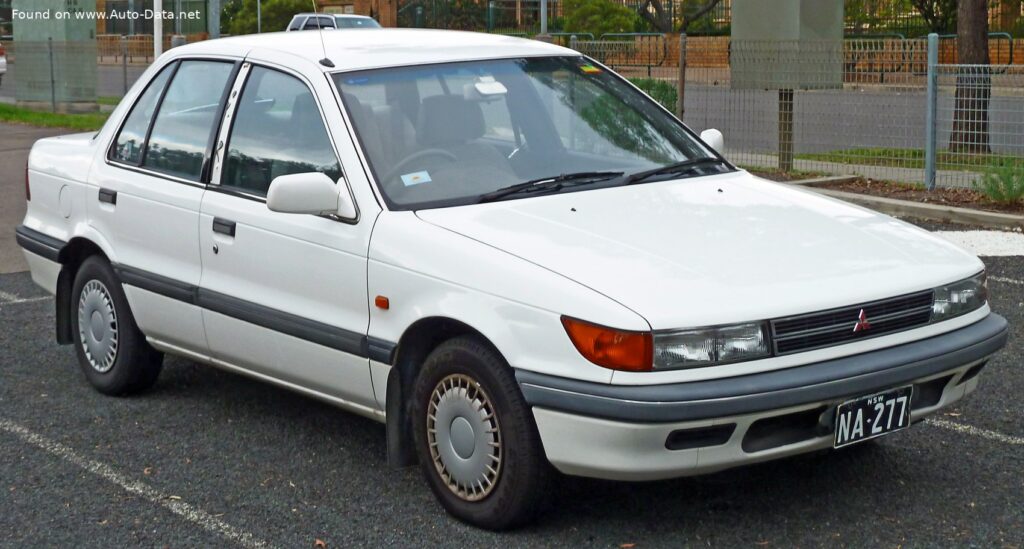
Aesthetically, the Lancer IV sedan adopted a smoother, more contemporary look for the late 1980s. Its design featured flush-mounted headlights, a slightly raked windshield, and a gently sloping hood and trunk lid, all contributing to improved aerodynamics compared to its predecessors. While not groundbreaking, the design was clean, functional, and aged relatively gracefully. Inside, the Lancer IV focused on ergonomics and utility. The cabin was spacious for its class, offering comfortable seating for four adults, or five for shorter journeys. Materials were durable and hard-wearing, designed to withstand years of daily use. Features, while basic by today’s standards, were appropriate for its segment and era. Depending on the trim level and market, buyers could expect amenities such as manual or power windows, a basic audio system, and effective heating and ventilation. Safety features were rudimentary compared to modern vehicles, typically including seatbelts and a sturdy body structure, common for vehicles of this vintage. The focus was on fundamental reliability and functionality, making it a dependable choice for budget-conscious consumers.
Technical Specifications
| Attribute | Specification |
|---|---|
| Brand | Mitsubishi |
| Model | Lancer |
| Generation | Lancer IV |
| Type (Engine) | 1.8 Diesel (60 Hp) |
| Start of Production | 1988 year |
| End of Production | 1992 year |
| Powertrain Architecture | Internal Combustion engine |
| Body Type | Sedan |
| Fuel Type | Diesel |
| Power | 60 Hp |
| Engine Model/Code | 4D65 |
| Engine Aspiration | Naturally aspirated engine |
| Engine Oil Capacity | 5.1 l (5.39 US qt | 4.49 UK qt) |
| Coolant Capacity | 6 l (6.34 US qt | 5.28 UK qt) |
Legacy and Market Impact
The Mitsubishi Lancer IV 1.8 Diesel (60 Hp) played a crucial, albeit understated, role in Mitsubishi’s global strategy during the late 1980s and early 1990s. While not a car that garnered headlines for its performance or luxury, its true impact lay in its unwavering dependability and economic viability. In markets like Western Europe, where diesel technology was highly valued for its fuel efficiency and lower running costs, and in many developing nations across Asia and Africa, this Lancer variant became a popular choice for those seeking a durable, low-cost-of-ownership vehicle.
Its primary competitors varied by region but generally included other compact diesel sedans of the era, such as the Volkswagen Jetta/Golf Diesel, Opel Kadett/Astra Diesel, Ford Escort Diesel, and diesel variants of the Toyota Corolla and Nissan Sunny/Sentra. Against these rivals, the Lancer IV 1.8 Diesel often held its own by offering a competitive package of reliability, fuel economy, and practical design. Mitsubishi’s reputation for building robust vehicles further bolstered its appeal.
The Lancer IV, and particularly its diesel iterations, contributed to establishing Mitsubishi as a credible player in the global compact car market, known for producing cars that could withstand demanding conditions. While the US market largely overlooked passenger car diesels of this size and power output in favor of gasoline engines, the Lancer IV’s success in other regions highlighted the diverse automotive needs worldwide. Today, these models are remembered as quintessential examples of the Japanese economic car philosophy: simple, effective, and built to last. They represent a significant chapter in the Lancer’s long and varied history, laying the groundwork for future generations that would increasingly focus on performance and advanced technology, even as the core values of reliability and practicality remained. The legacy of the Mitsubishi Lancer IV 1.8 Diesel is not one of speed records or design accolades, but of countless miles reliably traversed, underpinning its role as a true global workhorse.