The Mitsubishi Lancer IV GTi 1.8 16V: A Compact Performance Sedan of the Early Nineties
The Mitsubishi Lancer IV GTi 1.8 16V, produced between 1992 and 1993, represents a significant chapter in Mitsubishi’s history, particularly in markets outside of the United States. This specific variant of the fourth-generation Lancer was a performance-oriented compact sedan, designed to offer an exhilarating driving experience in a practical four-door package. While the Lancer nameplate gained global recognition, especially with its rally-bred Evolution series, the GTi 1.8 16V was a more understated, yet highly capable, precursor to that high-performance lineage. Positioned as a “hot sedan” in its primary markets such as Europe and Japan, it aimed to blend everyday usability with genuine sporting credentials, appealing to enthusiasts looking for a discreet but potent daily driver.
The fourth-generation Lancer, known internally as the C60/C70/C80 series, built upon Mitsubishi’s reputation for reliable and efficient compact cars. The GTi variant, however, elevated this platform with a focus on driver engagement and spirited performance. It showcased Mitsubishi’s engineering prowess, particularly its ability to extract significant power from naturally aspirated engines, a hallmark of many Japanese performance cars of the era. This model served as a testament to the brand’s commitment to offering diverse options, from economical family cars to enthusiast-focused machines, even within the same vehicle line.
Engine and Performance of the Mitsubishi Lancer IV GTi 1.8 16V
At the heart of the Mitsubishi Lancer IV GTi 1.8 16V lay a formidable 1.8-liter, inline four-cylinder engine. This powerplant featured a Double Overhead Camshaft (DOHC) valvetrain with 16 valves, a setup that was indicative of modern, high-revving engines of its time. Naturally aspirated, it relied on efficient design and precise multi-port manifold injection to deliver its power, rather than forced induction. This configuration contributed to a linear power delivery and a satisfying engine note, particularly as the RPMs climbed.
The engine produced a robust 140 horsepower at 6500 rpm, a considerable output for a 1.8-liter engine in the early 1990s. Torque figures were equally impressive for its class, peaking at 123.91 lb.-ft. (168 Nm). This power was channeled through a precise 5-speed manual transmission, which was the sole gearbox option, reinforcing the car’s driver-centric philosophy. The combination of a relatively lightweight body – with a curb weight of just 2292.81 lbs. (1040 kg) – and this potent engine resulted in an excellent power-to-weight ratio of 134.6 Hp per ton (7.4 kg/Hp).
Performance metrics for the Lancer IV GTi 1.8 16V were genuinely quick for its segment. It could accelerate from 0 to 60 mph in a swift 7.2 seconds, making it competitive with many sports coupes of its era. The sprint from 0 to 100 km/h was achieved in 7.6 seconds. Furthermore, the top speed was a remarkable 149.13 mph (240 km/h), demonstrating its capability as a high-speed cruiser on unrestricted European highways or Japanese expressways. These figures underscored the GTi’s intent as a serious performance machine, capable of holding its own against more established hot hatches and compact sports sedans.
Despite its performance leanings, the Lancer GTi also offered reasonable fuel economy for its class. The combined fuel consumption was rated at 27.7 US mpg (8.5 l/100 km), with urban driving yielding 21.2 US mpg (11.1 l/100 km) and extra-urban driving achieving an impressive 35.6 US mpg (6.6 l/100 km). This balance of performance and efficiency made it an attractive proposition for those seeking excitement without excessive running costs.
Design and Features
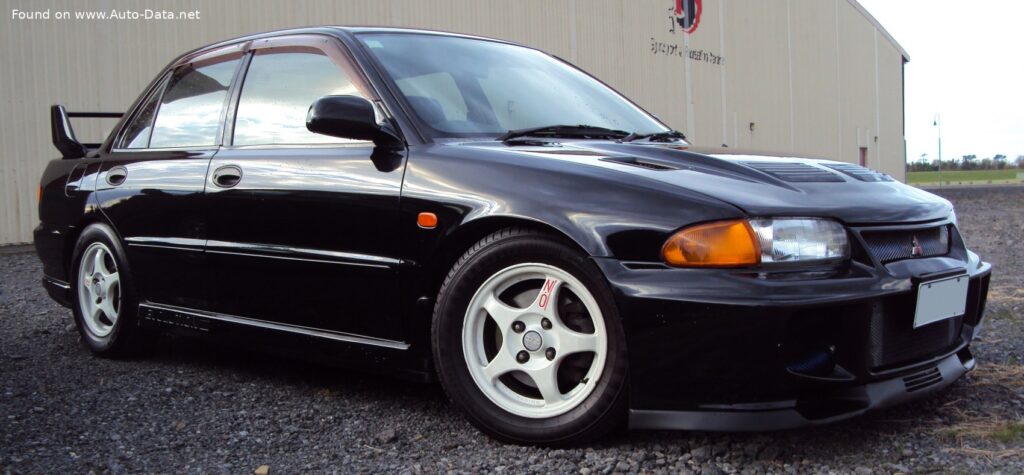
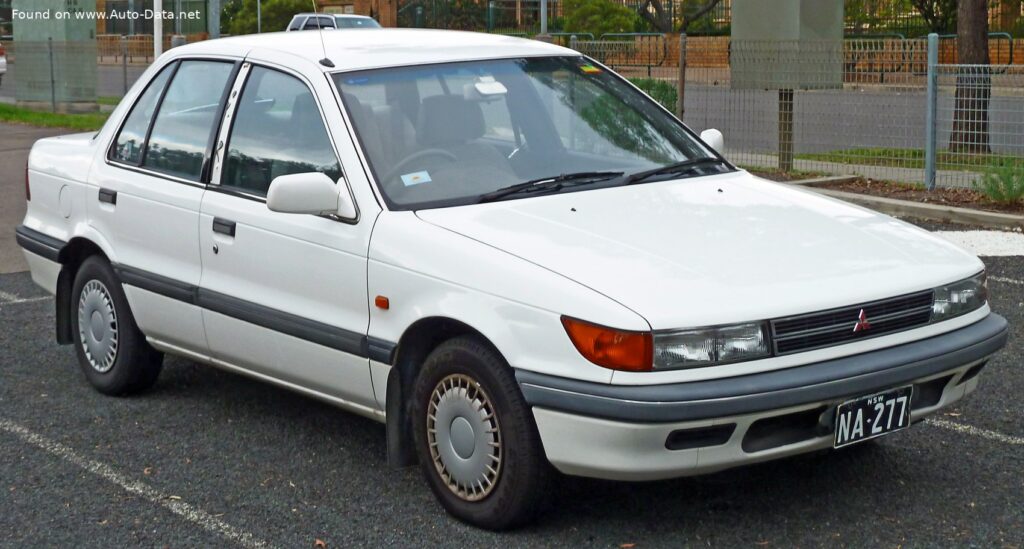
The Mitsubishi Lancer IV GTi 1.8 16V adopted a classic four-door sedan body type, offering seating for five occupants. Its design language was characteristic of early 1990s Japanese automotive aesthetics: clean lines, a relatively low beltline, and a focus on aerodynamic efficiency without overly aggressive styling cues. Unlike some of its more flamboyant competitors, the GTi’s exterior modifications were subtle, often limited to unique alloy wheels, a discreet rear spoiler, and GTi badging, signaling its performance potential without being ostentatious. This “sleeper” appeal was part of its charm, allowing it to blend seamlessly into traffic while possessing significant underlying capability.
Inside, the Lancer GTi provided a functional and driver-focused cabin. While specific luxury features might have been sparse compared to contemporary premium vehicles, the emphasis was on ergonomics and utility. Sport-bolstered seats would have been standard to hold occupants firmly during spirited driving. The instrument cluster was clear and easy to read, providing all necessary information for the driver. Being a sedan, it offered practical rear-seat space and a decent trunk capacity, maintaining its versatility as a family vehicle or a comfortable daily commuter.
In terms of advanced features for its time, the Lancer GTi was equipped with an Anti-lock Braking System (ABS), a significant safety enhancement for the early 1990s, especially in a performance car. This system provided improved control during emergency braking maneuvers, a crucial aspect given the car’s speed capabilities. The braking system itself was robust, featuring ventilated discs at the front and disc brakes at the rear, ensuring consistent stopping power. Steering was managed by a hydraulic rack and pinion system, offering direct feedback and a connected feel to the road, which was highly valued by enthusiasts.
The car rode on 14-inch wheel rims, fitted with 185/50 R14 tires. While these tire dimensions might seem modest by today’s standards, they were appropriate for the vehicle’s weight and power, contributing to agile handling and a communicative ride. The front-wheel-drive architecture, combined with a well-tuned suspension (though specific details are not provided, it can be inferred to be firmer than standard Lancer models), ensured predictable handling characteristics, making it an enjoyable car to drive on winding roads.
Technical Specifications
| Specification | Value |
|---|---|
| Brand | Mitsubishi |
| Model | Lancer |
| Generation | Lancer IV |
| Type (Engine) | GTi 1.8 16V (140 Hp) |
| Start of Production | 1992 year |
| End of Production | 1993 year |
| Powertrain Architecture | Internal Combustion engine |
| Body Type | Sedan |
| Seats | 5 |
| Doors | 4 |
| Fuel Type | Petrol (Gasoline) |
| Fuel Consumption (Urban) | 11.1 l/100 km (21.2 US mpg) |
| Fuel Consumption (Extra Urban) | 6.6 l/100 km (35.6 US mpg) |
| Fuel Consumption (Combined) | 8.5 l/100 km (27.7 US mpg) |
| Acceleration 0 – 60 mph | 7.2 sec |
| Acceleration 0 – 100 km/h | 7.6 sec |
| Maximum Speed | 240 km/h (149.13 mph) |
| Power | 140 Hp @ 6500 rpm |
| Torque | 168 Nm (123.91 lb.-ft.) |
| Number of Cylinders | 4 |
| Engine Configuration | Inline |
| Fuel Injection System | Multi-port manifold injection |
| Engine Aspiration | Naturally aspirated engine |
| Valvetrain | DOHC |
| Kerb Weight | 1040 kg (2292.81 lbs.) |
| Weight-to-Power Ratio | 7.4 kg/Hp (134.6 Hp/tonne) |
| Weight-to-Torque Ratio | 6.2 kg/Nm (161.5 Nm/tonne) |
| Fuel Tank Capacity | 50 l (13.21 US gal) |
| Drivetrain Architecture | Internal Combustion engine drives the front wheels |
| Drive Wheel | Front wheel drive |
| Number of Gears and Type of Gearbox | 5 gears, manual transmission |
| Front Brakes | Ventilated discs |
| Rear Brakes | Disc |
| Assisting Systems | ABS (Anti-lock braking system) |
| Steering Type | Steering rack and pinion |
| Power Steering | Hydraulic Steering |
| Tires Size | 185/50 R14 |
| Wheel Rims Size | 14 inch |
Legacy and Market Impact
The Mitsubishi Lancer IV GTi 1.8 16V carved out a niche for itself as a respected, if somewhat under-the-radar, performance sedan in its primary markets. It didn’t achieve the widespread fame of its rally-bred Lancer Evolution successors, nor was it ever officially sold in the United States, which limits its recognition among American enthusiasts. However, for those in Europe, Japan, and other regions where it was available, it was celebrated for its blend of everyday practicality and genuine driving thrills.
Its reputation was built on reliability, a characteristic often associated with Japanese engineering, combined with an engaging powertrain. The naturally aspirated 1.8-liter DOHC engine was praised for its eagerness to rev and its strong performance figures, especially when coupled with the precise 5-speed manual gearbox and front-wheel-drive dynamics. It offered a purer, more direct driving experience compared to some of the heavier, more complex vehicles that began to emerge later in the decade.
In its competitive landscape, the Lancer GTi faced formidable rivals. In Europe, it contended with established hot hatches and sedans like the Volkswagen Golf GTi, Opel Kadett GSi (Vauxhall Astra GTE in the UK), Ford Escort RS2000, and even performance variants of the Honda Civic and Nissan Pulsar. While some rivals offered more aggressive styling or, in the case of the Pulsar GTi-R, all-wheel-drive rally-derived technology, the Lancer GTi distinguished itself with its balanced approach: a competent chassis, a rev-happy engine, and a practical sedan body. Its “sleeper” appeal meant it often surprised larger, more overtly sporty cars.
Historically, the Lancer IV GTi 1.8 16V stands as an important step in Mitsubishi’s performance car evolution. It demonstrated the brand’s ability to produce highly capable compact cars before the Lancer Evolution series captured global attention with its rally successes. While not a direct ancestor in terms of drivetrain (the Evos were all-wheel-drive and turbocharged), it laid some of the groundwork by proving the Lancer platform’s potential for high-performance applications. It showcased Mitsubishi’s commitment to engineering excellence and its understanding of what made a car fun to drive, offering a compelling option for enthusiasts who appreciated performance without sacrificing practicality.
Today, finding a well-preserved Lancer IV GTi 1.8 16V can be challenging, particularly outside its original markets. However, it remains a beloved classic among a dedicated group of enthusiasts who recognize its understated charm and potent performance. It serves as a reminder of an era when compact, naturally aspirated sedans offered a pure, unadulterated driving experience, and Mitsubishi was at the forefront of delivering such vehicles.