The Mitsubishi Lancer IV Hatchback 1.6 16V (113 Hp): A Global Compact Contender of the Early 1990s
The Mitsubishi Lancer IV Hatchback 1.6 16V (113 Hp) represents a significant chapter in the history of Mitsubishi Motors’ global compact car strategy. Introduced in 1992 and produced until 1994, this specific variant of the fourth-generation Lancer hatchback was a testament to the Japanese automaker’s commitment to delivering practical, efficient, and surprisingly peppy vehicles to a diverse international market. While the Lancer nameplate garnered considerable recognition in North America, often sold alongside its platform twin, the Mirage, this five-door hatchback configuration was particularly popular in European and Asian markets, where its versatility and economical operation resonated strongly with consumers.
At a time when the compact car segment was fiercely competitive, the Mitsubishi Lancer IV Hatchback aimed to carve out its niche by offering a compelling blend of modern design, a responsive powertrain, and the renowned reliability associated with Japanese engineering. The 1.6-liter, 16-valve engine, delivering 113 horsepower, placed it squarely in the performance-oriented end of the mainstream compact class, appealing to drivers seeking more than just basic transportation. This model served as a cornerstone of Mitsubishi’s lineup, providing an accessible entry point into their range while upholding the brand’s reputation for quality and innovation.
Engine and Performance: The Heart of the Mitsubishi Lancer IV Hatchback
Under the hood of the Mitsubishi Lancer IV Hatchback 1.6 16V (113 Hp) lay the robust 4G92 engine, a 1.6-liter (1598 cm³ or 97.52 cu. in.) naturally aspirated inline-four powerplant. This engine was a prime example of early 1990s Japanese engineering, featuring a 16-valve cylinder head design that allowed for improved airflow and, consequently, better power delivery and efficiency compared to older 8-valve designs. Fueling was handled by a multi-port manifold injection system, a sophisticated setup for its time that ensured precise fuel delivery to each cylinder, optimizing combustion and reducing emissions.
The 4G92 engine produced a healthy 113 horsepower, translating to an impressive power-per-liter ratio of 70.7 HP/l, a figure that was quite competitive within its class. Torque output stood at 137 Nm (101.05 lb-ft), providing ample pulling power for daily driving and highway cruising. Mated exclusively to a crisp-shifting 5-speed manual transmission, the powertrain delivered a direct and engaging driving experience. Power was sent to the front wheels, a common and efficient layout for compact cars, contributing to predictable handling characteristics.
Performance figures for the Lancer IV Hatchback 1.6 16V were commendably brisk. It could accelerate from 0 to 60 mph in just 9.3 seconds, a respectable time that allowed it to easily keep pace with traffic and offered a degree of spirited driving enjoyment. The top speed was rated at 118.06 mph (190 km/h), making it a capable performer on unrestricted highways where applicable. The vehicle’s relatively light curb weight of 2314.85 lbs (1050 kg) contributed significantly to its agility and performance, resulting in a favorable weight-to-power ratio of 9.3 kg/Hp, or 107.6 Hp/tonne.
Design and Features: Practicality Meets Early 90s Aerodynamics
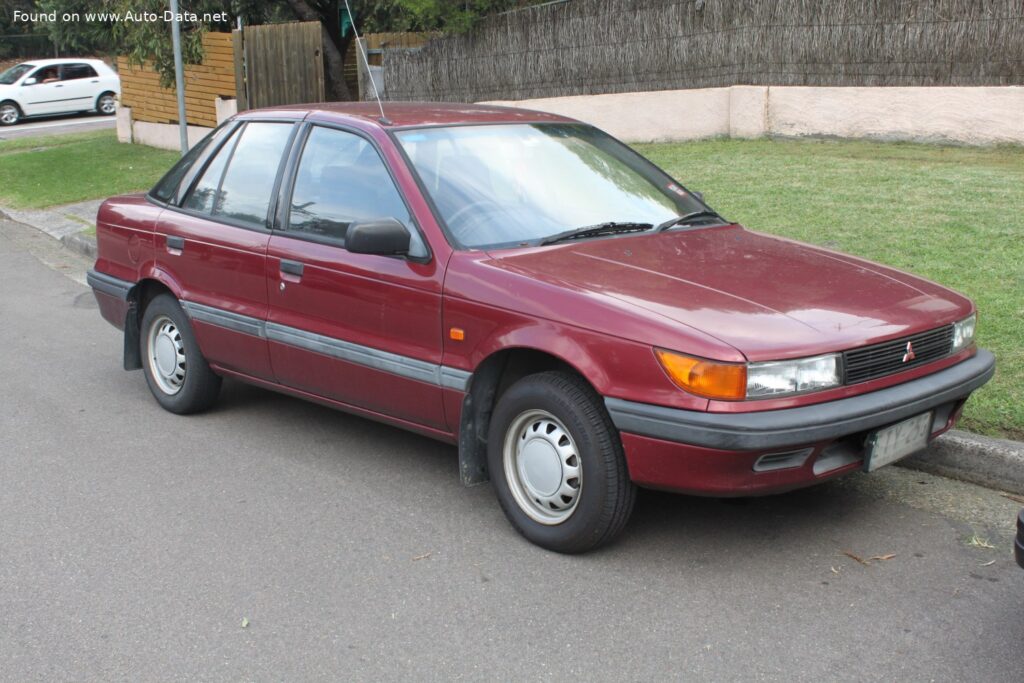
The design of the Mitsubishi Lancer IV Hatchback was characteristic of the early 1990s, emphasizing smooth, rounded lines that prioritized aerodynamics and a modern aesthetic. The five-door hatchback body style was inherently practical, offering excellent cargo versatility thanks to its large rear opening and folding rear seats. This design choice made it a popular option for families and individuals who required more utility than a traditional sedan could provide, without sacrificing the compact footprint necessary for urban environments.
Inside, the Lancer IV Hatchback was designed to accommodate five occupants comfortably. The cabin layout was straightforward and functional, with controls logically placed for ease of use. While specific luxury features varied by market and trim level, the core focus remained on durability and ergonomic efficiency. Materials, though not always premium, were chosen for their hard-wearing qualities, ensuring longevity in day-to-day use. The instrument cluster was clear and concise, providing drivers with essential information at a glance.
Safety features for the era included standard seatbelts and, in some markets, optional driver-side airbags, reflecting the evolving safety standards of the time. The vehicle’s braking system comprised ventilated discs at the front, offering superior stopping power and heat dissipation, paired with reliable drum brakes at the rear. This combination was standard for many compact cars of its generation, providing adequate braking performance for its intended use. The fuel tank capacity of 11.89 US gallons (45 liters) provided a decent range, making it suitable for longer journeys as well as city commuting.
Technical Specifications
| Category | Specification |
|---|---|
| Brand | Mitsubishi |
| Model | Lancer IV Hatchback |
| Type (Engine) | 1.6 16V (113 Hp) |
| Production Start | 1992 year |
| Production End | 1994 year |
| Powertrain Architecture | Internal Combustion engine |
| Body type | Hatchback |
| Seats | 5 |
| Doors | 5 |
| Fuel Type | Petrol (Gasoline) |
| Acceleration 0 – 60 mph | 9.3 sec |
| Maximum speed | 118.06 mph (190 km/h) |
| Weight-to-power ratio | 9.3 kg/Hp, 107.6 Hp/tonne |
| Weight-to-torque ratio | 7.7 kg/Nm, 130.5 Nm/tonne |
| Power | 113 Hp |
| Power per liter | 70.7 Hp/l |
| Torque | 101.05 lb-ft (137 Nm) |
| Engine Model/Code | 4G92 |
| Engine displacement | 1598 cm³ (97.52 cu. in.) |
| Number of cylinders | 4 |
| Engine configuration | Inline |
| Fuel injection system | Multi-port manifold injection |
| Engine aspiration | Naturally aspirated engine |
| Kerb Weight | 2314.85 lbs (1050 kg) |
| Fuel tank capacity | 11.89 US gal (45 l) |
| Drivetrain Architecture | Front-wheel drive (ICE drives front wheels) |
| Drive wheel | Front wheel drive |
| Number of gears and type of gearbox | 5 gears, manual transmission |
| Front brakes | Ventilated discs |
| Rear brakes | Drum |
Legacy and Market Impact
The Mitsubishi Lancer IV Hatchback, particularly the 1.6 16V (113 Hp) variant, played a crucial role in Mitsubishi’s global presence during the early 1990s. While the Lancer nameplate would later become synonymous with the high-performance Evolution models, this mainstream hatchback solidified the Lancer’s reputation as a reliable, economical, and unexpectedly engaging compact car. It competed in a crowded segment against formidable rivals such as the Honda Civic, Toyota Corolla, Nissan Sentra, and European stalwarts like the Volkswagen Golf and Opel Astra.
What set the Lancer apart was its blend of practical utility, spirited performance for its class, and Mitsubishi’s growing reputation for robust engineering. The 4G92 engine, in particular, was lauded for its smooth operation and efficiency, contributing to the car’s appeal among a wide demographic. Its front-wheel-drive architecture and well-tuned suspension offered a comfortable ride with competent handling, making it suitable for both daily commuting and longer journeys.
The impact of the Lancer IV Hatchback extended beyond mere sales figures. It reinforced Mitsubishi’s image as a manufacturer capable of producing well-rounded vehicles that offered value without compromising on driving enjoyment. In markets where hatchbacks were a dominant force, this Lancer variant provided a compelling alternative, offering a distinct Japanese flavor to the compact car landscape. Its longevity and durability meant that many of these vehicles continued to serve their owners for many years, further cementing Mitsubishi’s reputation for reliability.
Ultimately, the Mitsubishi Lancer IV Hatchback 1.6 16V (113 Hp) stands as a testament to an era when compact cars were evolving rapidly, offering increasing levels of refinement, performance, and technology. It was a car that perfectly encapsulated the brand’s philosophy of delivering quality and performance in an accessible package, leaving a lasting mark on the global automotive scene and contributing to the enduring legacy of the Mitsubishi Lancer nameplate.