The Mitsubishi Lancer IX 2.0i (150 Hp): A Global Contender in the Compact Sedan Segment
The Mitsubishi Lancer, a nameplate synonymous with accessible performance and robust reliability, saw its ninth generation, internally referred to as the Lancer IX, make its debut in 2010. Produced until 2015, this iteration continued the Lancer’s legacy as a formidable competitor in the global compact sedan market. While the Lancer name often evokes images of its rally-bred Evolution counterpart, the mainstream variants, such as the Mitsubishi Lancer IX 2.0i (150 Hp), were the true workhorses, offering a blend of practicality, efficiency, and a touch of sporty demeanor to a broad audience.
The Lancer IX, known as the “Lancer EX” in some Asian markets and simply “Lancer” in North America and Europe, represented a significant evolution in design and engineering from its predecessors. It adopted a more aggressive, contemporary aesthetic that mirrored the styling cues of its more potent Evolution X sibling, providing a visually appealing package that stood out in its segment. The 2.0i variant, specifically with its 150 horsepower engine, was a popular choice in numerous international markets, balancing everyday usability with adequate power for both urban commuting and highway cruising. This article delves into the specifics of this particular model, highlighting its technical prowess, design philosophy, and its enduring impact on the automotive landscape.
Engine and Performance of the Mitsubishi Lancer IX 2.0i (150 Hp)
At the heart of the Mitsubishi Lancer IX 2.0i (150 Hp) lies the capable 4B11 naturally aspirated engine, a 2.0-liter (1998 cm3 or 121.93 cu. in.) inline four-cylinder powerplant. This engine, shared with other Mitsubishi models of the era, was engineered for a balance of performance and fuel efficiency, a critical factor in the compact sedan segment. With a DOHC (Double Overhead Camshaft) valvetrain and multi-port manifold injection, the engine delivered a respectable 150 horsepower at 6000 rpm, translating to a power-per-liter output of approximately 75.1 Hp/l. Torque figures stood at 146.04 lb.-ft. (198 Nm) available at 4250 rpm, providing sufficient pulling power across a usable rev range.
Power was channeled to the front wheels via a standard 5-speed manual transmission, a choice that appealed to drivers who preferred a more engaging driving experience and offered better fuel economy compared to automatic options of the time. This powertrain combination allowed the Lancer IX 2.0i to accelerate from 0 to 60 mph in a brisk 9 seconds (0-100 km/h in 9.5 seconds), with a top speed reaching 124.27 mph (200 km/h). These figures positioned it competitively against other naturally aspirated compact sedans of its class, offering a peppy feel for daily driving.
Fuel economy was a strong suit for the Lancer IX 2.0i, especially for a vehicle of its power output. The combined cycle reported an average of 29 US mpg (8.1 l/100 km), with extra-urban driving achieving an impressive 35.6 US mpg (6.6 l/100 km). Even in city conditions, it managed a reasonable 21.8 US mpg (10.8 l/100 km). Adhering to the Euro 4 emission standard, the Lancer IX 2.0i demonstrated Mitsubishi’s commitment to environmental considerations within its primary markets.
Design and Features
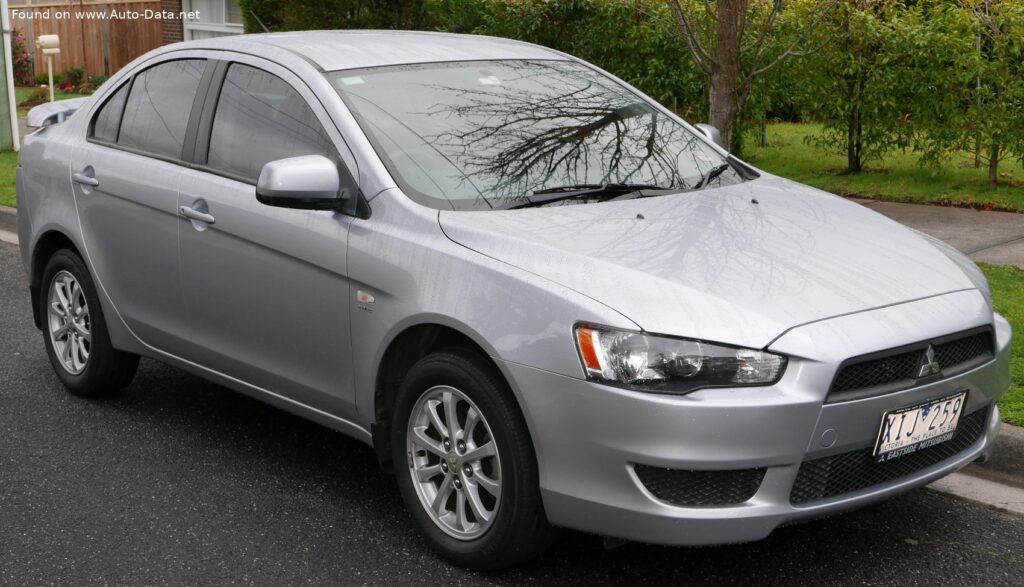
The Mitsubishi Lancer IX adopted a distinct and modern design language that set it apart from its more conservative predecessors. The sedan body type, with its four doors and seating for five occupants, featured a bold “shark nose” front fascia, characterized by a large, trapezoidal grille and angular headlights. This aggressive styling was a direct influence from the Lancer Evolution X, lending the standard Lancer a sportier aesthetic than many of its rivals.
Measuring 179.92 inches (4570 mm) in length, 69.29 inches (1760 mm) in width, and 59.25 inches (1505 mm) in height, the Lancer IX offered a spacious cabin for its class. The wheelbase of 103.74 inches (2635 mm) contributed to a stable ride and adequate legroom for rear passengers. With a curb weight of 3009.31 lbs. (1365 kg), the car offered a solid feel on the road without being excessively heavy, which benefited both performance and fuel efficiency. The compact turning circle of 35.43 feet (10.8 m) made it maneuverable in urban environments.
Underneath its stylish exterior, the Lancer IX 2.0i featured a robust suspension setup, with a spring strut system at the front and a wishbone arrangement at the rear. This combination aimed to provide a comfortable ride while maintaining competent handling dynamics. Braking duties were handled by ventilated discs at the front and solid discs at the rear, complemented by an Anti-lock Braking System (ABS), a crucial safety feature for improved control during emergency stops. The steering system utilized a rack and pinion setup, offering direct and responsive feedback to the driver. The vehicle rode on 205/60 R16 tires mounted on 6J x 16-inch wheel rims, providing a good balance of grip and ride comfort.
While specific trim levels and interior features would vary by market, typical amenities for a vehicle of this segment and era included air conditioning, power windows and locks, and a basic audio system. The focus was on practicality, durability, and a straightforward user experience, consistent with the Lancer’s reputation as a reliable daily driver.
Technical Specifications: Mitsubishi Lancer IX 2.0i (150 Hp)
Below is a comprehensive table detailing the technical specifications for the Mitsubishi Lancer IX 2.0i (150 Hp) model, produced between 2010 and 2015.
| Category | Specification |
|---|---|
| Brand | Mitsubishi |
| Model | Lancer |
| Generation | Lancer IX |
| Type (Engine) | 2.0i (150 Hp) |
| Production Start | 2010 year |
| Production End | 2015 year |
| Powertrain Architecture | Internal Combustion Engine |
| Body Type | Sedan |
| Seats | 5 |
| Doors | 4 |
| Performance Specs | |
| Fuel Consumption (Urban) | 21.8 US mpg (10.8 l/100 km) |
| Fuel Consumption (Extra Urban) | 35.6 US mpg (6.6 l/100 km) |
| Fuel Consumption (Combined) | 29 US mpg (8.1 l/100 km) |
| Fuel Type | Petrol (Gasoline) |
| Acceleration 0 – 60 mph | 9.0 sec |
| Acceleration 0 – 100 km/h | 9.5 sec |
| Maximum Speed | 124.27 mph (200 km/h) |
| Emission Standard | Euro 4 |
| Weight-to-Power Ratio | 9.1 kg/Hp, 109.9 Hp/tonne |
| Weight-to-Torque Ratio | 6.9 kg/Nm, 145.1 Nm/tonne |
| Engine Specs | |
| Power | 150 Hp @ 6000 rpm |
| Power per Liter | 75.1 Hp/l |
| Torque | 146.04 lb.-ft. (198 Nm) @ 4250 rpm |
| Engine Layout | Front, Transverse |
| Engine Model/Code | 4B11 |
| Engine Displacement | 121.93 cu. in. (1998 cm3) |
| Number of Cylinders | 4 |
| Engine Configuration | Inline |
| Number of Valves per Cylinder | 4 |
| Fuel Injection System | Multi-port manifold injection |
| Engine Aspiration | Naturally aspirated engine |
| Valvetrain | DOHC |
| Engine Oil Capacity | 4.54 US qt (4.3 l) |
| Coolant Capacity | 7.4 US qt (7 l) |
| Space, Volume and Weights | |
| Kerb Weight | 3009.31 lbs. (1365 kg) |
| Max. Weight | 4078.55 lbs. (1850 kg) |
| Max Load | 1069.24 lbs. (485 kg) |
| Fuel Tank Capacity | 15.59 US gal (59 l) |
| Dimensions | |
| Length | 179.92 in. (4570 mm) |
| Width | 69.29 in. (1760 mm) |
| Height | 59.25 in. (1505 mm) |
| Wheelbase | 103.74 in. (2635 mm) |
| Front Track | 60.24 in. (1530 mm) |
| Rear Track | 60.24 in. (1530 mm) |
| Minimum Turning Circle | 35.43 ft. (10.8 m) |
| Drivetrain, Brakes and Suspension Specs | |
| Drivetrain Architecture | Internal combustion engine drives the front wheels. |
| Drive Wheel | Front wheel drive |
| Number of Gears & Gearbox Type | 5 gears, manual transmission |
| Front Suspension | Spring Strut |
| Rear Suspension | Wishbone |
| Front Brakes | Ventilated discs |
| Rear Brakes | Disc |
| Assisting Systems | ABS (Anti-lock braking system) |
| Steering Type | Steering rack and pinion |
| Tires Size | 205/60 R16 |
| Wheel Rims Size | 6J x 16 |
Legacy and Market Impact
The Mitsubishi Lancer has a long and storied history, and the ninth generation, including the 2.0i (150 Hp) variant, played a crucial role in maintaining the brand’s presence in the highly competitive compact sedan segment from 2010 to 2015. While it might not have garnered the same enthusiast following as the Lancer Evolution, the standard Lancer IX carved out its niche as a reliable, practical, and somewhat understated option for buyers seeking value and dependability.
In various markets, the Lancer IX 2.0i competed directly with established players like the Honda Civic, Toyota Corolla, Mazda3, Ford Focus, and Chevrolet Cruze. Its aggressive styling, which borrowed heavily from the revered Evo, gave it a visual edge that appealed to a younger demographic or those who simply appreciated a sportier look without the associated performance or cost. Its reputation for robust engineering and durability, hallmarks of Mitsubishi vehicles, also contributed to its appeal, particularly in regions where reliability is a paramount concern.
The Lancer IX’s market impact was significant in demonstrating Mitsubishi’s ability to produce a globally competitive compact sedan that offered a compelling package of style, performance, and efficiency. Although Mitsubishi’s focus in subsequent years shifted more towards SUVs and crossovers, the Lancer IX stands as a testament to the brand’s capability in the passenger car segment. It represented a period where Mitsubishi was still a strong contender in traditional car categories, offering a distinct alternative to its Japanese and American rivals.
Today, the Lancer IX 2.0i (150 Hp) remains a popular choice in the used car market, particularly in regions where it was widely sold. Its straightforward mechanicals, reasonable running costs, and decent performance make it a practical and affordable option for those seeking a reliable daily driver. The legacy of the Lancer name continues to resonate with many, and the ninth generation, especially in its well-rounded 2.0i guise, is a solid chapter in that enduring story.