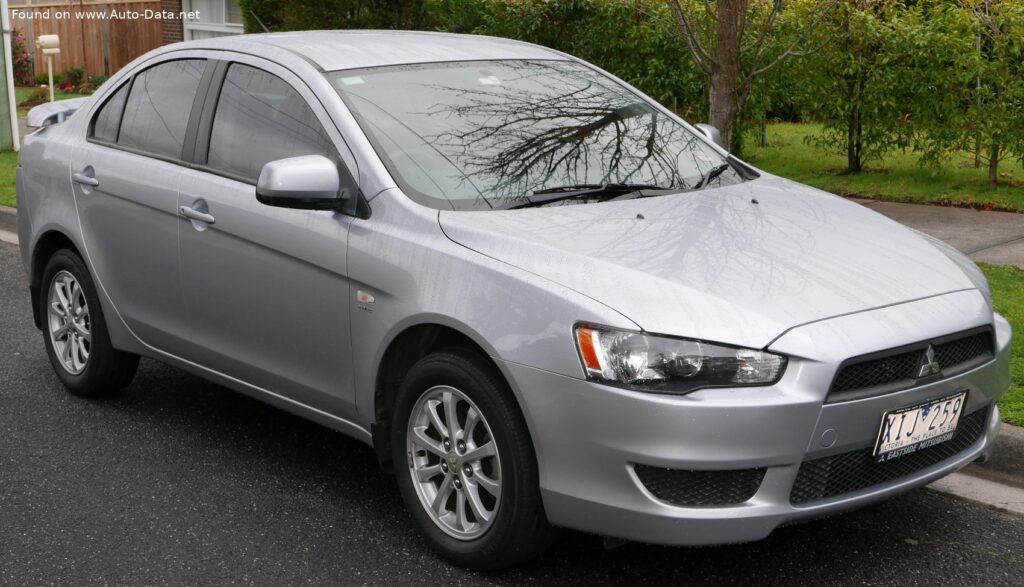
Introduction: The Mitsubishi Lancer IX 2.0i (150 Hp) 4WD
The Mitsubishi Lancer, a nameplate synonymous with durability and a motorsport heritage, saw its ninth generation (often referred to as Lancer X in many markets, but specifically designated Lancer IX in the provided data context for this variant) produced between 2010 and 2015. This particular iteration, the Mitsubishi Lancer IX 2.0i (150 Hp) 4WD, represented a compelling offering in the global compact sedan segment. While the Lancer had a strong presence in North America, this specific powertrain and all-wheel-drive combination, paired with a manual transmission, was particularly significant in European and Asian markets where drivers often sought enhanced traction and a more engaging driving experience from their daily compacts.
Positioned as a practical yet capable four-door sedan, the Lancer IX 2.0i (150 Hp) 4WD aimed to bridge the gap between Mitsubishi’s more utilitarian offerings and its legendary high-performance Evolution models. It provided a balanced package of a naturally aspirated 2.0-liter engine, a robust all-wheel-drive system, and a traditional manual gearbox, catering to consumers who valued reliability, all-weather capability, and a degree of driver involvement not always found in its front-wheel-drive competitors. This variant underscored Mitsubishi’s engineering prowess, offering a sophisticated drivetrain architecture in an accessible, family-friendly package.
Engineering the Mitsubishi Lancer IX: Powertrain and Performance
At the heart of the Mitsubishi Lancer IX 2.0i (150 Hp) 4WD lies a capable 2.0-liter (1998 cm³) naturally aspirated inline-four engine, designated by Mitsubishi as the 4B11. This powerplant, featuring a Double Overhead Camshaft (DOHC) valvetrain with four valves per cylinder, was engineered for a blend of smooth power delivery and dependable performance. It produced a respectable 150 horsepower at 6000 rpm, translating to a power-per-liter output of 75.1 Hp/l, which was competitive for a non-turbocharged engine in its class during its production run.
Torque output was rated at 198 Nm, or approximately 146.04 lb.-ft., peaking at 4250 rpm. This mid-range torque delivery ensured adequate responsiveness in various driving scenarios, from city commuting to highway cruising. The engine utilized a multi-port manifold injection system, a proven and reliable fuel delivery method that contributed to its Euro 4 emission standard compliance. With an engine oil capacity of 4.3 liters (4.54 US quarts) and a coolant capacity of 7 liters (7.4 US quarts), the 4B11 was designed for straightforward maintenance and long-term durability, hallmarks of Mitsubishi engineering.
A defining characteristic of this Lancer variant was its sophisticated powertrain architecture. Power was channeled through a precise 5-speed manual transmission, offering drivers direct control over the engine’s output. Crucially, the vehicle featured an all-wheel-drive (4×4) system, a significant advantage over many of its front-wheel-drive rivals. This system provided superior traction and stability, particularly beneficial in adverse weather conditions