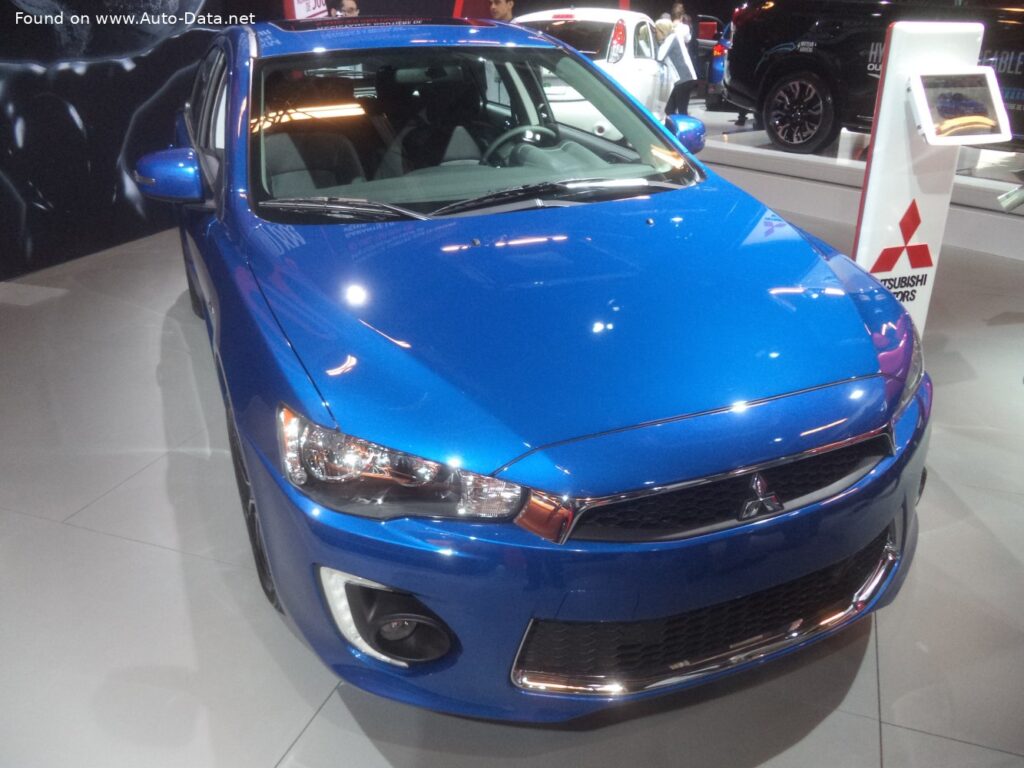
The Mitsubishi Lancer Sportback IX (facelift 2015): A Global Compact Player
The Mitsubishi Lancer, a nameplate synonymous with durability and, in some variants, high-performance rallying, has had a long and varied history across global markets. The Mitsubishi Lancer Sportback IX (facelift 2015) represents a specific iteration of the ninth-generation Lancer, specifically tailored for markets where compact hatchbacks are highly popular, such as Europe and parts of Asia. Produced from 2015 to 2017, this model served as a practical, family-oriented five-door hatchback, offering a blend of Mitsubishi’s established reliability with modern efficiency and utility. While the Lancer sedan had a more prominent, albeit declining, presence in the North American market during its later years, the Sportback variant was never officially offered in the United States, focusing instead on regions with a strong demand for versatile compact vehicles. This particular version, powered by a 1.6-liter naturally aspirated engine delivering 117 horsepower, was positioned as a sensible choice for daily commuting and light family duties, emphasizing fuel economy and a compliant ride.
Engine & Performance: The Efficient Heart of the Mitsubishi Lancer Sportback IX (facelift 2015)
Under the hood of the Mitsubishi Lancer Sportback IX (facelift 2015) resided a 1.6-liter (1590 cm3 or 97.03 cubic inches) inline four-cylinder engine, designated by Mitsubishi as the 4A92. This naturally aspirated unit featured a Double Overhead Camshaft (DOHC) valvetrain with four valves per cylinder, optimizing airflow for both power and efficiency. Fuel delivery was managed by a multi-port manifold injection system, a tried-and-true method for reliable fuel atomization. With a compression ratio of 11:1, the engine produced a respectable 117 horsepower at 6000 rpm and 113.58 lb.-ft. of torque (154 Nm) at 4000 rpm. This output translated to a power-per-liter rating of 73.6 HP/l, indicative of a well-balanced, non-turbocharged engine designed for everyday use rather than outright performance.
Power was sent to the front wheels via a standard five-speed manual transmission, a common and efficient setup for compact cars of this segment. This drivetrain architecture contributed to the vehicle’s commendable fuel economy figures: an estimated 33.6 US mpg in urban driving, 50 US mpg on the extra-urban cycle, and a combined average of 42.8 US mpg (5.5 liters per 100 km). These figures, coupled with CO2 emissions of 128 g/km, allowed the Lancer Sportback to meet stringent Euro 6 emission standards, showcasing Mitsubishi’s commitment to environmental responsibility in its global lineup. In terms of acceleration, the 1.6-liter Sportback could achieve 0 to 60 mph in a reasonable 10.5 seconds, with a top speed of 116.82 mph (188 km/h). Its weight-to-power ratio of 11.1 kg/Hp (90 Hp/tonne) and weight-to-torque ratio of 8.4 kg/Nm (118.5 Nm/tonne) further solidified its positioning as a practical and economical vehicle.
Design & Features: Practicality Meets Refinement
The Mitsubishi Lancer Sportback IX (facelift 2015) adopted a five-door hatchback body style, a highly practical configuration offering flexible cargo and passenger space. The facelift introduced subtle styling updates to the front fascia, grille, and lighting elements, aiming to keep the Lancer’s design fresh and competitive within its segment. Its overall dimensions – a length of 182.68 inches, a width of 69.29 inches, and a height of 59.25 inches – placed it firmly in the compact car category, making it maneuverable in urban environments while still providing ample interior room for five occupants. The wheelbase measured 103.74 inches, contributing to a stable ride and generous legroom.
The Sportback’s design prioritized utility. The trunk (boot) space offered a minimum of 12.15 cubic feet (344 liters), which could be expanded significantly to 47.64 cubic feet (1349 liters) by folding down the rear seats, rivaling some smaller SUVs in cargo capacity. This versatility was a key selling point for families and individuals requiring adaptable storage. Standard features for the era included essential safety systems like an Anti-lock Braking System (ABS) for enhanced stopping control. The vehicle utilized a robust suspension setup, featuring independent McPherson struts with coil springs and an anti-roll bar at the front, complemented by an independent multi-link spring suspension with a stabilizer bar at the rear. This configuration aimed to provide a comfortable ride while maintaining predictable handling. Braking was handled by ventilated discs at the front and solid discs at the rear, ensuring adequate stopping power for its performance class. Electric power steering made for light and responsive handling, especially beneficial for city driving and parking maneuvers. The car rode on 205/60 R16 tires fitted to 6.5J x 16 wheel rims, a common size for balancing ride comfort and grip.
Technical Specifications
| Category | Specification |
|---|---|
| General Information | |
| Brand | Mitsubishi |
| Model | Lancer |
| Generation | Lancer Sportback IX (facelift 2015) |
| Type (Engine) | 1.6 (117 Hp) |
| Start of Production | 2015 |
| End of Production | 2017 |
| Powertrain Architecture | Internal Combustion Engine |
| Body Type | Hatchback |
| Seats | 5 |
| Doors | 5 |
| Performance Specs | |
| Fuel Consumption (Urban) | 33.6 US mpg (7 l/100 km) |
| Fuel Consumption (Extra Urban) | 50 US mpg (4.7 l/100 km) |
| Fuel Consumption (Combined) | 42.8 US mpg (5.5 l/100 km) |
| CO2 Emissions | 128 g/km |
| Fuel Type | Petrol (Gasoline) |
| Acceleration 0 – 60 mph | 10.5 sec |
| Acceleration 0 – 62 mph (0-100 km/h) | 11.1 sec |
| Maximum Speed | 116.82 mph (188 km/h) |
| Emission Standard | Euro 6 |
| Weight-to-Power Ratio | 11.1 kg/Hp (90 Hp/tonne) |
| Weight-to-Torque Ratio | 8.4 kg/Nm (118.5 Nm/tonne) |
| Engine Specs | |
| Power | 117 Hp @ 6000 rpm |
| Power per Liter | 73.6 Hp/l |
| Torque | 113.58 lb.-ft. @ 4000 rpm (154 Nm) |
| Engine Layout | Front, Transverse |
| Engine Model/Code | 4A92 |
| Engine Displacement | 1.6 liters (1590 cm3 / 97.03 cu. in.) |
| Number of Cylinders | 4 |
| Engine Configuration | Inline |
| Cylinder Bore | 2.95 inches (75 mm) |
| Piston Stroke | 3.54 inches (90 mm) |
| Compression Ratio | 11:1 |
| Number of Valves per Cylinder | 4 |
| Fuel Injection System | Multi-port manifold injection |
| Engine Aspiration | Naturally aspirated |
| Valvetrain | DOHC |
| Engine Oil Capacity | 4.44 US qt (4.2 l) |
| Coolant Capacity | 6.34 US qt (6 l) |
| Space, Volume and Weights | |
| Kerb Weight | 2866.01 lbs (1300 kg) |
| Max. Weight | 3968.32 lbs (1800 kg) |
| Max Load | 1102.31 lbs (500 kg) |
| Trunk (Boot) Space – Minimum | 12.15 cu. ft. (344 l) |
| Trunk (Boot) Space – Maximum | 47.64 cu. ft. (1349 l) |
| Fuel Tank Capacity | 15.59 US gal (59 l) |
| Max. Roof Load | 176.37 lbs (80 kg) |
| Permitted Trailer Load with Brakes (12%) | 2425.08 lbs (1100 kg) |
| Permitted Trailer Load without Brakes | 1212.54 lbs (550 kg) |
| Permitted Towbar Download | 121.25 lbs (55 kg) |
| Dimensions | |
| Length | 182.68 inches (4640 mm) |
| Width | 69.29 inches (1760 mm) |
| Width Including Mirrors | 79.88 – 80.47 inches (2029-2044 mm) |
| Height | 59.25 inches (1505 mm) |
| Wheelbase | 103.74 inches (2635 mm) |
| Front Track | 60.24 inches (1530 mm) |
| Rear (Back) Track | 60.24 inches (1530 mm) |
| Front Overhang | 39.76 inches (1010 mm) |
| Rear Overhang | 39.17 inches (995 mm) |
| Ride Height (Ground Clearance) | 5.51 inches (140 mm) |
| Minimum Turning Circle (Turning Diameter) | 32.81 ft (10.0 m) |
| Drivetrain, Brakes and Suspension Specs | |
| Drivetrain Architecture | Front-wheel drive, Internal Combustion Engine |
| Drive Wheel | Front-wheel drive |
| Number of Gears and Type of Gearbox | 5 gears, manual transmission |
| Front Suspension | Independent, McPherson type with coil spring and anti-roll bar |
| Rear Suspension | Independent multi-link spring suspension with stabilizer |
| Front Brakes | Ventilated discs |
| Rear Brakes | Disc |
| Assisting Systems | ABS (Anti-lock Braking System) |
| Steering Type | Steering rack and pinion |
| Power Steering | Electric Steering |
| Tires Size | 205/60 R16 |
| Wheel Rims Size | 6.5J x 16 |
Legacy & Market Impact of the Mitsubishi Lancer Sportback
The Mitsubishi Lancer, in its various forms, carved out a reputation globally as a reliable and affordable compact car. The Sportback variant, particularly the IX generation and its 2015 facelift, played a crucial role in Mitsubishi’s lineup in markets outside of North America where the hatchback body style commands significant market share. In Europe, for instance, it competed against established players like the Volkswagen Golf, Ford Focus, Opel Astra, and Honda Civic hatchback. In Asian markets, it faced rivals such as the Toyota Corolla hatchback (Auris), Mazda3, and Hyundai i30. Its appeal lay in its practical five-door configuration, competitive pricing, and Mitsubishi’s long-standing reputation for robust engineering and durability, particularly in regions with diverse road conditions.
While it didn’t possess the rally-bred performance heritage of its iconic Lancer Evolution brethren, the standard Lancer Sportback offered a more attainable and economical package. The 2015 facelift aimed to keep the model relevant against newer, more technologically advanced competitors by providing updated aesthetics and maintaining strong efficiency credentials with its Euro 6 compliant 1.6-liter engine. Its focus on practicality, combined with a comfortable ride and decent cargo capacity, made it a strong contender for buyers seeking a no-nonsense, dependable compact car for daily commuting and family transport.
The Lancer Sportback, despite its relatively short production run for this facelifted model (2015-2017), represented Mitsubishi’s commitment to the compact segment before the company began to shift its global strategy increasingly towards SUVs and crossovers. It stands as a testament to the Lancer’s enduring legacy as a versatile global car, providing accessible mobility and utility to a wide range of consumers in its primary markets. Its impact was less about groundbreaking innovation and more about consistent, reliable performance in a fiercely competitive segment, solidifying Mitsubishi’s presence in key international markets.