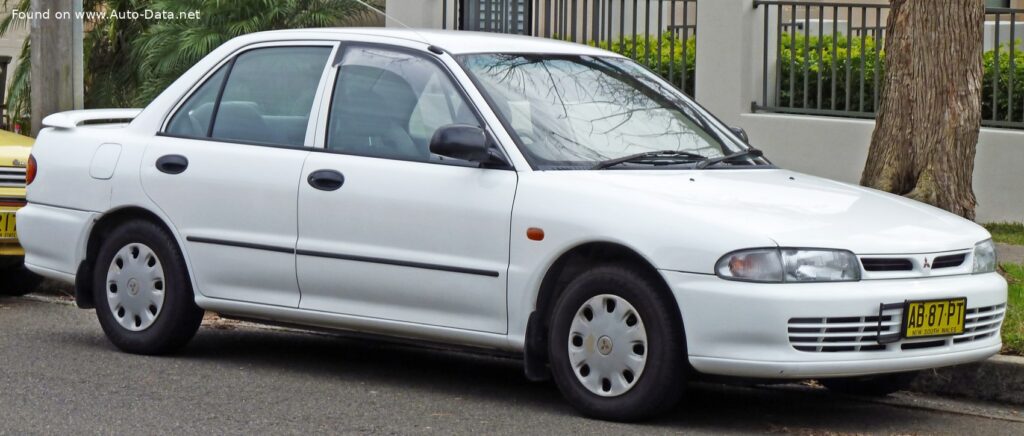
The Mitsubishi Lancer V 1.5 CB3A (115 Hp) Automatic: A Global Compact Sedan of the Early 1990s
The Mitsubishi Lancer, a nameplate synonymous with reliable and accessible compact motoring for decades, saw its fifth major iteration, known internally as the CB/CD/CE series, introduced in 1991. Among its diverse global offerings, the Mitsubishi Lancer V 1.5 CB3A (115 Hp) Automatic variant, produced from 1992 to 1996, represented a practical and efficient choice for consumers in its primary markets, particularly across Asia and parts of Europe. While the Lancer nameplate did appear in the United States, this specific 1.5-liter, 115-horsepower automatic configuration was more prevalent in regions where compact sedans prioritizied fuel economy, a comfortable ride, and straightforward engineering over outright performance.
This generation of the Lancer was a critical model for Mitsubishi, solidifying its presence in the highly competitive compact segment. It offered a compelling package of modern styling for its era, a comfortable interior, and Mitsubishi’s reputation for durability. The 1.5 CB3A variant, with its four-door sedan body style and five-seat configuration, was engineered as a capable daily driver, suitable for families and commuters seeking an uncomplicated and dependable vehicle.
Engine and Performance: The Heart of the Mitsubishi Lancer V 1.5 CB3A (115 Hp) Automatic
Under the hood of the Mitsubishi Lancer V 1.5 CB3A (115 Hp) Automatic lay a robust 1.5-liter (1496 cm³ or 91.29 cu. in.) inline four-cylinder engine. This powertrain, designated CB3A, was designed with a focus on efficiency and smooth operation, characteristic of Japanese automotive engineering of the early 1990s. Featuring a Double Overhead Camshaft (DOHC) valvetrain with four valves per cylinder, it was a relatively advanced setup for a compact car of its time, ensuring efficient air intake and exhaust flow.
The engine was naturally aspirated, meaning it relied solely on atmospheric pressure for air intake, and utilized a multi-port manifold injection system for precise fuel delivery. This combination allowed the engine to produce a respectable 115 horsepower at 6000 rpm, translating to 76.9 horsepower per liter – a good specific output for a non-turbocharged engine in its class. Torque output stood at 99.57 lb.-ft. (135 Nm) peaking at 4000 rpm, providing adequate pulling power for city driving and highway cruising.
Power was sent to the front wheels via a 4-speed automatic transmission. This gearbox was tuned for smooth shifts and ease of use, aligning with the car’s role as a commuter and family vehicle. While not a performance-oriented setup, the transmission efficiently managed the engine’s output. The Lancer V 1.5 CB3A (115 Hp) Automatic could accelerate from 0 to 60 mph in a calculated 11.9 seconds, reaching a maximum speed of 105.63 mph (170 km/h). These figures were competitive within the compact sedan segment of the early 90s, offering a balanced blend of performance and fuel economy for everyday driving.
Design and Features: Practicality Meets Early 90s Style
The fifth-generation Mitsubishi Lancer adopted a clean, aerodynamic design that was contemporary for the early 1990s. Its four-door sedan body type featured smooth lines and a relatively low profile, contributing to both its visual appeal and aerodynamic efficiency. With a length of 168.31 inches (4275 mm), a width of 66.54 inches (1690 mm), and a height of 54.53 inches (1385 mm), the Lancer V was a compact car that offered surprising interior space.
The wheelbase measured 98.43 inches (2500 mm), providing a stable ride and contributing to the car’s interior volume, comfortably accommodating five occupants. The design prioritized practicality, with a trunk (boot) space of 11.3 cu. ft. (320 liters), sufficient for groceries, luggage, or daily essentials. The vehicle’s kerb weight of 2072.35 lbs. (940 kg) was commendably light, aiding both performance and fuel efficiency.
The Lancer V’s chassis featured a front-wheel-drive architecture, a common and efficient layout for compact cars. The suspension system comprised a wishbone setup at the front and a spring strut design at the rear, providing a comfortable yet competent ride for varying road conditions. Braking duties were handled by disc brakes at the front and drum brakes at the rear, a standard configuration for non-performance compacts of the era, offering reliable stopping power. Steering was managed by a hydraulic rack and pinion system, providing direct feedback and ease of maneuverability. The car rode on 155/80 R13 tires, emphasizing comfort and efficiency.
Technical Specifications
| Category | Specification | US Equivalent / Notes |
|---|---|---|
| Brand | Mitsubishi | |
| Model | Lancer V | Generation V (CB/CD/CE series) |
| Type (Engine) | 1.5 CB3A (115 Hp) Automatic | |
| Start of Production | 1992 year | |
| End of Production | 1996 year | |
| Powertrain Architecture | Internal Combustion engine | |
| Body type | Sedan | |
| Seats | 5 | |
| Doors | 4 | |
| Performance Specs | ||
| Fuel Type | Petrol (Gasoline) | |
| Acceleration 0 – 60 mph | 11.9 sec | Calculated by Auto-Data.net |
| Acceleration 0 – 100 km/h | 12.5 sec | |
| Maximum speed | 170 km/h | 105.63 mph |
| Weight-to-power ratio | 8.2 kg/Hp | 122.3 Hp/tonne |
| Weight-to-torque ratio | 7 kg/Nm | 143.6 Nm/tonne |
| Engine Specs | ||
| Power | 115 Hp @ 6000 rpm. | |
| Power per liter | 76.9 Hp/l | |
| Torque | 135 Nm @ 4000 rpm. | 99.57 lb.-ft. @ 4000 rpm. |
| Engine layout | Front, Transverse | |
| Engine displacement | 1496 cm³ | 1.5 liters | 91.29 cu. in. |
| Number of cylinders | 4 | |
| Engine configuration | Inline | |
| Cylinder Bore | 75 mm | 2.95 in. |
| Piston Stroke | 84.8 mm | 3.34 in. |
| Compression ratio | 10.5:1 | |
| Number of valves per cylinder | 4 | |
| Fuel injection system | Multi-port manifold injection | |
| Engine aspiration | Naturally aspirated engine | |
| Valvetrain | DOHC | Double Overhead Camshaft |
| Space, Volume and Weights | ||
| Kerb Weight | 940 kg | 2072.35 lbs. |
| Max. weight (Gross) | 1450 kg | 3196.7 lbs. |
| Max load | 510 kg | 1124.36 lbs. |
| Trunk (boot) space – minimum | 320 l | 11.3 cu. ft. |
| Fuel tank capacity | 50 l | 13.21 US gal | 11 UK gal |
| Dimensions | ||
| Length | 4275 mm | 168.31 in. |
| Width | 1690 mm | 66.54 in. |
| Height | 1385 mm | 54.53 in. |
| Wheelbase | 2500 mm | 98.43 in. |
| Front track | 1450 mm | 57.09 in. |
| Rear (Back) track | 1460 mm | 57.48 in. |
| Drivetrain, Brakes and Suspension Specs | ||
| Drivetrain Architecture | The Internal combustion engine (ICE) drives the front wheels of the vehicle. | |
| Drive wheel | Front wheel drive | |
| Number of gears and type of gearbox | 4 gears, automatic transmission | |
| Front suspension | Wishbone | |
| Rear suspension | Spring Strut | |
| Front brakes | Disc | |
| Rear brakes | Drum | |
| Steering type | Steering rack and pinion | |
| Power steering | Hydraulic Steering | |
| Tires size | 155/80 R13 | |
Legacy and Market Impact of the Mitsubishi Lancer V
The fifth-generation Mitsubishi Lancer, including the Mitsubishi Lancer V 1.5 CB3A (115 Hp) Automatic, played a crucial role in Mitsubishi’s global strategy during the 1990s. While not as widely recognized in the North American market in this specific trim, where larger engines or sportier variants often took precedence, it was a workhorse in many other parts of the world. In markets like Southeast Asia, Australia, and parts of Europe, the Lancer competed fiercely with established rivals such as the Honda Civic, Toyota Corolla, and Nissan Sentra.
Its reputation was built on Mitsubishi’s core values: reliability, affordability, and practical engineering. The Lancer V was often praised for its robust build quality and straightforward mechanics, which translated into lower ownership costs and dependable service life. Its comfortable interior, decent fuel economy, and ease of driving with the automatic transmission made it an attractive option for first-time car buyers, small families, and urban commuters.
Historically, this generation of the Lancer is also significant as it laid the groundwork for the legendary Lancer Evolution series. Although the 1.5 CB3A was far removed from the high-performance rally-bred Evolution models, the underlying chassis and global appeal of the Lancer platform were instrumental in allowing Mitsubishi to develop and market its iconic performance variants. The Lancer V, in its various guises, helped to cement Mitsubishi’s image as a global automaker capable of producing both practical, everyday vehicles and high-performance machines.
Today, the Mitsubishi Lancer V 1.5 CB3A (115 Hp) Automatic stands as a testament to early 1990s Japanese automotive engineering – a period defined by efficiency, reliability, and a focus on core automotive principles. It represents a classic example of a compact sedan that successfully met the diverse needs of an international market, upholding Mitsubishi’s reputation for dependable and accessible transportation.