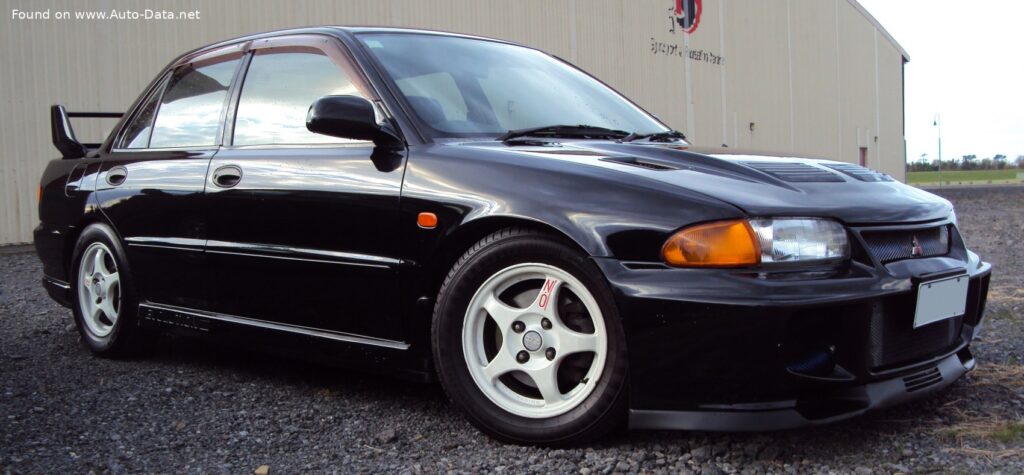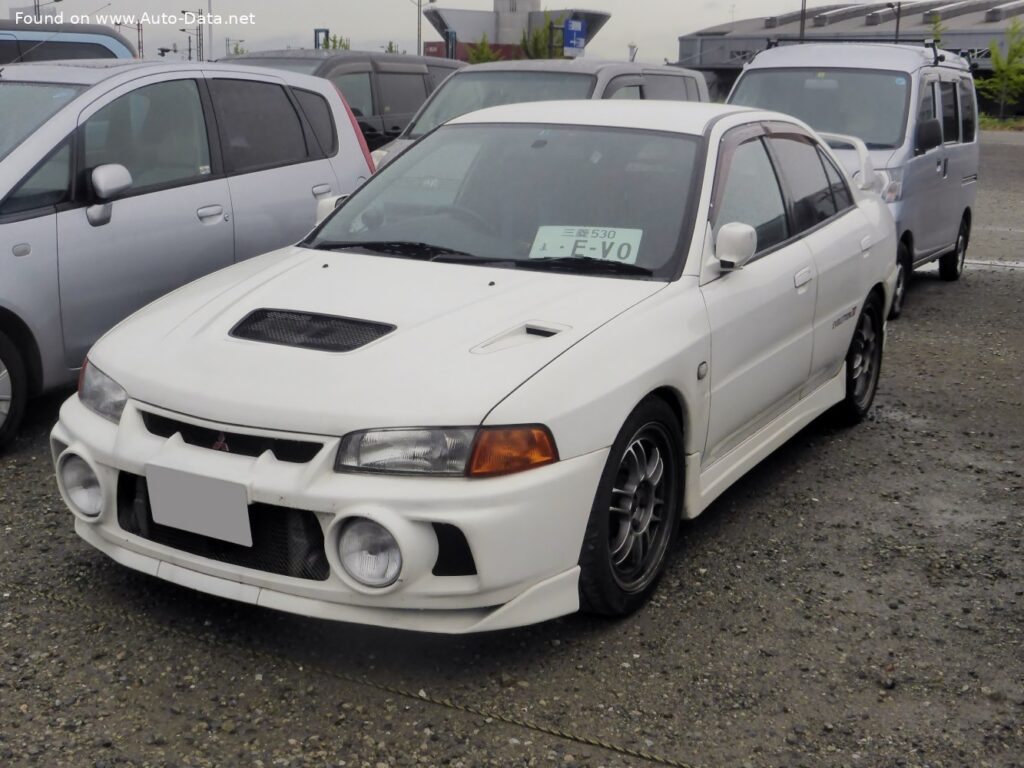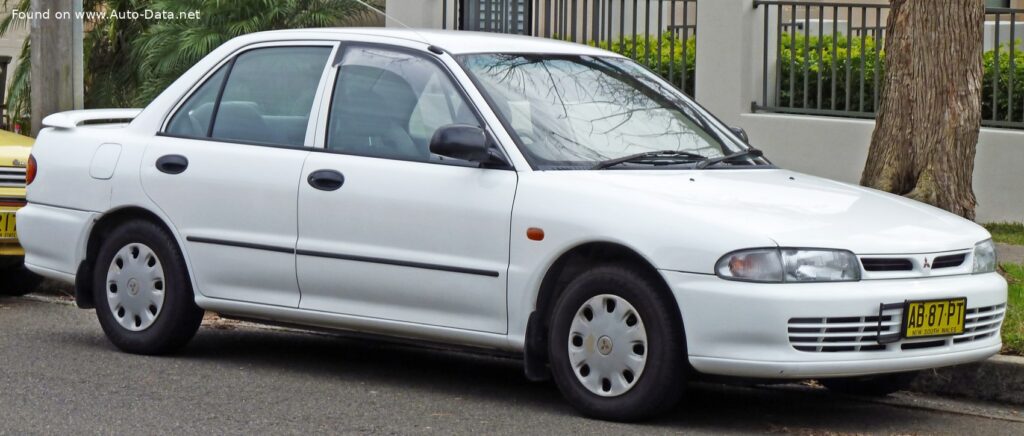
Mitsubishi Lancer V 1.6 16V (CB4A) (113 Hp)
The Mitsubishi Lancer, a nameplate with a rich heritage in both everyday motoring and motorsports, saw its fifth generation (often referred to by its chassis codes CB/CD/CE) debut in 1991. This era was a significant period for Mitsubishi Motors, as it aimed to strengthen its foothold in the global compact car segment with a focus on reliability, efficiency, and a touch of driving engagement. Among the various configurations offered, the Mitsubishi Lancer V 1.6 16V (CB4A) (113 Hp), produced from 1992 to 1996, stood out as a particularly balanced and popular choice in its primary markets, which predominantly included Asia and Europe.
Unlike its more aggressive, rally-bred Evolution siblings that would gain legendary status, the CB4A was designed for a broader audience, emphasizing affordability, robust engineering, and fuel economy. It embodied the typical Japanese compact sedan values of the early to mid-1990s: a straightforward design, dependable mechanics, and a focus on utility, all wrapped in a package that was competitive against its international rivals. This specific variant of the Lancer V represented Mitsubishi’s approach to delivering a practical, four-door sedan that could comfortably serve as a daily driver while still offering a spirited performance for its class. Its understated elegance and proven mechanicals made it a staple in numerous households and a common sight on roads across continents where it was sold, establishing itself as a testament to Mitsubishi’s engineering prowess in the compact segment.
Engine & Performance: The Heart of the Mitsubishi Lancer V 1.6 16V (CB4A)
At the core of the Mitsubishi Lancer V 1.6 16V (CB4A) (113 Hp) was its well-engineered 1.6-liter (1597 cm³ or 97.45 cu. in.) inline-four gasoline engine. Internally designated as the 4G92, this powerplant was a testament to Mitsubishi’s commitment to multi-valve technology, which was becoming increasingly prevalent in the automotive industry for its benefits in terms of both power and efficiency. The engine featured a 16-valve cylinder head, meaning four valves per cylinder, operated by a Single Overhead Camshaft (SOHC) valvetrain. This configuration allowed for optimized airflow into and out of the combustion chambers, contributing to its lively characteristics and improved volumetric efficiency compared to older two-valve-per-cylinder designs.
The 4G92 engine produced a healthy 113 horsepower at 6000 rpm, a commendable output for a naturally aspirated 1.6-liter unit of its time. Torque figures were equally competitive, reaching 101.05 lb.-ft. (137 Nm) at 5000 rpm. This power delivery profile suggested an engine that was eager to rev, providing a rewarding experience for drivers who preferred to extract performance through higher engine speeds. With a compression ratio of 10:1 and a multi-port manifold injection system, the engine demonstrated efficient fuel combustion and responsive throttle input, ensuring a smooth and predictable driving experience across the rev range. The combination of a relatively high compression ratio and precise fuel delivery contributed significantly to both its power output and fuel economy.
Power was efficiently transmitted to the front wheels through a standard five-speed manual transmission, a common and reliable setup for compact cars in this segment. This drivetrain architecture, combined with the engine’s output, enabled the Lancer V 1.6 16V to accelerate from 0 to 60 mph in an estimated 9.3 seconds, with a top speed reaching 118.06 mph (190 km/h). These performance metrics positioned it as a brisk performer within its class, capable of keeping pace with traffic and offering sufficient power for highway cruising or spirited back-road driving, especially considering its lightweight curb weight of 2248.72 lbs (1020 kg).
Fuel economy was another significant advantage of this powertrain. The combined fuel consumption was rated at an impressive 32.7 US mpg (7.2 l/100 km), making the Lancer V 1.6 16V an economical choice for daily commuting and long-distance travel. The naturally aspirated design also contributed to its reputation for reliability and straightforward maintenance, appealing to cost-conscious owners seeking a dependable and inexpensive-to-run vehicle. Its 13.21 US gallon (50 liter) fuel tank provided a generous cruising range, further enhancing its practicality for various use cases.
Design & Features: The Mitsubishi Lancer V’s Practicality
The fifth-generation Mitsubishi Lancer, including the Mitsubishi Lancer V 1.6 16V (CB4A), was conceived as a practical and unpretentious four-door, five-seat sedan. Its design language was distinctly of the early 1990s, characterized by clean, rounded lines and a focus on aerodynamic efficiency, which contributed to both fuel economy and a quieter cabin. The exterior dimensions were compact yet well-proportioned for its segment: 168.31 inches (4275 mm) in length, 66.54 inches (1690 mm) in width, and 54.53 inches (1385 mm) in height. A wheelbase of 98.43 inches (2500 mm) provided a stable platform and helped maximize interior passenger space, a crucial factor for a family sedan.
Inside, the Lancer offered a functional and ergonomic cabin environment. While luxury features varied by market and trim level, the core philosophy centered on durability and ease of use. The dashboard design was straightforward, with clearly legible instrumentation and intuitive controls for the climate system and audio. Standard amenities for the era would have typically included an AM/FM radio, manual windows, and basic fabric upholstery, though options such as power windows, power mirrors, and air conditioning were often available or standard on higher trims in various regions, catering to diverse customer preferences and climates.
In terms of safety, the Lancer V, like many of its contemporaries, relied on fundamental passive safety measures. Its unibody construction provided a rigid passenger cell designed to absorb and dissipate crash energy, aiming to protect occupants during an impact. Three-point seatbelts were standard for all outboard occupants, providing essential restraint. While advanced active safety features like anti-lock brakes (ABS) were not standard on this base variant, the braking system itself was robust. It comprised ventilated discs at the front for effective heat dissipation and reliable stopping power, complemented by drum brakes at the rear. This combination was a proven and cost-effective setup for a vehicle of its weight and performance capabilities, offering adequate deceleration for everyday driving.
The suspension system was designed for a balance of comfort and predictable handling. It featured a wishbone setup at the front, known for its ability to provide precise wheel control and absorb road imperfections effectively, and spring struts at the rear. This configuration ensured a comfortable ride over various road surfaces while maintaining confident handling characteristics, making it agreeable for both city commutes and longer journeys. The hydraulic rack and pinion power steering system offered light and responsive steering, making the Lancer easy to maneuver in urban settings and parking situations. The car rode on modest 175/70 R13 tires, which provided a good balance of grip, ride comfort, and economic replacement costs. With a curb weight of 2248.72 lbs (1020 kg) and a maximum load capacity of 1168.45 lbs (530 kg), the Lancer V was a lightweight yet capable vehicle for transporting its occupants and a reasonable amount of cargo. The trunk offered a practical 11.3 cu. ft. (320 liters) of space, sufficient for groceries, luggage, or daily essentials, reinforcing its role as a practical family sedan.
Technical Specifications: Mitsubishi Lancer V 1.6 16V (CB4A) (113 Hp)
| Category | Specification | Value |
|---|---|---|
| General Information | ||
| Brand | Mitsubishi | |
| Model | Lancer | |
| Generation | Lancer V | |
| Type (Engine) | 1.6 16V (CB4A) (113 Hp) | |
| Production Start Year | 1992 | |
| Production End Year | 1996 | |
| Powertrain Architecture | Internal Combustion engine | |
| Body Type | Sedan | |
| Seats | 5 | |
| Doors | 4 | |
| Performance Specifications | ||
| Fuel Consumption (Combined) | 32.7 US mpg (7.2 l/100 km) | |
| Fuel Type | Petrol (Gasoline) | |
| Acceleration 0-60 mph | 9.3 sec | |
| Acceleration 0-62 mph (0-100 km/h) | 9.8 sec | |
| Maximum Speed | 118.06 mph (190 km/h) | |
| Weight-to-Power Ratio | 9 kg/Hp, 110.8 Hp/tonne | |
| Weight-to-Torque Ratio | 7.4 kg/Nm, 134.3 Nm/tonne | |
| Engine Specifications | ||
| Power | 113 Hp @ 6000 rpm | |
| Power per Liter | 70.8 Hp/l | |
| Torque | 101.05 lb.-ft. (137 Nm) @ 5000 rpm | |
| Engine Layout | Front, Transverse | |
| Engine Displacement | 97.45 cu. in. (1597 cm³) | |
| Number of Cylinders | 4 | |
| Engine Configuration | Inline | |
| Cylinder Bore | 3.19 in. (81 mm) | |
| Piston Stroke | 3.05 in. (77.5 mm) | |
| Compression Ratio | 10:1 | |
| Valves per Cylinder | 4 | |
| Fuel Injection System | Multi-port manifold injection | |
| Engine Aspiration | Naturally aspirated engine | |
| Valvetrain | OHC | |
| Space, Volume and Weights | ||
| Kerb Weight | 2248.72 lbs (1020 kg) | |
| Max. Weight | 3417.17 lbs (1550 kg) | |
| Max Load | 1168.45 lbs (530 kg) | |
| Trunk (Boot) Space – Minimum | 11.3 cu. ft. (320 l) | |
| Fuel Tank Capacity | 13.21 US gal (50 l) | |
| Dimensions | ||
| Length | 168.31 in. (4275 mm) | |
| Width | 66.54 in. (1690 mm) | |
| Height | 54.53 in. (1385 mm) | |
| Wheelbase | 98.43 in. (2500 mm) | |
| Front Track | 60.63 in. (1540 mm) | |
| Rear Track | 57.48 in. (1460 mm) | |
| Drivetrain, Brakes and Suspension | ||
| Drivetrain Architecture | The Internal combustion engine (ICE) drives the front wheels of the vehicle. | |
| Drive Wheel | Front wheel drive | |
| Number of Gears and Type | 5 gears, manual transmission | |
| Front Suspension | Wishbone | |
| Rear Suspension | Spring Strut | |
| Front Brakes | Ventilated discs | |
| Rear Brakes | Drum | |
| Steering Type | Steering rack and pinion | |
| Power Steering | Hydraulic Steering | |
| Tires Size | 175/70 R13 | |
Legacy & Market Impact: The Enduring Appeal of the Mitsubishi Lancer V 1.6 16V (CB4A) (113 Hp)
The Mitsubishi Lancer V 1.6 16V (CB4A) (113 Hp), and the fifth-generation Lancer as a whole, played a pivotal role in Mitsubishi’s global market strategy during the 1990s. While not a headline-grabber like its high-performance Lancer Evolution counterparts, this particular 1.6-liter variant was a crucial volume seller, establishing Mitsubishi’s reputation for producing reliable, efficient, and affordable compact sedans. In its primary markets across Asia, particularly Southeast Asia and Japan, as well as in various European countries, it was celebrated for its robust build quality, commendable fuel efficiency, and straightforward, dependable mechanics.
The Lancer V competed in a fiercely contested segment, going head-to-head with established rivals such as the Honda Civic, Toyota Corolla, Nissan Sunny (Sentra in some markets), Mazda 323, and European contenders like the Volkswagen Golf and Opel Astra. What set the Lancer V apart was its blend of practical design, energetic yet economical powertrain, and Mitsubishi’s growing reputation for durability. Its “no-frills, gets-the-job-done” attitude resonated with a wide demographic, from young families to commuters looking for a cost-effective and reliable mode of transport.
The CB4A variant, with its 113 horsepower 4G92 engine, struck an excellent balance between performance and economy. It offered enough power to make daily driving engaging without sacrificing the fuel efficiency that was increasingly important to consumers. This balance contributed significantly to its market success and its enduring appeal even years after its production ceased. Its relatively simple engineering meant lower maintenance costs and greater longevity, factors highly valued by owners in markets where vehicle ownership costs are a primary concern.
Historically, the Lancer V cemented Mitsubishi’s position as a serious player in the global compact car market. It bridged the gap between basic transportation and more performance-oriented models, demonstrating Mitsubishi’s ability to cater to a broad spectrum of customer needs. Its legacy is one of quiet competence and steadfast reliability, characteristics that helped build brand loyalty and pave the way for future generations of Mitsubishi vehicles. Even today, the fifth-generation Lancer, particularly well-maintained examples of the 1.6 16V, are remembered fondly as dependable workhorses that delivered consistent value and performance, underscoring its historical significance in the automotive landscape of the 1990s.