
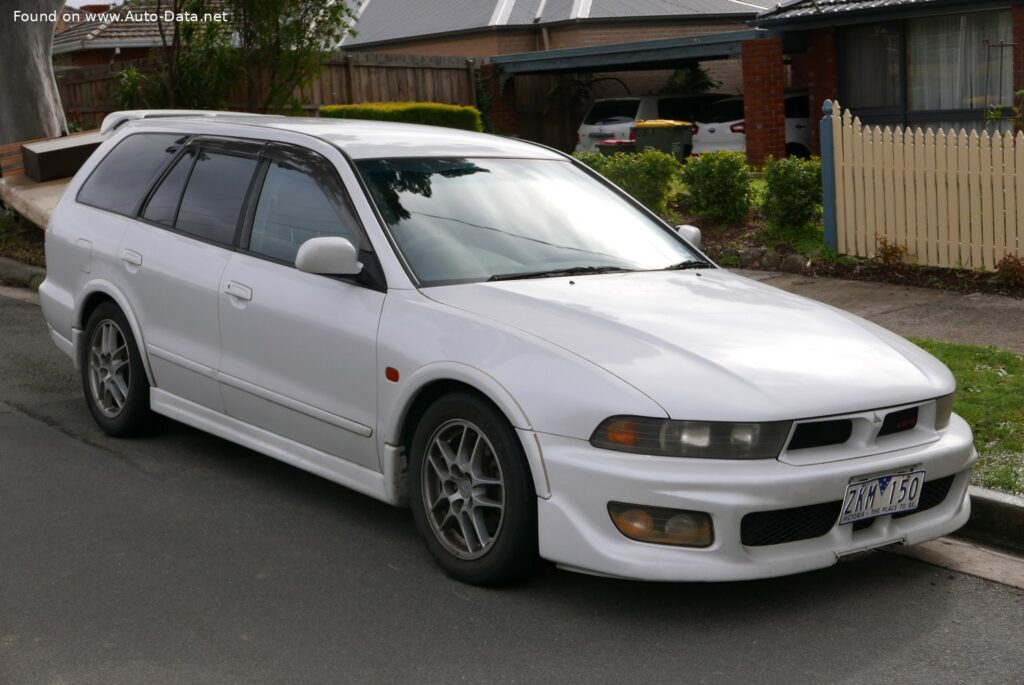
Introduction to the Mitsubishi Legnum (EAO) 2.0 Viento
The Mitsubishi Legnum (EAO) represents a distinct and noteworthy chapter in the history of Japanese automotive engineering, serving as the station wagon variant of the eighth-generation Mitsubishi Galant. Produced from 2000 to 2002, the Mitsubishi Legnum (EAO) 2.0 Viento was primarily targeted at the Japanese domestic market (JDM) and select right-hand drive international markets, where it carved out a niche for itself as a practical yet performance-oriented family vehicle. Unlike its sedan counterpart, the Legnum offered enhanced versatility and cargo capacity, appealing to consumers who required the utility of a wagon without compromising on dynamic driving characteristics or sophisticated styling.
The EAO generation of the Legnum, specifically the 2.0 Viento variant, exemplified Mitsubishi’s approach to blending everyday usability with advanced powertrain technology for its era. While the Legnum was not officially sold in the United States, its mechanical underpinnings and design philosophy were reflective of Mitsubishi’s global design language and engineering prowess at the turn of the millennium. It stood as a testament to the brand’s commitment to offering diverse body styles, including spacious wagons, during a period when SUVs had not yet fully dominated the family vehicle segment.
Positioned as a mid-size station wagon, the Mitsubishi Legnum (EAO) 2.0 Viento competed in a fiercely contested segment in Japan, offering a compelling blend of comfort, reliability, and engaging driving dynamics. This article will delve into the specific technical details, design elements, and market impact of this particular iteration of the Legnum, providing an expert analysis for automotive enthusiasts and historians alike.
Engineering and Performance of the Mitsubishi Legnum (EAO)
Powertrain and Dynamics
At the heart of the Mitsubishi Legnum (EAO) 2.0 Viento lies a sophisticated 2.0-liter (1999 cm³) inline four-cylinder engine, designated with a naturally aspirated architecture. This powerplant was engineered to deliver a balanced combination of responsive power and reasonable fuel efficiency for its class and time. It produced a respectable 145 horsepower at 5700 revolutions per minute (rpm), making it quite capable for daily driving and highway cruising. Torque output stood at 191 Newton-meters (140.87 lb-ft) at 3750 rpm, providing ample pulling power across a usable rev range, which was particularly beneficial for a station wagon often laden with passengers and cargo.
The engine featured a Double Overhead Camshaft (DOHC) valvetrain with four valves per cylinder, a configuration that allowed for optimized airflow and combustion efficiency. A notable technological highlight for the period was its direct injection fuel system, a feature that was still relatively advanced for mainstream vehicles in the early 2000s. This system contributed to improved fuel atomization and combustion, enhancing both power output and fuel economy. With a compression ratio of 11:1, the engine was designed for optimal performance using unleaded gasoline.
Power was delivered to the front wheels via a precise 5-speed manual transmission, offering the driver direct control over the vehicle’s dynamics. This front-wheel-drive (FWD) powertrain architecture, coupled with the manual gearbox, provided a driving experience that was both engaging and efficient. The vehicle’s kerb weight of 3417.17 pounds (1550 kg) resulted in a weight-to-power ratio of 10.7 kg/Hp (93.5 Hp/tonne) and a weight-to-torque ratio of 8.1 kg/Nm (123.2 Nm/tonne), indicating a well-matched relationship between its mass and motive force.
Suspension duties were handled by coil springs at both the front and rear, providing a comfortable yet stable ride characteristic of Japanese mid-size cars. Braking performance was ensured by ventilated discs on both the front and rear axles, complemented by an Anti-lock Braking System (ABS), which was a crucial safety feature for improved control during emergency stops. The steering system utilized a hydraulic rack and pinion setup, offering tactile feedback and responsive handling.
Design and Features of the Mitsubishi Legnum (EAO) 2.0 Viento
Exterior and Interior Aesthetics
The Mitsubishi Legnum (EAO) 2.0 Viento embodied a sleek and functional design, typical of Japanese station wagons from the turn of the millennium. Its body type was a 5-door station wagon, designed to maximize interior space and utility. With a length of 186.61 inches (4740 mm), a width of 69.29 inches (1760 mm), and a height of 57.87 inches (1470 mm), the Legnum presented a substantial yet elegant profile. The wheelbase of 103.74 inches (2635 mm) contributed to a stable ride and generous interior room.
The exterior styling was characterized by smooth lines and a somewhat aerodynamic silhouette, sharing many visual cues with its Galant sedan sibling, particularly from the front fascia to the B-pillar. The rear section was thoughtfully integrated to provide practical cargo space without appearing overly bulky, a common challenge for wagon designs. The standard tire size of 225/50 R16V suggested a focus on both comfort and confident road holding, fitting for a vehicle intended for diverse driving conditions.
Inside, the Legnum was designed to accommodate five occupants comfortably. The cabin layout emphasized ergonomics and functionality, with controls intuitively placed for the driver. While specific interior material details are not provided, vehicles in this segment from Mitsubishi typically featured durable fabrics and plastics, with optional leather trims available in higher specifications. The focus was on creating a practical and pleasant environment for long journeys and daily commutes.
Safety and Convenience
For its production years, the Mitsubishi Legnum (EAO) 2.0 Viento incorporated a range of features aimed at enhancing both safety and convenience. The standard inclusion of ABS (Anti-lock Braking System) was a significant safety asset, allowing drivers to maintain steering control during hard braking maneuvers. The presence of ventilated disc brakes on all four wheels further underscored Mitsubishi’s commitment to effective stopping power.
Convenience features included hydraulic power steering, which made maneuvering the wagon easier, especially at low speeds and during parking. The 5-speed manual transmission offered a direct and engaging driving experience, favored by many enthusiasts, while also providing robust reliability. With a fuel tank capacity of 15.85 US gallons (60 liters), the Legnum offered a decent cruising range, suitable for family road trips or extended commutes. The maximum load capacity of 606.27 lbs (275 kg) highlighted its practical utility for carrying passengers and luggage.
Technical Specifications: Mitsubishi Legnum (EAO) 2.0 Viento (145 Hp)
| Category | Specification |
|---|---|
| Brand | Mitsubishi |
| Model | Legnum |
| Generation | Legnum (EAO) |
| Type (Engine) | 2.0 Viento (145 Hp) |
| Start of Production | 2000 year |
| End of Production | 2002 year |
| Powertrain Architecture | Internal Combustion engine |
| Body Type | Station wagon (estate) |
| Seats | 5 |
| Doors | 5 |
| Performance Specs | |
| Fuel Type | Petrol (Gasoline) |
| Weight-to-Power Ratio | 10.7 kg/Hp, 93.5 Hp/tonne |
| Weight-to-Torque Ratio | 8.1 kg/Nm, 123.2 Nm/tonne |
| Engine Specs | |
| Power | 145 Hp @ 5700 rpm |
| Power per Liter | 72.5 Hp/l |
| Torque | 191 Nm @ 3750 rpm (140.87 lb-ft @ 3750 rpm) |
| Engine Layout | Front, Transverse |
| Engine Displacement | 1999 cm³ (121.99 cu. in.) |
| Number of Cylinders | 4 |
| Engine Configuration | Inline |
| Cylinder Bore | 81.5 mm (3.21 in.) |
| Piston Stroke | 95.8 mm (3.77 in.) |
| Compression Ratio | 11:1 |
| Number of Valves per Cylinder | 4 |
| Fuel Injection System | Direct injection |
| Engine Aspiration | Naturally aspirated engine |
| Valvetrain | DOHC |
| Space, Volume and Weights | |
| Kerb Weight | 1550 kg (3417.17 lbs) |
| Max. Weight | 1825 kg (4023.44 lbs) |
| Max Load | 275 kg (606.27 lbs) |
| Fuel Tank Capacity | 60 l (15.85 US gal) |
| Dimensions | |
| Length | 4740 mm (186.61 in.) |
| Width | 1760 mm (69.29 in.) |
| Height | 1470 mm (57.87 in.) |
| Wheelbase | 2635 mm (103.74 in.) |
| Front Track | 1525 mm (60.04 in.) |
| Rear (Back) Track | 1520 mm (59.84 in.) |
| Drivetrain, Brakes and Suspension Specs | |
| Drivetrain Architecture | The Internal combustion engine (ICE) drives the front wheels of the vehicle. |
| Drive Wheel | Front wheel drive |
| Number of Gears and Type of Gearbox | 5 gears, manual transmission |
| Front Suspension | Coil spring |
| Rear Suspension | Coil spring |
| Front Brakes | Ventilated discs |
| Rear Brakes | Ventilated discs |
| Assisting Systems | |
| ABS | ABS (Anti-lock braking system) |
| Steering Type | Steering rack and pinion |
| Power Steering | Hydraulic Steering |
| Tires Size | 225/50 R16V |
Legacy and Market Impact of the Mitsubishi Legnum (EAO)
Market Positioning and Competition
The Mitsubishi Legnum (EAO) 2.0 Viento held a respectable position within the Japanese domestic market’s mid-size station wagon segment. It was designed to offer a blend of practicality, comfort, and a touch of sportiness, distinguishing it from more utilitarian offerings. Its primary competitors included other popular Japanese wagons of the era, such as the Subaru Legacy Wagon, Toyota Caldina, Honda Accord Wagon, and Nissan Primera Wagon. Against these rivals, the Legnum often stood out for its slightly more distinctive styling, particularly the front end shared with the Galant, and its advanced engine technology, such as the direct injection system.
While the Legnum’s market share in Japan was significant, its absence from major Western markets like the United States under its own name limited its global recognition. However, it contributed to Mitsubishi’s reputation for producing reliable and capable vehicles, especially within its home market and other regions where the Galant family was well-received. The Viento trim, often denoting a slightly enhanced or more luxurious specification, aimed to appeal to buyers seeking a more refined experience.
Historical Significance
The Mitsubishi Legnum (EAO), particularly the 2.0 Viento, is historically significant for several reasons. Firstly, it represents a period when Mitsubishi was a prolific manufacturer, offering a wide array of body styles and catering to diverse consumer needs. The Legnum underscored the enduring popularity of the station wagon in Japan and other Asian markets, even as the global automotive landscape began its shift towards sport utility vehicles.
Secondly, the vehicle’s adoption of direct injection technology in a mainstream 2.0-liter engine was forward-thinking for its time. Mitsubishi’s GDI (Gasoline Direct Injection) engines were pioneers in bringing this efficiency-enhancing technology to a broader audience, contributing to advancements in fuel economy and emissions control. This technological foresight is a key aspect of the Legnum’s engineering legacy.
Finally, the Legnum, as part of the larger Galant family, maintained a reputation for solid build quality and engaging driving dynamics. It offered a compelling alternative for those who needed the space of a wagon but desired a more car-like driving experience than early SUVs could provide. Although its production run ended in 2002, the Legnum remains a testament to Mitsubishi’s engineering capabilities and its response to market demands in its primary operating regions during a pivotal period of automotive evolution.
