
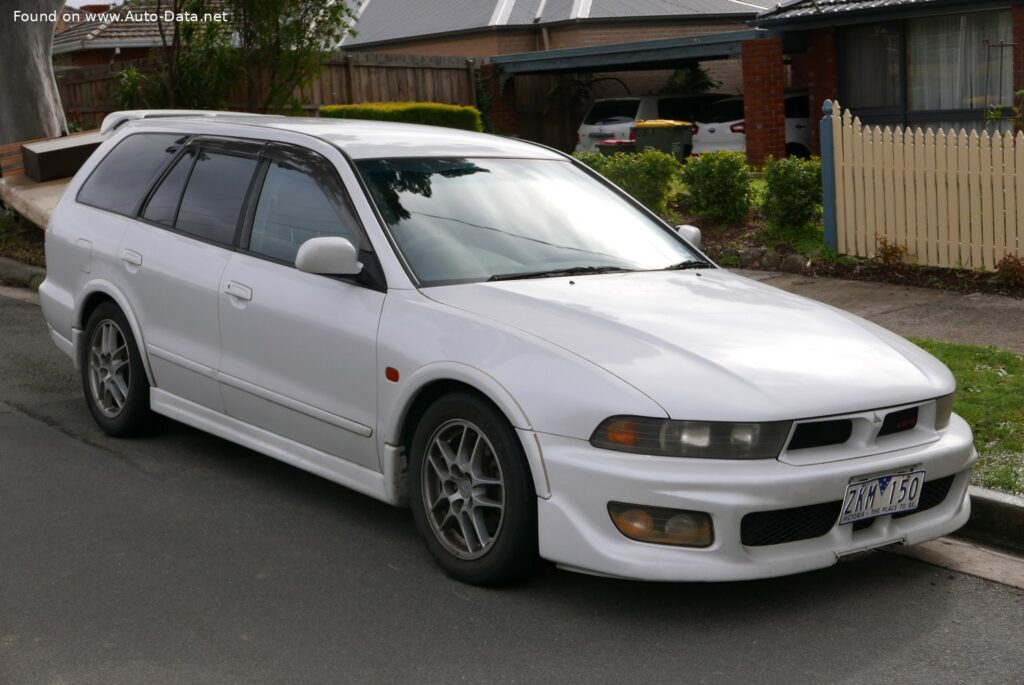
Introduction to the Mitsubishi Legnum (EAO)
The Mitsubishi Legnum (EAO) represents a distinctive chapter in the history of Japanese performance vehicles, specifically catering to the domestic market’s unique blend of practicality and high-octane engineering. Introduced in 1997 as the station wagon variant of the eighth-generation Galant, the Legnum carved out a niche for itself as a sophisticated yet potent family hauler. While the Galant sedan gained international recognition, particularly through its rally-bred VR-4 iteration, the Legnum offered an equally compelling package in a more versatile body style. It was never officially sold in the United States, making it a coveted “grey import” among enthusiasts seeking a taste of JDM (Japanese Domestic Market) forbidden fruit.
The specific model under examination, the Mitsubishi Legnum (EAO) 2.5 VR-4 Type-S 4WD (280 Hp), stood at the pinnacle of the Legnum lineup. It embodied Mitsubishi’s commitment to advanced powertrain technology and all-wheel-drive performance, leveraging decades of experience gained from its successful motorsport endeavors. This particular variant, produced from 1997 to 2002, combined a potent twin-turbocharged V6 engine with a sophisticated all-wheel-drive system and a manual transmission, creating a vehicle that was both understated in appearance and exhilarating in performance. It delivered a compelling proposition for Japanese consumers who desired the utility of a station wagon without compromising on driving dynamics or outright speed.
The Mitsubishi Legnum (EAO) VR-4 Legacy
The “VR-4” designation has long been synonymous with Mitsubishi’s high-performance, rally-inspired vehicles, and the Legnum VR-4 Type-S was no exception. Building on the heritage established by the Galant VR-4, which dominated rally stages in the late 1980s and early 1990s, the Legnum VR-4 applied this engineering philosophy to a more family-friendly package. Its primary market was Japan, where the demand for versatile, high-performance vehicles was strong. The Legnum was designed to offer a practical solution for daily driving while providing an exhilarating experience when pushed, a true “sleeper” in its segment.
During its production run, the Legnum VR-4 competed against other performance wagons from Japanese rivals, most notably the Subaru Legacy GT-B, which also offered a compelling blend of turbocharged power and all-wheel drive. These vehicles represented a distinct segment within the JDM, offering a unique alternative to traditional sports sedans and coupes. The Legnum’s rarity outside of Japan has only enhanced its cult status, making it a highly desirable vehicle for collectors and enthusiasts in markets like the US, where it can be imported under specific regulations.
Powertrain and Performance Dynamics
At the heart of the Mitsubishi Legnum (EAO) 2.5 VR-4 Type-S 4WD (280 Hp) was its formidable powertrain. It featured a 2.5-liter (2498 cm3 or 152.44 cu. in.) V6 engine, configured with a DOHC (Double Overhead Camshaft) valvetrain and four valves per cylinder. What truly set this engine apart was its twin-turbocharger setup, which allowed it to produce a remarkable 280 horsepower at 5500 rpm. This output figure was the maximum allowed under Japan’s “gentlemen’s agreement” among manufacturers at the time, though many speculate the actual output was often higher.
The engine delivered a substantial 363 Newton-meters (267.74 lb-ft) of torque at a relatively accessible 4000 rpm, providing strong acceleration and excellent mid-range pull. With a compression ratio of 8.5:1 and a multi-port manifold injection system, the engine was designed for both efficiency and high performance. The power-per-liter ratio stood at an impressive 112.1 horsepower per liter, underscoring the advanced engineering packed into this V6.
Power was sent to all four wheels via a sophisticated All-Wheel Drive (4×4) system, which was a hallmark of Mitsubishi’s performance models. This system provided exceptional traction and stability, especially in adverse conditions or during spirited driving. Mated to a precise 5-speed manual transmission, the driver had full control over the engine’s output, allowing for an engaging and dynamic driving experience. The vehicle’s curb weight of 3417.17 pounds (1550 kg) resulted in an impressive weight-to-power ratio of 5.5 kg/Hp (180.6 Hp/tonne), highlighting its potent performance capabilities for a station wagon.
Design, Interior, and Advanced Features
The Mitsubishi Legnum (EAO) adopted a sleek, aerodynamic station wagon body style, measuring 186.61 inches (4740 mm) in length, 69.29 inches (1760 mm) in width, and 57.87 inches (1470 mm) in height. Its 103.74-inch (2635 mm) wheelbase contributed to a stable ride and ample interior space. With five doors and seating for five occupants, the Legnum offered genuine practicality, making it a versatile choice for families who didn’t want to sacrifice performance.
Despite its practical exterior, the Legnum VR-4 Type-S featured several performance-oriented enhancements. The suspension system, utilizing coil springs at both the front and rear, was tuned for a sportier ride and improved handling, providing a firm yet compliant feel. Braking performance was equally robust, with ventilated disc brakes employed on both the front and rear axles, ensuring confident stopping power even under demanding conditions. An Anti-lock Braking System (ABS) was standard, enhancing safety and control during emergency braking maneuvers.
Steering was managed by a responsive rack-and-pinion system with hydraulic power steering, providing direct feedback to the driver. The vehicle rode on 225/50 R16V tires, a size that offered a good balance of grip and ride comfort. Inside, while specific features are not detailed, VR-4 models typically boasted a sportier interior with bolstered seats, unique gauge clusters, and higher-quality materials, reflecting its premium and performance-oriented positioning within the Mitsubishi lineup. The design ethos was one of understated aggression, allowing it to blend seamlessly into urban environments while hinting at its underlying capabilities.
Technical Specifications of the Legnum VR-4 Type-S
| General Information | |
| Brand | Mitsubishi |
| Model | Legnum |
| Generation | Legnum (EAO) |
| Type (Engine) | 2.5 VR-4 Type-S 4WD (280 Hp) |
| Start of production | 1997 year |
| End of production | 2002 year |
| Powertrain Architecture | Internal Combustion engine |
| Body type | Station wagon (estate) |
| Seats | 5 |
| Doors | 5 |
| Performance Specs | |
| Fuel Type | Petrol (Gasoline) |
| Weight-to-power ratio | 5.5 kg/Hp, 180.6 Hp/tonne |
| Weight-to-torque ratio | 4.3 kg/Nm, 234.2 Nm/tonne |
| Engine Specs | |
| Power | 280 Hp @ 5500 rpm. |
| Power per liter | 112.1 Hp/l |
| Torque | 363 Nm @ 4000 rpm (267.74 lb.-ft. @ 4000 rpm) |
| Engine layout | Front, Transverse |
| Engine displacement | 2498 cm3 (152.44 cu. in.) |
| Number of cylinders | 6 |
| Engine configuration | V-engine |
| Cylinder Bore | 81 mm (3.19 in.) |
| Piston Stroke | 80.8 mm (3.18 in.) |
| Compression ratio | 8.5:1 |
| Number of valves per cylinder | 4 |
| Fuel injection system | Multi-port manifold injection |
| Engine aspiration | Turbocharger |
| Valvetrain | DOHC |
| Space, Volume and Weights | |
| Kerb Weight | 1550 kg (3417.17 lbs.) |
| Max. weight | 1825 kg (4023.44 lbs.) |
| Max load | 275 kg (606.27 lbs.) |
| Fuel tank capacity | 60 l (15.85 US gal) |
| Dimensions | |
| Length | 4740 mm (186.61 in.) |
| Width | 1760 mm (69.29 in.) |
| Height | 1470 mm (57.87 in.) |
| Wheelbase | 2635 mm (103.74 in.) |
| Front track | 1525 mm (60.04 in.) |
| Rear (Back) track | 1520 mm (59.84 in.) |
| Drivetrain, Brakes and Suspension Specs | |
| Drive wheel | All wheel drive (4×4) |
| Number of gears and type of gearbox | 5 gears, manual transmission |
| Front suspension | Coil spring |
| Rear suspension | Coil spring |
| Front brakes | Ventilated discs |
| Rear brakes | Ventilated discs |
| Assisting systems | ABS (Anti-lock braking system) |
| Steering type | Steering rack and pinion |
| Power steering | Hydraulic Steering |
| Tires size | 225/50 R16V |
Market Positioning and Enduring Appeal
In its primary Japanese market, the Mitsubishi Legnum (EAO) 2.5 VR-4 Type-S 4WD (280 Hp) occupied a unique space. It was a high-performance vehicle that didn’t scream for attention, offering an alluring blend of speed, sophisticated all-wheel-drive technology, and the practicality of a station wagon. Its main competitor was undoubtedly the Subaru Legacy GT-B, a direct rival in the JDM performance wagon segment, known for its horizontally opposed engine and symmetrical all-wheel drive. While European competitors such as the Audi S4 Avant or even certain BMW 3 Series Touring models offered luxury and performance in a wagon body, the Legnum VR-4 provided a distinctly Japanese take on the concept, often with a more raw and engaging driving feel.
The Legnum VR-4 Type-S played a significant role in showcasing Mitsubishi’s engineering capabilities during a golden era for Japanese automotive manufacturers. It demonstrated that a family-friendly vehicle could still offer exhilarating performance without compromise. The car’s robust 6A13TT twin-turbo V6 engine, coupled with Mitsubishi’s renowned all-wheel-drive system, ensured its place in the pantheon of JDM performance legends. Its association with the broader Galant VR-4 lineage, which had a storied history in rally racing, further cemented its reputation as a serious performance machine.
Today, the Mitsubishi Legnum (EAO) 2.5 VR-4 Type-S 4WD (280 Hp) remains a highly sought-after vehicle among enthusiasts worldwide. Its rarity outside of Japan, combined with its potent performance and unique blend of utility and speed, contributes to its enduring appeal. It stands as a testament to Mitsubishi’s innovative spirit and its ability to produce vehicles that were ahead of their time, offering a driving experience that continues to captivate those who appreciate a true “sleeper” performance wagon. Its legacy is one of quiet competence, proving that practicality doesn’t have to come at the expense of pure driving enjoyment.
