
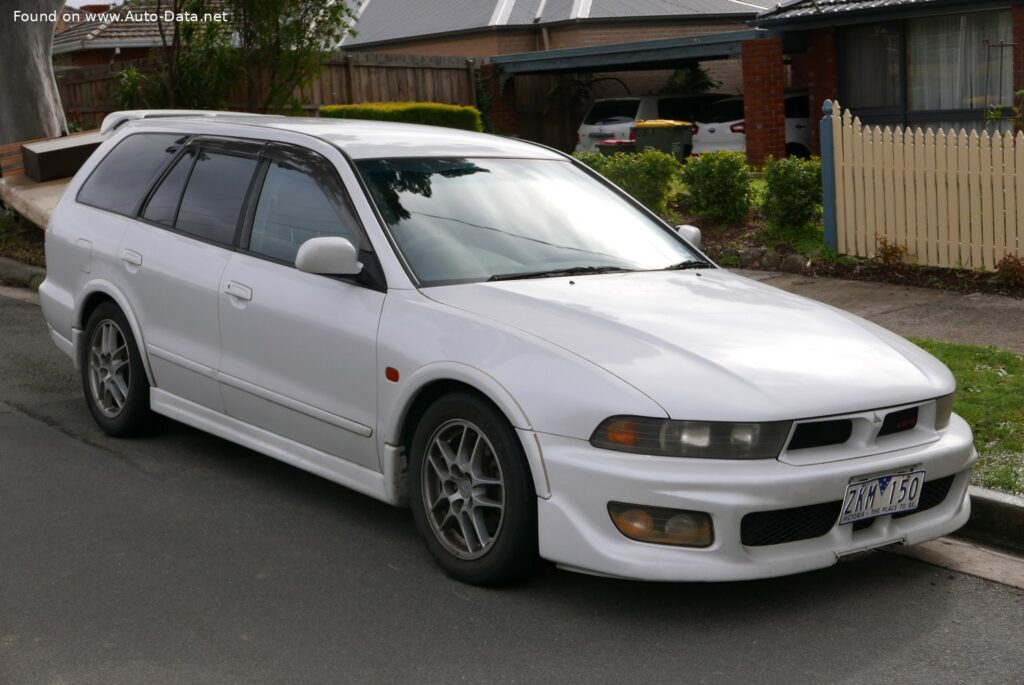
Introduction: The Mitsubishi Legnum (EAO) 2.5 VR-4 Type-S 4WD Automatic – A JDM Performance Wagon
The Mitsubishi Legnum (EAO) 2.5 VR-4 Type-S 4WD (280 Hp) Automatic represents a fascinating chapter in the history of Japanese performance vehicles, particularly within the often-overlooked segment of high-performance station wagons. Launched in 1997 as the wagon counterpart to the eighth-generation Galant sedan, the Legnum was specifically designed for the Japanese Domestic Market (JDM) and select other regions, never officially sold in the United States. The VR-4 Type-S variant, in particular, was the pinnacle of the Legnum lineup, combining practical five-door, five-seat utility with a potent twin-turbocharged V6 engine and sophisticated all-wheel-drive technology. It carved out a niche for enthusiasts seeking a discreet yet incredibly capable family hauler, embodying Mitsubishi’s engineering prowess from an era defined by intense competition in Japan’s automotive landscape.
Positioned as a premium sports wagon, the Mitsubishi Legnum (EAO) 2.5 VR-4 Type-S 4WD (280 Hp) Automatic offered a blend of luxury, advanced technology, and raw power that few of its contemporaries could match. Its production run from 1997 to 2002 saw it evolve slightly, but its core identity as a JDM “sleeper” remained intact, appealing to those who appreciated performance without ostentation. This article delves into the specifics of this remarkable vehicle, exploring its engineering, design, and lasting impact on the global automotive scene.
Engine & Performance: The Heart of the Mitsubishi Legnum (EAO) 2.5 VR-4 Type-S 4WD Automatic
At the core of the Legnum VR-4 Type-S’s formidable capabilities was its transversely mounted, front-engine, 2.5-liter (2498 cm3 or 152.44 cu. in.) 6A13TT V6 engine. This powerplant was a marvel of engineering for its time, featuring a Double Overhead Camshaft (DOHC) valvetrain with four valves per cylinder, ensuring efficient breathing and high-revving potential. Crucially, the engine was force-fed by a twin-turbocharger system, which contributed significantly to its impressive power output. The VR-4 Type-S delivered a robust 280 horsepower at 5500 rpm, a figure that famously adhered to the “gentleman’s agreement” among Japanese manufacturers to limit advertised output for domestic models. Torque was equally impressive, peaking at 363 Nm (267.74 lb.-ft.) at 4000 rpm, providing strong acceleration across a wide powerband.
The engine’s compression ratio of 8.5:1 was well-suited for its turbocharged application, balancing performance with reliability. Fuel was delivered via a multi-port manifold injection system, ensuring precise fuel metering for optimal combustion. This potent engine, combined with a kerb weight of 3417.17 lbs (1550 kg), resulted in an excellent weight-to-power ratio of 5.5 kg/Hp (180.6 Hp/tonne) and a weight-to-torque ratio of 4.3 kg/Nm (234.2 Nm/tonne). These figures underscored the Legnum VR-4’s status as a genuine performance machine, capable of exhilarating acceleration despite its practical station wagon body.
Power was channeled to all four wheels through a sophisticated all-wheel-drive (4×4) system, a hallmark of Mitsubishi’s performance vehicles, drawing from its extensive rallying heritage. The Type-S variant specifically featured a 5-gear automatic transmission, offering smooth and rapid shifts, making it a comfortable daily driver while still providing immediate access to its considerable power when needed. This combination of a high-output twin-turbo V6 and advanced AWD system provided exceptional grip and handling dynamics, allowing the Legnum VR-4 to perform confidently in various driving conditions.
Design & Features: Blending Practicality with Performance
The Mitsubishi Legnum (EAO) was conceived as a five-door, five-seat station wagon, offering a compelling blend of family-friendly practicality and sporting intent. Its exterior design, while sharing the basic silhouette with the Galant sedan, featured a distinctive wagon rear end that was both functional and aesthetically pleasing. Measuring 186.61 inches (4740 mm) in length, 69.29 inches (1760 mm) in width, and 57.87 inches (1470 mm) in height, the Legnum possessed a purposeful stance. The 103.74-inch (2635 mm) wheelbase contributed to a stable ride and generous interior space for passengers and cargo.
The VR-4 Type-S variant typically sported subtle but effective visual cues to denote its performance pedigree, such as specific alloy wheel designs and perhaps a more aggressive front fascia, though it largely maintained the Legnum’s understated appearance. The standard tire size was 225/50 R16 V on 16-inch wheel rims, providing a good balance of grip and ride comfort for a performance car of its era.
Inside, the Legnum VR-4 would have offered a well-appointed cabin, often featuring supportive sport seats, automatic climate control, and a comprehensive instrument cluster. While specific luxury features aren’t detailed in the provided data, as a top-tier model, it would have included amenities expected of a premium Japanese vehicle from the late 1990s. Safety was addressed with standard Anti-lock Braking System (ABS), a crucial feature for managing the vehicle’s significant performance capabilities. The steering system utilized a hydraulic rack and pinion setup, offering direct feedback and precise control, enhancing the driving experience.
The suspension system, featuring coil springs at both the front and rear, was tuned to handle the car’s power and maintain composure during spirited driving, while also providing adequate comfort for daily use. Braking performance was ensured by ventilated disc brakes on both the front and rear axles, providing strong, fade-resistant stopping power necessary for a car capable of such high speeds and rapid acceleration.
Technical Specifications: Mitsubishi Legnum (EAO) 2.5 VR-4 Type-S 4WD (280 Hp) Automatic
| Category | Specification | US Equivalent / Notes |
|---|---|---|
| General Information | ||
| Brand | Mitsubishi | |
| Model | Legnum | |
| Generation | Legnum (EAO) | |
| Type (Engine) | 2.5 VR-4 Type-S 4WD (280 Hp) Automatic | |
| Start of Production | 1997 year | |
| End of Production | 2002 year | |
| Powertrain Architecture | Internal Combustion engine | |
| Body type | Station wagon (estate) | 5-door wagon |
| Seats | 5 | |
| Doors | 5 | |
| Performance Specs | ||
| Fuel Type | Petrol (Gasoline) | |
| Power | 280 Hp @ 5500 rpm. | |
| Power per liter | 112.1 Hp/l | |
| Torque | 363 Nm @ 4000 rpm. | 267.74 lb.-ft. @ 4000 rpm. |
| Weight-to-power ratio | 5.5 kg/Hp | 180.6 Hp/tonne |
| Weight-to-torque ratio | 4.3 kg/Nm | 234.2 Nm/tonne |
| Engine Specs | ||
| Engine layout | Front, Transverse | |
| Engine displacement | 2498 cm3 | 2.5 Liters / 152.44 cu. in. |
| Number of cylinders | 6 | V-engine configuration |
| Cylinder Bore | 81 mm | 3.19 in. |
| Piston Stroke | 80.8 mm | 3.18 in. |
| Compression ratio | 8.5:1 | |
| Number of valves per cylinder | 4 | Total 24 valves |
| Fuel injection system | Multi-port manifold injection | |
| Engine aspiration | Turbocharger | Twin-turbocharged |
| Valvetrain | DOHC | Dual Overhead Camshaft |
| Space, Volume and Weights | ||
| Kerb Weight | 1550 kg | 3417.17 lbs. |
| Max. weight (Gross Vehicle Weight) | 1825 kg | 4023.44 lbs. |
| Max load | 275 kg | 606.27 lbs. |
| Fuel tank capacity | 60 l | 15.85 US gal |
| Dimensions | ||
| Length | 4740 mm | 186.61 in. |
| Width | 1760 mm | 69.29 in. |
| Height | 1470 mm | 57.87 in. |
| Wheelbase | 2635 mm | 103.74 in. |
| Front track | 1525 mm | 60.04 in. |
| Rear (Back) track | 1520 mm | 59.84 in. |
| Drivetrain, Brakes and Suspension Specs | ||
| Drive wheel | All wheel drive (4×4) | |
| Number of gears and type of gearbox | 5 gears, automatic transmission | |
| Front suspension | Coil spring | |
| Rear suspension | Coil spring | |
| Front brakes | Ventilated discs | |
| Rear brakes | Ventilated discs | |
| Assisting systems | ABS (Anti-lock braking system) | |
| Steering type | Steering rack and pinion | |
| Power steering | Hydraulic Steering | |
| Tires size | 225/50 R16 V | |
| Wheel rims size | 16 | 16-inch diameter |
Legacy & Market Impact: The Underrated Performer
The Mitsubishi Legnum VR-4 Type-S, despite its limited market availability, forged a significant legacy, particularly among JDM enthusiasts globally. In its primary market of Japan, it was lauded for its ability to combine everyday usability with thrilling performance, standing out in a segment that often prioritized one over the other. Its “sleeper” aesthetic appealed to those who preferred to keep their car’s true capabilities under wraps, only to unleash them when the situation demanded.
Competitors in the Japanese market included other high-performance wagons like the Subaru Legacy GT-B, which also offered turbocharged power and all-wheel drive, albeit typically with a boxer engine. The Legnum VR-4, with its V6 engine, presented a distinct alternative, often praised for its smoother power delivery and refined cruising characteristics compared to some of its four-cylinder rivals. While not directly competing with European luxury performance wagons like the Audi S4 Avant in terms of market presence, its technical specifications and performance placed it in a similar league, offering a distinctly Japanese interpretation of the genre.
Beyond Japan, the Legnum VR-4 gained a cult following in countries like the United Kingdom, Australia, and New Zealand, where it became a popular “grey import.” Enthusiasts in these regions sought out the Legnum for its robust engineering, potent powertrain, and the relative rarity that set it apart from more common performance cars. Its connection to Mitsubishi’s rallying heritage, through the VR-4 badge that was famously worn by the Galant VR-4 rally car, further enhanced its appeal, imbuing it with a sense of motorsport pedigree even though the Legnum itself wasn’t a rally machine.
Today, the Mitsubishi Legnum (EAO) 2.5 VR-4 Type-S 4WD (280 Hp) Automatic is considered a modern classic. It represents a golden era of Japanese automotive engineering where manufacturers pushed the boundaries of performance and technology, often within practical body styles. Its rarity and the increasing appreciation for JDM performance cars have solidified its place in automotive history as an underrated, high-performance wagon that perfectly encapsulated Mitsubishi’s innovative spirit in the late 1990s and early 2000s.
