
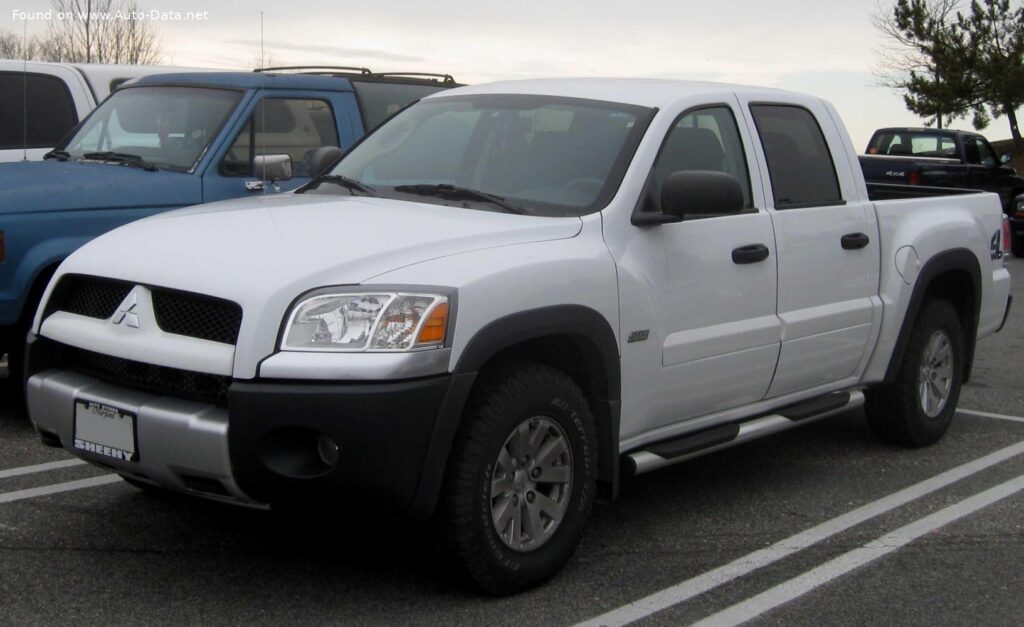
The Mitsubishi Raider, specifically the 3.7 LS V6 (210 Hp) variant, represented Mitsubishi’s foray into the highly competitive North American mid-size pickup truck market during its production run from 2006 to 2009. As a rebadged version of the second-generation Dodge Dakota, the Raider was a pivotal, albeit short-lived, attempt by Mitsubishi to capture a segment dominated by established domestic and Japanese rivals. This generation of the Mitsubishi Raider 3.7 LS V6 (210 Hp) aimed to offer consumers a blend of Mitsubishi’s brand identity with the proven architecture and utility of a well-regarded American truck, making it a unique proposition in its time. While its primary market was the United States and Canada, the Raider’s existence underscored Mitsubishi’s broader strategy to diversify its product portfolio in key global regions.
The Mitsubishi Raider: A Unique Market Proposition
The introduction of the Mitsubishi Raider in 2006 was a strategic move by the automaker to leverage an existing, robust platform for a segment where developing an entirely new truck would have been prohibitively expensive. By partnering with DaimlerChrysler (which owned Dodge at the time), Mitsubishi gained access to the Dodge Dakota’s chassis, powertrain, and manufacturing capabilities. This collaboration allowed Mitsubishi to quickly bring a mid-size pickup to market, filling a significant gap in its lineup, particularly for American consumers who value the versatility and capability of trucks. The Raider differentiated itself from its Dakota sibling primarily through unique front-end styling, including Mitsubishi’s distinct grille and headlights, along as well as specific trim levels and interior appointments designed to align with Mitsubishi’s brand aesthetic.
Positioned as a practical and capable workhorse, the Raider aimed to appeal to a demographic seeking a truck that could handle both daily commuting and moderate hauling or towing tasks. Its availability with multiple engine options, including the potent 3.7 LS V6, ensured a range of choices for different buyer needs. Despite its solid underpinnings and competent performance, the Raider faced an uphill battle against deeply entrenched competitors like the Toyota Tacoma, Nissan Frontier, and Ford Ranger. The challenge was not just in terms of product, but also in establishing brand recognition and trust within a segment fiercely loyal to existing players. The Raider’s relatively brief production span from 2006 to 2009 reflects the intense competition and the evolving market dynamics that ultimately led to its discontinuation.
Powertrain and Performance of the Mitsubishi Raider 3.7 LS V6 (210 Hp)
At the heart of the Mitsubishi Raider 3.7 LS V6 (210 Hp) model was a robust 3.7-liter V6 gasoline engine, designated by the engine code EKG. This naturally aspirated, multi-port manifold injected powerplant was designed to deliver a balance of power and durability essential for a pickup truck. It produced a respectable 210 horsepower at 5200 rpm, translating to a power output of 56.7 horsepower per liter. This figure provided ample motivation for the mid-size truck, whether it was navigating urban environments or carrying moderate loads. More critically for a truck, the engine developed a substantial 235 lb.-ft. of torque at a relatively low 3600 rpm. This low-end torque was crucial for strong acceleration from a standstill, confident merging onto highways, and effective towing capabilities, contributing significantly to the Raider’s utility.
The engine featured a V-configuration with six cylinders, each equipped with two valves, managed by a Single Overhead Camshaft (SOHC) valvetrain. Its bore and stroke measurements of 3.66 inches (93 mm) and 3.57 inches (90.8 mm), respectively, indicated an oversquare design, generally conducive to higher-revving power delivery while maintaining good low-end response. A compression ratio of 9.7:1 further optimized combustion efficiency for regular unleaded gasoline. Power was transmitted to the rear wheels via a 6-speed manual transmission, offering drivers direct engagement and control over the powertrain. This rear-wheel-drive architecture is traditional for pickup trucks, providing robust traction under load and a simple, durable drivetrain. The engine’s oil capacity was 4.97 US quarts (4.7 liters), simplifying maintenance for owners.
Design and Practical Features
The Mitsubishi Raider, in its 3.7 LS V6 (210 Hp) configuration, embodied the functional design principles of a mid-size pickup truck. It was offered exclusively as a four-door, five-seat pickup, emphasizing its role as a versatile vehicle capable of accommodating both passengers and cargo. Its exterior dimensions were substantial for its class, with an overall length of 219.88 inches (5585 mm), a width of 71.89 inches (1826 mm), and a height of 68.58 inches (1742 mm). These dimensions, combined with a generous wheelbase of 131.3 inches (3335 mm), contributed to a stable ride and a spacious cabin, while also providing a sizable bed for cargo. The front track measured 64.17 inches (1630 mm) and the rear track 62.44 inches (1586 mm), ensuring a planted stance on the road.
The practical utility of the Raider was further underscored by its cargo capacity. The truck bed offered a minimum volume of 29.98 cubic feet (849 liters), expandable to a maximum of 46.62 cubic feet (1320 liters) depending on configuration and accessories. This flexibility made it suitable for a range of tasks, from hauling tools and equipment to transporting recreational gear. For ride comfort and capability, the Raider featured an independent double wishbone front suspension, designed to absorb road imperfections effectively and provide precise steering. At the rear, a dependent suspension system utilizing two longitudinal semi-elliptic leaf springs was employed, a tried-and-true setup for pickups that excels at managing heavy loads without excessive sag. Braking performance was handled by ventilated disc brakes at the front for superior heat dissipation and stopping power, complemented by drum brakes at the rear, a common and cost-effective solution for rear axles in this class. Steering was managed by a rack and pinion system, offering a direct and responsive feel for a truck of its size, with a minimum turning circle of 43.96 feet (13.4 meters), aiding maneuverability in tighter spaces.
Technical Specifications: Mitsubishi Raider 3.7 LS V6 (210 Hp)
| Brand | Mitsubishi |
| Model | Raider |
| Generation | Raider |
| Type (Engine) | 3.7 LS V6 (210 Hp) |
| Start of production | 2006 year |
| End of production | 2009 year |
| Powertrain Architecture | Internal Combustion engine |
| Body type | Pick-up |
| Seats | 5 |
| Doors | 4 |
| Fuel Type | Petrol (Gasoline) |
| Power | 210 Hp @ 5200 rpm. |
| Power per liter | 56.7 Hp/l |
| Torque | 235 Nm (173.33 lb.-ft.) @ 3600 rpm. |
| Engine layout | Front, Longitudinal |
| Engine Model/Code | EKG |
| Engine displacement | 3701 cm3 (225.85 cu. in.) |
| Number of cylinders | 6 |
| Engine configuration | V-engine |
| Cylinder Bore | 93 mm (3.66 in.) |
| Piston Stroke | 90.8 mm (3.57 in.) |
| Compression ratio | 9.7:1 |
| Number of valves per cylinder | 2 |
| Fuel injection system | Multi-port manifold injection |
| Engine aspiration | Naturally aspirated engine |
| Valvetrain | SOHC |
| Engine oil capacity | 4.7 l (4.97 US qt) |
| Trunk (boot) space – minimum | 849 l (29.98 cu. ft.) |
| Trunk (boot) space – maximum | 1320 l (46.62 cu. ft.) |
| Length | 5585 mm (219.88 in.) |
| Width | 1826 mm (71.89 in.) |
| Height | 1742 mm (68.58 in.) |
| Wheelbase | 3335 mm (131.3 in.) |
| Front track | 1630 mm (64.17 in.) |
| Rear (Back) track | 1586 mm (62.44 in.) |
| Minimum turning circle (turning diameter) | 13.4 m (43.96 ft.) |
| Drivetrain Architecture | The Internal combustion engine (ICE) drives the rear wheels of the vehicle. |
| Drive wheel | Rear wheel drive |
| Number of gears and type of gearbox | 6 gears, manual transmission |
| Front suspension | Double wishbone |
| Rear suspension | Dependent suspension of two longitudinal semi-elliptic leaf springs |
| Front brakes | Ventilated discs |
| Rear brakes | Drum |
| Steering type | Steering rack and pinion |
