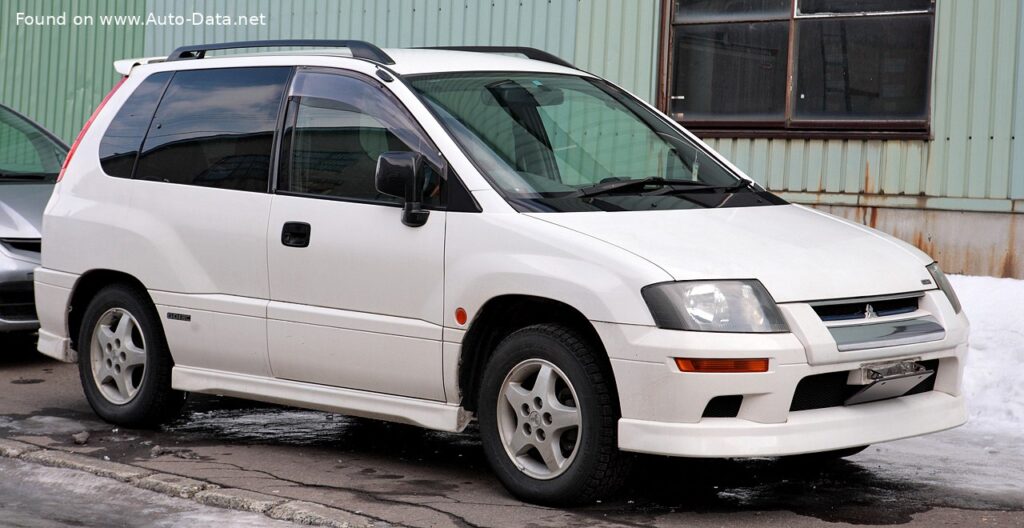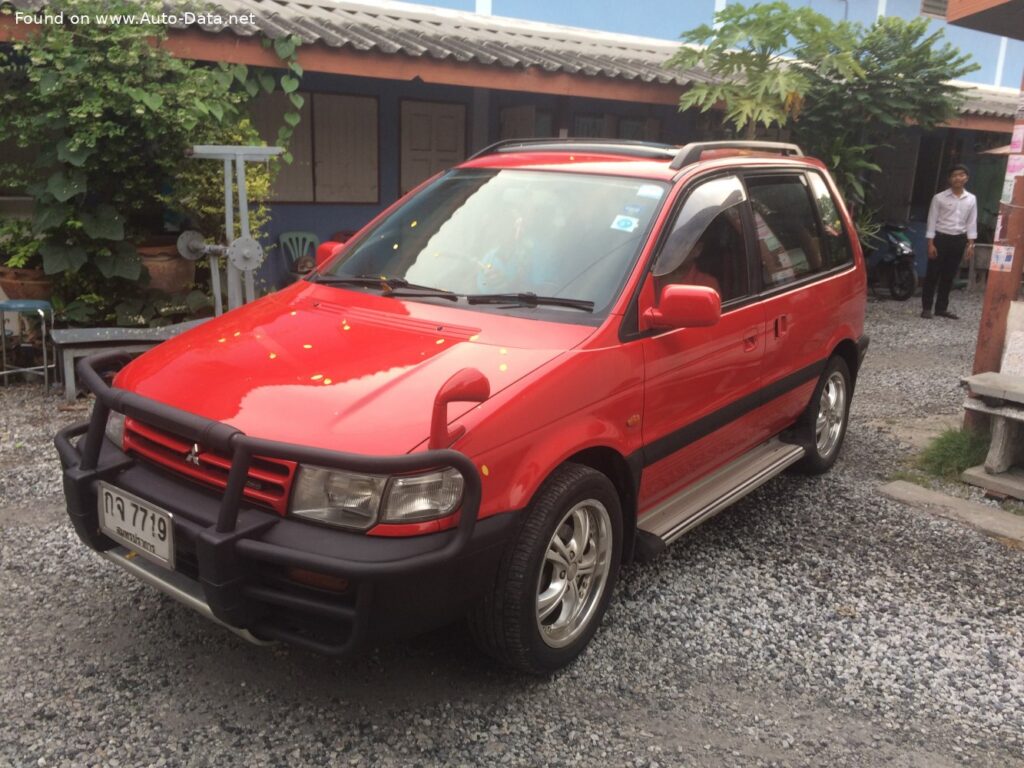
The Mitsubishi RVR (E-N23W) represented a pioneering entry into the compact multi-purpose vehicle (MPV) segment, a class that gained significant traction in the early to mid-1990s. Launched in 1991, this specific variant, the 1.8 i 16V 4WD Z (120 Hp), carved out a niche for itself as a versatile and practical family vehicle, particularly popular in its home market of Japan and various European territories. While the RVR nameplate itself was not directly offered in the United States, rebadged versions such as the Dodge/Plymouth Colt Vista and Eagle Summit Wagon shared its foundational architecture, reflecting Mitsubishi’s global strategy of adapting models to regional markets. The E-N23W generation, produced from 1991 to 1997, was designed to offer a blend of passenger car comfort, minivan utility, and, in this particular configuration, the added capability of all-wheel drive, making it a compelling option for consumers seeking a vehicle capable of handling diverse driving conditions with a relatively small footprint. Its compact dimensions, combined with intelligent interior packaging, allowed it to navigate urban environments with ease while still providing ample space for up to four occupants and their cargo.
Mitsubishi RVR (E-N23W): A Pioneer in Compact Utility
The Mitsubishi RVR (E-N23W) emerged during an era when manufacturers were experimenting with new vehicle categories beyond traditional sedans and station wagons. Positioned as a “Recreational Vehicle Runner,” the RVR aimed to bridge the gap between compact cars and larger minivans or SUVs. Its design philosophy emphasized versatility, offering a practical solution for active families and individuals who needed more space and utility than a typical sedan but preferred a vehicle that was more maneuverable and fuel-efficient than a full-size SUV. The all-wheel-drive system, a hallmark of many Mitsubishi vehicles of the time, further enhanced its appeal by providing improved traction and stability, making it suitable for varied climates and light off-road excursions. The RVR’s success in markets outside the U.S. underscored a growing global demand for adaptable, compact vehicles that could serve multiple purposes, from daily commuting to weekend adventures.
Powertrain and Performance
At the heart of the Mitsubishi RVR (E-N23W) 1.8 i 16V 4WD Z (120 Hp) was a robust 1.8-liter (1834 cm³ or 111.92 cu. in.) inline four-cylinder engine. This naturally aspirated gasoline unit, featuring a multi-port manifold injection system and an OHC (Overhead Camshaft) valvetrain with four valves per cylinder, was engineered for a balance of efficiency and responsive performance. It generated a respectable 120 horsepower at 6000 revolutions per minute (rpm), translating to a power output of 65.4 horsepower per liter. Torque output stood at 159 Newton-meters (117.27 lb.-ft.) delivered at a peak of 4500 rpm. This power was efficiently transferred to all four wheels via a durable 5-speed manual transmission, providing engaging control for the driver. The permanent all-wheel-drive system ensured consistent traction, a significant advantage in adverse weather conditions or on unpaved roads. With a kerb weight of 2976.24 lbs (1350 kg), the vehicle achieved a weight-to-power ratio of 11.3 kg/Hp (88.9 Hp/tonne) and a weight-to-torque ratio of 8.5 kg/Nm (117.8 Nm/tonne), indicating a well-matched powertrain for its size and intended use. Fuel economy figures were competitive for its class and era, with an urban consumption of approximately 24.5 US mpg (9.62 l/100 km) and an impressive extra-urban rating of around 44.5 US mpg (5.29 l/100 km), highlighting its efficiency on longer journeys.
Design, Ergonomics, and Features
The design of the Mitsubishi RVR (E-N23W) was distinctly utilitarian yet contemporary for the early 1990s. Its minivan body type featured four doors and seating for four occupants, emphasizing passenger comfort and ease of access. The exterior dimensions were compact, with a length of 168.9 inches (4290 mm), a width of 66.73 inches (1695 mm), and a height of 63.98 inches (1625 mm). A wheelbase of 99.21 inches (2520 mm) contributed to a stable ride and a surprisingly spacious interior for its external footprint. The RVR’s interior was designed with practicality in mind, offering a versatile cargo area. Minimum trunk space started at 23.87 cubic feet (676 liters), which could be expanded significantly to a maximum of 57.56 cubic feet (1630 liters) by folding down the rear seats, making it highly adaptable for carrying luggage, sports equipment, or groceries. Standard features for the time included hydraulic power steering, ensuring effortless maneuverability, and an Anti-lock Braking System (ABS) for enhanced safety during emergency stops. The vehicle rode on 185/70 R14 tires, providing a comfortable ride and adequate grip for its intended applications. The overall design prioritized functionality, offering a well-rounded package for daily driving and recreational pursuits.
Drivetrain and Chassis Dynamics
The drivetrain and chassis setup of the Mitsubishi RVR (E-N23W) 1.8 i 16V 4WD Z (120 Hp) were engineered to provide a blend of on-road composure and off-road capability. The all-wheel-drive system was a key differentiator, offering enhanced traction and stability, particularly beneficial in regions with challenging weather conditions or varied terrain. This permanent 4×4 system, paired with the 5-speed manual transmission, allowed the driver to confidently navigate slippery roads, light snow, or gravel paths. The front suspension utilized a spring strut design, a common and effective setup for passenger cars, providing a good balance between comfort and handling. At the rear, coil springs were employed, contributing to ride quality and load-carrying capacity. Braking performance was handled by ventilated discs at the front, offering superior heat dissipation and consistent stopping power, while traditional drum brakes were fitted at the rear. The steering system was a responsive rack and pinion unit, complemented by hydraulic power steering, which reduced driver effort, especially at lower speeds and during parking maneuvers. These components collectively contributed to the RVR’s reputation as a reliable and capable vehicle, well-suited to the demands of its target market.
Technical Specifications of the Mitsubishi RVR (E-N23W) 1.8 i 16V 4WD Z (120 Hp)
| Brand | Mitsubishi |
| Model | RVR |
| Generation | RVR (E-N23W) |
| Type (Engine) | 1.8 i 16V 4WD Z (120 Hp) |
| Start of Production | 1991 year |
| End of Production | 1997 year |
| Powertrain Architecture | Internal Combustion engine |
| Body Type | Minivan |
| Seats | 4 |
| Doors | 4 |
| Fuel Consumption (Urban) | 9.62 l/100 km (24.5 US mpg) |
| Fuel Consumption (Extra Urban) | 5.29 l/100 km (44.5 US mpg) |
| Fuel Type | Petrol (Gasoline) |
| Weight-to-Power Ratio | 11.3 kg/Hp (88.9 Hp/tonne) |
| Weight-to-Torque Ratio | 8.5 kg/Nm (117.8 Nm/tonne) |
| Power | 120 Hp @ 6000 rpm |
| Power per Liter | 65.4 Hp/l |
| Torque | 159 Nm @ 4500 rpm (117.27 lb.-ft. @ 4500 rpm) |
| Engine Layout | Front, Transverse |
| Engine Displacement | 1834 cm³ (111.92 cu. in.) |
| Number of Cylinders | 4 |
| Engine Configuration | Inline |
| Cylinder Bore | 81 mm (3.19 in.) |
| Piston Stroke | 89 mm (3.5 in.) |
| Compression Ratio | 9.5:1 |
| Number of Valves per Cylinder | 4 |
| Fuel Injection System | Multi-port manifold injection |
| Engine Aspiration | Naturally aspirated engine |
| Valvetrain | OHC |
| Kerb Weight | 1350 kg (2976.24 lbs) |
| Max. Weight | 1570 kg (3461.26 lbs) |
| Max Load | 220 kg (485.02 lbs) |
| Trunk (Boot) Space – Minimum | 676 l (23.87 cu. ft.) |
| Trunk (Boot) Space – Maximum | 1630 l (57.56 cu. ft.) |
| Fuel Tank Capacity | 55 l (14.53 US gal) |
| Length | 4290 mm (168.9 in.) |
| Width | 1695 mm (66.73 in.) |
| Height | 1625 mm (63.98 in.) |
| Wheelbase | 2520 mm (99.21 in.) |
| Front Track | 1460 mm (57.48 in.) |
| Rear (Back) Track | 1460 mm (57.48 in.) |
| Drive Wheel | All wheel drive (4×4) |
| Number of Gears and Type of Gearbox | 5 gears, manual transmission |
| Front Suspension | Spring Strut |
| Rear Suspension | Coil spring |
| Front Brakes | Ventilated discs |
| Rear Brakes | Drum |
| Assisting Systems | ABS (Anti-lock braking system) |
| Steering Type | Steering rack and pinion |
| Power Steering | Hydraulic Steering |
| Tires Size | 185/70 R14 |