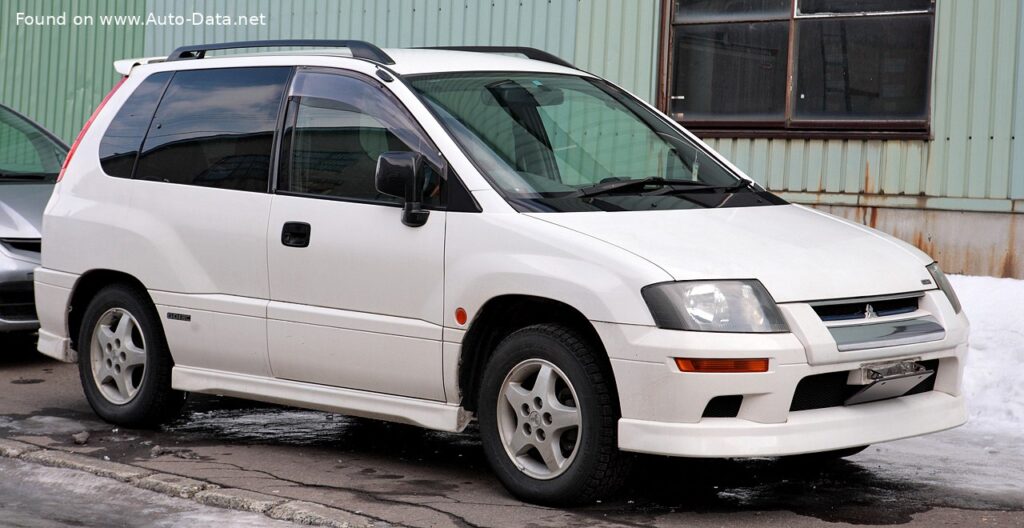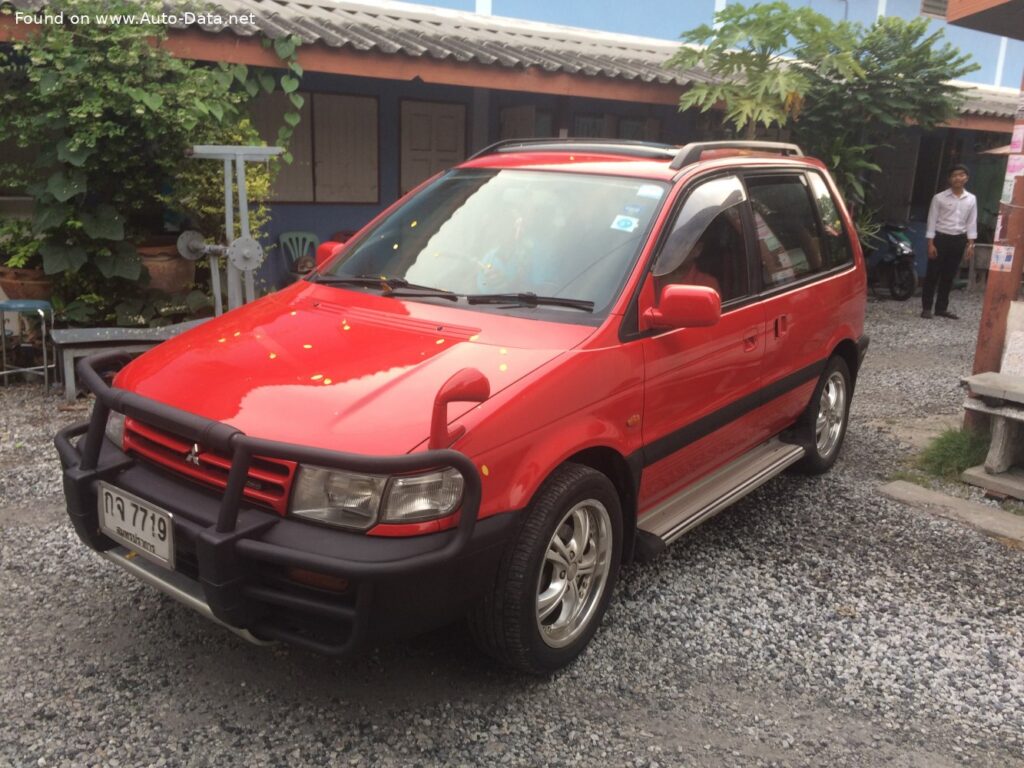
The Mitsubishi RVR (E-N23W) represents a significant entry in the burgeoning compact minivan segment of the early 1990s, a period when manufacturers began exploring more versatile and family-friendly alternatives to traditional sedans and station wagons. Launched in 1991 and produced until 1997, this first-generation RVR was a pioneering vehicle that blurred the lines between a conventional car and a larger people mover. Known in various international markets as the Mitsubishi Space Runner, Mitsubishi Space Wagon (for its longer wheelbase variant), and in North America as the Dodge/Plymouth Colt Vista, Eagle Summit, or Mitsubishi Expo LRV, the RVR (E-N23W) carved out a niche for itself with its relatively compact footprint, elevated driving position, and adaptable interior. Its primary market was Japan and parts of Europe and Asia, where urban environments favored smaller, more maneuverable vehicles that still offered substantial utility. This particular variant, the 1.8 i 16V Z (120 Hp) Automatic, showcased Mitsubishi’s commitment to delivering a practical, albeit modestly powered, vehicle designed for everyday family use and urban commuting.
Engineering and Performance of the Mitsubishi RVR (E-N23W)
At the heart of the Mitsubishi RVR (E-N23W) 1.8 i 16V Z (120 Hp) Automatic was a robust and reliable 1.8-liter (1834 cm3 or 111.92 cu. in.) naturally aspirated inline-four gasoline engine. This powerplant was engineered for efficiency and durability, characteristic of Mitsubishi’s offerings during this era. Featuring a multi-port manifold injection system and an OHC (Overhead Camshaft) valvetrain with four valves per cylinder, the engine produced a respectable 120 horsepower at 6000 rpm. This power output, especially for a compact minivan in the early 1990s, was adequate for its intended purpose, providing sufficient acceleration for city driving and comfortable cruising on highways. The engine’s maximum torque of 159 Nm (117.27 lb.-ft.) was delivered at a lower 4500 rpm, ensuring accessible pulling power for daily tasks and moderate loads.
The engine’s configuration was a front, transverse layout, driving the front wheels through a 4-speed automatic transmission. This drivetrain architecture was a common and practical choice for minivans of the period, offering a good balance of interior space, cost-effectiveness, and predictable handling. The transmission, while not as sophisticated as modern multi-speed units, was designed for smooth shifts and ease of use, contributing to a relaxed driving experience. The RVR (E-N23W) could achieve a maximum speed of 185 km/h (114.95 mph), which was competitive for its segment. Fuel economy was rated at a combined 6.7 liters per 100 km, translating to approximately 35.1 US mpg or 42.2 UK mpg, a commendable figure considering the vehicle’s size and the technology available at the time. This efficiency made it an attractive option for budget-conscious families. The engine’s compression ratio of 9.5:1, combined with a cylinder bore of 81 mm (3.19 in.) and a piston stroke of 89 mm (3.5 in.), indicated a design optimized for a balance of power and fuel efficiency rather than outright performance. With a weight-to-power ratio of 10.1 kg/Hp (99.2 Hp/tonne) and a weight-to-torque ratio of 7.6 kg/Nm (131.4 Nm/tonne), the RVR offered a driving dynamic that prioritized practicality and comfort over sportiness, aligning perfectly with its role as a versatile family vehicle.
Design, Features, and Practicality
The design of the Mitsubishi RVR (E-N23W) was a notable departure from the boxy minivans that dominated the market, featuring a more car-like silhouette and a distinctive, slightly rounded aesthetic that was modern for its time. Classified as a minivan, its compact dimensions—length of 4290 mm (168.9 in.), width of 1695 mm (66.73 in.), and height of 1625 mm (63.98 in.)—made it highly maneuverable in tight urban settings, a significant advantage in its primary markets. The wheelbase of 2520 mm (99.21 in.) contributed to a stable ride quality, while the front and rear track of 1460 mm (57.48 in.) ensured a balanced stance.
Despite its compact exterior, the RVR (E-N23W) was ingeniously designed to maximize interior space and versatility. It featured a 4-door configuration and seating for four occupants, emphasizing comfort and individual space, particularly for rear passengers. The true highlight was its cargo capacity: a minimum trunk space of 676 liters (23.87 cu. ft.) that could expand dramatically to a maximum of 1630 liters (57.56 cu. ft.) with the rear seats folded or removed. This flexibility made it incredibly practical for carrying luggage, groceries, or even larger items, reinforcing its utility as a family vehicle or a compact utility vehicle for active lifestyles. The curb weight of 1210 kg (2667.59 lbs.) further underscored its compact and efficient design.
From a mechanical and safety standpoint, the RVR (E-N23W) was equipped with features that were considered advanced for a vehicle in its class during the early 1990s. The suspension system comprised a spring strut setup for the front and coil springs at the rear, a configuration designed to provide a comfortable ride while maintaining reasonable handling characteristics. Braking performance was managed by ventilated discs at the front, offering superior heat dissipation and stopping power, complemented by reliable drum brakes at the rear. A crucial safety feature for the era was the inclusion of ABS (Anti-lock Braking System), which significantly enhanced driver control during emergency braking situations, a testament to Mitsubishi’s forward-thinking approach to automotive safety. Steering was facilitated by a rack and pinion system with hydraulic power steering, providing ease of maneuverability at low speeds and a stable feel at higher velocities. The vehicle rode on 185/70 R14 S tires mounted on 14-inch wheel rims, a practical choice offering a good balance of ride comfort and grip for daily driving conditions. With a fuel tank capacity of 55 liters (14.53 US gal), the RVR offered a decent range for both urban commutes and longer journeys, solidifying its reputation as a well-rounded and versatile compact minivan.
Technical Specifications
| Brand | Mitsubishi |
| Model | RVR |
| Generation | RVR (E-N23W) |
| Type (Engine) | 1.8 i 16V Z (120 Hp) Automatic |
| Start of production | 1991 year |
| End of production | 1997 year |
| Powertrain Architecture | Internal Combustion engine |
| Body type | Minivan |
| Seats | 4 |
| Doors | 4 |
| Fuel consumption (economy) – combined | 6.7 l/100 km (35.1 US mpg) |
| Fuel Type | Petrol (Gasoline) |
| Maximum speed | 185 km/h (114.95 mph) |
| Weight-to-power ratio | 10.1 kg/Hp (99.2 Hp/tonne) |
| Weight-to-torque ratio | 7.6 kg/Nm (131.4 Nm/tonne) |
| Power | 120 Hp @ 6000 rpm. |
| Power per litre | 65.4 Hp/l |
| Torque | 159 Nm @ 4500 rpm. (117.27 lb.-ft.) |
| Engine layout | Front, Transverse |
| Engine displacement | 1834 cm3 (111.92 cu. in.) |
| Number of cylinders | 4 |
| Engine configuration | Inline |
| Cylinder Bore | 81 mm (3.19 in.) |
| Piston Stroke | 89 mm (3.5 in.) |
| Compression ratio | 9.5:1 |
| Number of valves per cylinder | 4 |
| Fuel injection system | Multi-port manifold injection |
| Engine aspiration | Naturally aspirated engine |
| Valvetrain | OHC |
| Kerb Weight | 1210 kg (2667.59 lbs.) |
| Trunk (boot) space – minimum | 676 l (23.87 cu. ft.) |
| Trunk (boot) space – maximum | 1630 l (57.56 cu. ft.) |
| Fuel tank capacity | 55 l (14.53 US gal) |
| Length | 4290 mm (168.9 in.) |
| Width | 1695 mm (66.73 in.) |
| Height | 1625 mm (63.98 in.) |
| Wheelbase | 2520 mm (99.21 in.) |
| Front track | 1460 mm (57.48 in.) |
| Rear (Back) track | 1460 mm (57.48 in.) |
| Drivetrain Architecture | Front wheel drive (ICE drives front wheels) |
| Drive wheel | Front wheel drive |
| Number of gears and type of gearbox | 4 gears, automatic transmission |
| Front suspension | Spring Strut |
| Rear suspension | Coil spring |
| Front brakes | Ventilated discs |
| Rear brakes | Drum |
| Assisting systems | ABS (Anti-lock braking system) |
| Steering type | Steering rack and pinion |
| Power steering | Hydraulic Steering |
| Tires size | 185/70 R14 S |
| Wheel rims size | 14 |