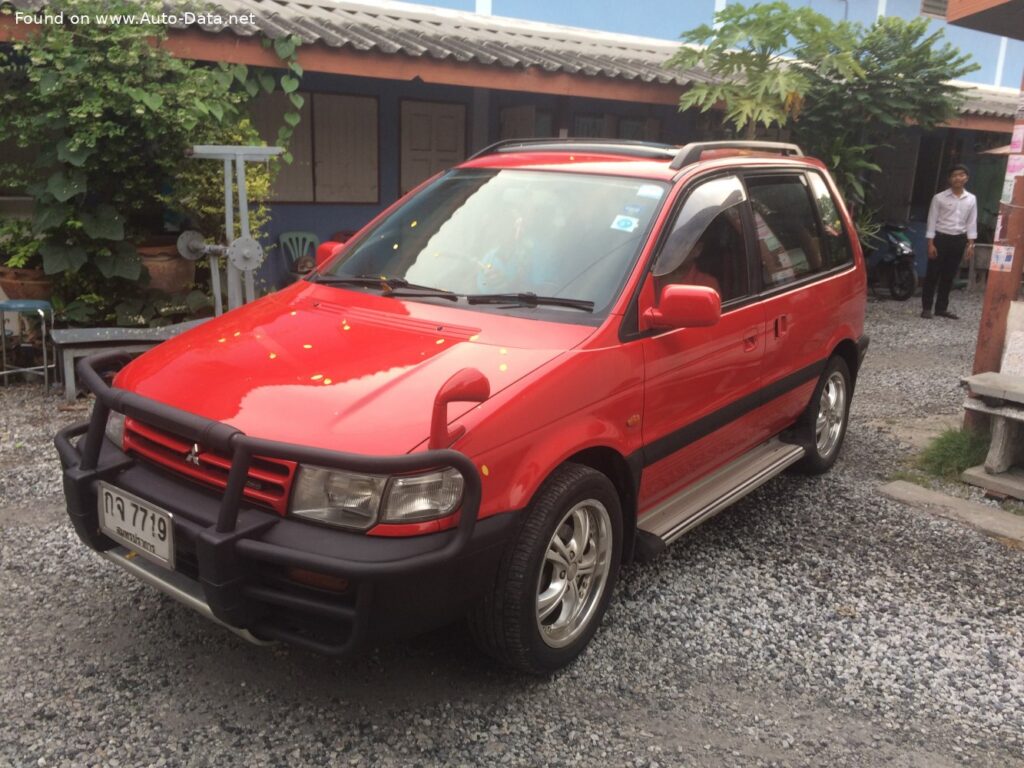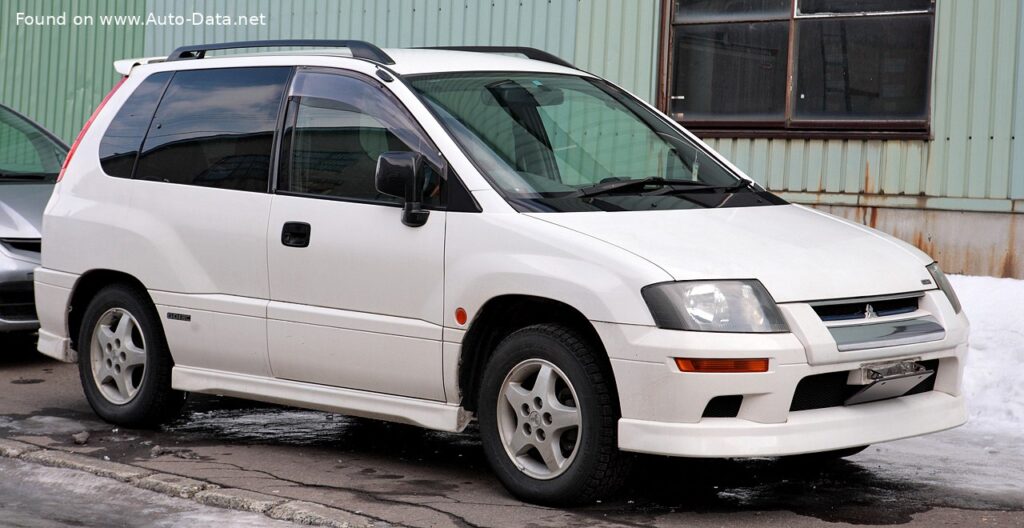
The Mitsubishi RVR (N61W) 1.8 i 16V GDI (140 Hp) represents a compelling chapter in Mitsubishi’s history of versatile and practical vehicles. Produced from 1999 to 2002, this iteration of the RVR, specifically the N61W generation, firmly established itself in the compact minivan segment, primarily targeting the Japanese domestic market (JDM) and select Asian and European regions. Unlike its more rugged SUV-derived brethren, the RVR N61W, often known as the Space Runner in some European markets or the Space Wagon/Chariot Grandis in a larger form, was designed as a family-friendly vehicle that prioritized interior space, maneuverability, and efficiency. Its unique blend of a relatively compact footprint with a spacious five-seat configuration made it an attractive option for urban families seeking utility without the bulk of a full-size minivan. This particular variant, powered by Mitsubishi’s innovative Gasoline Direct Injection (GDI) engine, showcased the brand’s commitment to advanced powertrain technology, offering a balance of performance and fuel economy that was noteworthy for its time.
The Powertrain of the Mitsubishi RVR (N61W) 1.8 i 16V GDI (140 Hp)
Engine Specifications and Innovation
At the heart of the Mitsubishi RVR (N61W) 1.8 i 16V GDI (140 Hp) lies an engineering marvel for its era: a 1.8-liter (1834 cubic centimeters or 111.92 cubic inches) inline four-cylinder engine. This powerplant was distinguished by Mitsubishi’s pioneering Gasoline Direct Injection (GDI) technology. While common today, GDI was a significant advancement in the late 1990s, allowing for precise control over fuel delivery directly into the combustion chamber. This method facilitated a leaner fuel-air mixture, particularly at lower engine speeds, leading to improved fuel efficiency and reduced emissions compared to conventional port fuel injection systems. The engine’s architecture featured a front, transverse layout, optimizing space within the engine bay and contributing to the vehicle’s overall compact design.
The 1.8-liter GDI engine was capable of producing a robust 140 horsepower at 6000 revolutions per minute, a respectable output for a naturally aspirated engine of its size and application. This translated to a power-per-liter rating of 76.3 Hp/l, indicating efficient power generation from its displacement. Torque output was equally impressive, peaking at 181 Newton-meters (133.5 lb.-ft.) at a relatively accessible 3750 rpm. This low-to-mid-range torque characteristic ensured responsive acceleration and adequate pulling power for daily driving scenarios, whether navigating city streets or cruising on highways. The engine’s internal specifications further underscore its advanced design: a cylinder bore of 81 mm (3.19 in) combined with a piston stroke of 89 mm (3.5 in), and a high compression ratio of 12:1. This elevated compression ratio was made possible by the precise fuel delivery of the GDI system, which mitigated the risk of pre-ignition (knocking), further enhancing efficiency and power. Each of the four cylinders featured four valves, totaling 16 valves, allowing for optimal airflow into and out of the combustion chambers, contributing to the engine’s breathing efficiency and overall performance.
Performance Dynamics and Drivetrain
The powertrain architecture of the Mitsubishi RVR (N61W) 1.8 i 16V GDI (140 Hp) was designed with practicality and ease of use in mind. Power was delivered to the front wheels, making it a front-wheel-drive vehicle. This configuration is typical for compact minivans, offering good traction, packaging efficiency, and a lighter overall weight compared to all-wheel-drive systems. The engine was paired with a 4-speed automatic transmission, a common choice for family vehicles of that era, providing smooth and convenient gear shifts for a comfortable driving experience. While a 4-speed automatic might seem modest by today’s standards, it was a reliable and effective solution for the RVR’s intended purpose, balancing urban drivability with highway cruising.
In terms of weight, the RVR (N61W) had a kerb weight of 1410 kg (3108.52 lbs), with a maximum gross weight of 1630 kg (3593.53 lbs). This allowed for a maximum load capacity of 220 kg (485.02 lbs), accommodating passengers and their belongings without significantly impacting performance. These figures result in a weight-to-power ratio of 10.1 kg/Hp (approximately 22.27 lbs/Hp) and a weight-to-torque ratio of 7.8 kg/Nm (approximately 17.2 lbs/Nm). These ratios indicate that the RVR possessed sufficient power for its segment, ensuring it felt nimble enough for city driving and capable of maintaining highway speeds. The vehicle’s fuel tank capacity of 63 liters (16.64 US gallons) provided a decent cruising range, making it suitable for both daily commutes and longer family trips.
Design and Practicality of the Mitsubishi RVR (N61W)
Exterior and Interior Design Philosophy
The Mitsubishi RVR (N61W) adopted a functional yet appealing design that was characteristic of compact minivans or multi-purpose vehicles (MPVs) from the late 1990s. Its body type was distinctly a minivan, offering five doors and a five-seat configuration, prioritizing passenger comfort and cargo versatility within a manageable footprint. The exterior dimensions underscore its compact nature: a length of 4300 mm (169.29 in), a width of 1695 mm (66.73 in), and a height of 1650 mm (64.96 in). These dimensions made the RVR easy to maneuver and park in congested urban environments, a crucial advantage in its primary markets where space is often at a premium. The wheelbase measured 2550 mm (100.39 in), providing a stable ride and contributing to the spaciousness of the cabin relative to its exterior size.
The design ethos was one of practicality and understated elegance, avoiding excessive styling flourishes in favor of clean lines and a purposeful stance. The relatively tall roofline contributed to generous headroom for all occupants, enhancing the sense of space. Inside, the five-seat layout was versatile, likely featuring rear seats that could be folded or adjusted to expand cargo capacity, a common and highly valued feature in minivans. The interior materials and ergonomics would have been designed for durability and ease of use, reflecting its role as a dependable family vehicle. The front and rear tracks, measuring 1460 mm (57.48 in) and 1465 mm (57.68 in) respectively, contributed to a stable road presence and predictable handling characteristics.
Ride, Handling, and Safety Features
The RVR (N61W) was engineered to provide a comfortable and secure driving experience. Its suspension system utilized coil springs at both the front and rear, a well-proven setup that balances ride comfort with handling stability. This configuration effectively absorbed road imperfections, ensuring a smooth journey for passengers. Braking performance was handled by ventilated discs at the front, offering superior heat dissipation and consistent stopping power, complemented by solid disc brakes at the rear. This all-disc brake setup was a standard for safety and performance in its class.
An essential safety feature for its production period was the inclusion of ABS (Anti-lock Braking System). ABS was a significant advancement, preventing wheel lock-up during hard braking and allowing the driver to maintain steering control, thereby reducing the risk of accidents. Steering was managed by a responsive rack and pinion system, enhanced by hydraulic power steering. This hydraulic assist provided a natural and communicative steering feel, making the vehicle easy to pilot at low speeds, such as during parking maneuvers, while offering adequate feedback at higher speeds. The RVR came equipped with 205/65 R15 tires, a sensible choice that provided a good balance of grip, ride comfort, and durability suitable for a family-oriented vehicle.
Technical Specifications
| Brand | Mitsubishi |
| Model | RVR |
| Generation | RVR (N61W) |
| Type (Engine) | 1.8 i 16V GDI (140 Hp) |
| Start of production | 1999 year |
| End of production | 2002 year |
| Powertrain Architecture | Internal Combustion engine |
| Body type | Minivan |
| Seats | 5 |
| Doors | 5 |
| Fuel Type | Petrol (Gasoline) |
| Weight-to-power ratio | 10.1 kg/Hp, 99.3 Hp/tonne |
| Weight-to-torque ratio | 7.8 kg/Nm, 128.4 Nm/tonne |
| Power | 140 Hp @ 6000 rpm. |
| Power per litre | 76.3 Hp/l |
| Torque | 181 Nm @ 3750 rpm. (133.5 lb.-ft. @ 3750 rpm.) |
| Engine layout | Front, Transverse |
| Engine displacement | 1834 cm3 (111.92 cu. in.) |
| Number of cylinders | 4 |
| Engine configuration | Inline |
| Cylinder Bore | 81 mm (3.19 in.) |
| Piston Stroke | 89 mm (3.5 in.) |
| Compression ratio | 12:1 |
| Number of valves per cylinder | 4 |
| Fuel injection system | Direct injection |
| Engine aspiration | Naturally aspirated engine |
| Kerb Weight | 1410 kg (3108.52 lbs.) |
| Max. weight | 1630 kg (3593.53 lbs.) |
| Max load | 220 kg (485.02 lbs.) |
| Fuel tank capacity | 63 l (16.64 US gal) |
| Length | 4300 mm (169.29 in.) |
| Width | 1695 mm (66.73 in.) |
| Height | 1650 mm (64.96 in.) |
| Wheelbase | 2550 mm (100.39 in.) |
| Front track | 1460 mm (57.48 in.) |
| Rear (Back) track | 1465 mm (57.68 in.) |
| Drivetrain Architecture | The Internal combustion engine (ICE) drives the front wheels of the vehicle. |
| Drive wheel | Front wheel drive |
| Number of gears and type of gearbox | 4 gears, automatic transmission |
| Front suspension | Coil spring |
| Rear suspension | Coil spring |
| Front brakes | Ventilated discs |
| Rear brakes | Disc |
| Assisting systems | ABS (Anti-lock braking system) |
| Steering type | Steering rack and pinion |
| Power steering | Hydraulic Steering |
| Tires size | 205/65 R15 |