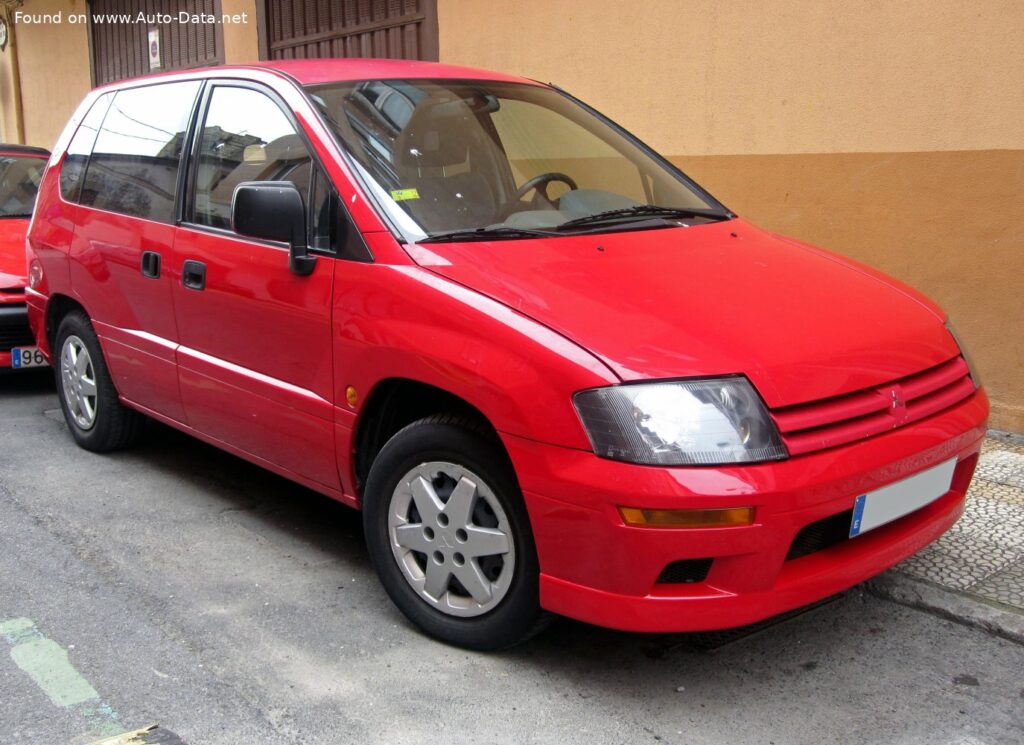
The Mitsubishi Space Runner (N50) 2.4 GDI, produced between 1999 and 2002, is a compact minivan primarily aimed at the European market. While not officially sold in the United States, it represents Mitsubishi’s offering in the increasingly popular multi-purpose vehicle (MPV) segment of the late 1990s and early 2000s. The Space Runner, known as the Mitsubishi RVR in some markets, offered a blend of practicality, fuel efficiency, and a relatively sporty driving experience for its class. This generation, the N50, was a significant update to the original Space Runner, featuring improved styling, enhanced safety features, and the introduction of Mitsubishi’s GDI (Gasoline Direct Injection) technology.
Mitsubishi Space Runner (N50) 2.4 GDI: An Overview
The N50 Space Runner was designed to appeal to families and individuals seeking a versatile vehicle capable of handling both daily commutes and weekend adventures. Its compact dimensions made it easy to maneuver in urban environments, while its spacious interior and flexible seating arrangements provided ample room for passengers and cargo. The 2.4 GDI engine was a key selling point, offering a balance of performance and fuel economy thanks to its direct injection system. The Space Runner competed with vehicles like the Renault Scenic, Citroën Xsara Picasso, and Opel/Vauxhall Zafira in the European market.
Engine & Performance
The heart of the Space Runner (N50) 2.4 GDI is a 2.4-liter inline-four cylinder engine producing 150 horsepower at 5500 rpm and 225 Nm (165.95 lb.-ft.) of torque at 3500 rpm. This engine utilizes Mitsubishi’s GDI technology, which directly injects fuel into the combustion chamber, resulting in improved fuel efficiency and reduced emissions compared to traditional port fuel injection systems. The engine’s power output translates to a 0-60 mph acceleration time of approximately 9.9 seconds, and a top speed of 190 km/h (118.06 mph). The engine’s specific output is 63.8 horsepower per liter. Power is delivered to the front wheels via a five-speed manual transmission. The weight-to-power ratio of 9.3 kg/Hp and a weight-to-torque ratio of 6.2 kg/Nm contribute to a reasonably responsive driving experience for a vehicle of its size and class.
Design & Features
The Space Runner (N50) features a practical and functional design. Its minivan body style offers a high roofline and a large rear hatch, maximizing interior space and cargo capacity. The vehicle seats five passengers comfortably, and the rear seats can be folded down or removed entirely to create a larger cargo area. Trunk space ranges from a minimum of 430 liters (15.19 cu. ft.) to a maximum of 1800 liters (63.57 cu. ft.) with the rear seats folded. Styling cues included rounded edges and a relatively streamlined profile for a vehicle of its type. Safety features for the era included ABS (Anti-lock Braking System) as standard equipment. The interior was designed with practicality in mind, featuring durable materials and a user-friendly layout. Hydraulic power steering and a steering rack and pinion system provided responsive handling. The vehicle rides on 205/65 R15 tires.
Technical Specifications
| Brand | Mitsubishi |
| Model | Space Runner |
| Generation | Space Runner (N50) |
| Type (Engine) | 2.4 GDI (150 Hp) |
| Start of production | 1999 |
| End of production | 2002 |
| Powertrain Architecture | Internal Combustion engine |
| Body type | Minivan |
| Seats | 5 |
| Doors | 4 |
| Fuel consumption (urban) | 11.9 l/100 km (19.8 US mpg / 23.7 UK mpg) |
| Fuel consumption (extra urban) | 7.3 l/100 km (32.2 US mpg / 38.7 UK mpg) |
| Fuel Type | Petrol (Gasoline) |
| Acceleration 0 – 100 km/h | 10.4 sec |
| Acceleration 0 – 62 mph | 10.4 sec |
| Acceleration 0 – 60 mph | 9.9 sec |
| Maximum speed | 190 km/h (118.06 mph) |
| Weight-to-power ratio | 9.3 kg/Hp |
| Weight-to-torque ratio | 6.2 kg/Nm |
| Power | 150 Hp @ 5500 rpm |
| Power per litre | 63.8 Hp/l |
| Torque | 225 Nm @ 3500 rpm (165.95 lb.-ft. @ 3500 rpm) |
| Engine layout | Front, Transverse |
| Engine displacement | 2351 cm3 (143.47 cu. in.) |
| Number of cylinders | 4 |
| Engine configuration | Inline |
| Cylinder Bore | 86.5 mm (3.41 in.) |
| Piston Stroke | 100 mm (3.94 in.) |
| Compression ratio | 11.5:1 |
| Number of valves per cylinder | 4 |
| Fuel injection system | Direct injection |
| Engine aspiration | Naturally aspirated |
| Valvetrain | OHC |
| Kerb Weight | 1400 kg (3086.47 lbs.) |
| Max. weight | 1920 kg (4232.88 lbs.) |
| Max load | 520 kg (1146.4 lbs.) |
| Trunk (boot) space – minimum | 430 l (15.19 cu. ft.) |
| Trunk (boot) space – maximum | 1800 l (63.57 cu. ft.) |
| Fuel tank capacity | 63 l (16.64 US gal | 13.86 UK gal) |
| Length | 4290 mm (168.9 in.) |
| Width | 1695 mm (66.73 in.) |
| Height | 1650 mm (64.96 in.) |
| Wheelbase | 2550 mm (100.39 in.) |
| Front track | 1460 mm (57.48 in.) |
| Rear (Back) track | 1460 mm (57.48 in.) |
| Drivetrain Architecture | Front wheel drive |
| Number of gears and type of gearbox | 5 gears, manual transmission |
| Front suspension | Wishbone |
| Rear suspension | Coil spring |
| Front brakes | Ventilated discs |
| Rear brakes | Disc |
| Assisting systems | ABS (Anti-lock braking system) |
| Steering type | Steering rack and pinion |
| Power steering | Hydraulic Steering |
| Tires size | 205/65 R15 |
The Mitsubishi Space Runner (N50) 2.4 GDI, while not a common sight in the United States, represents a well-rounded and practical MPV that offered a compelling combination of performance, fuel efficiency, and versatility in the European market. Its GDI engine and functional design made it a popular choice for families and individuals seeking a reliable and adaptable vehicle.