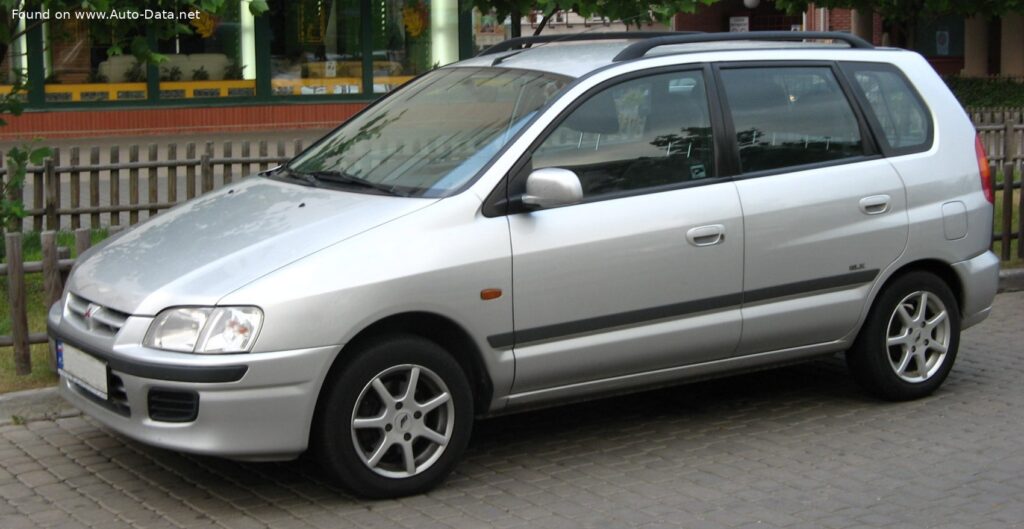
The Mitsubishi Space Star (DG0) is a compact minivan produced by Mitsubishi Motors between 1998 and 2000. Positioned as an affordable and practical family vehicle, the Space Star primarily served the European market, where the demand for small, versatile MPVs was significant. While not officially sold in the United States, understanding its specifications provides insight into the evolving trends of compact vehicle design during the late 1990s. The DG0 generation represented Mitsubishi’s attempt to capture a segment increasingly focused on maximizing interior space and fuel efficiency within a small footprint.
Mitsubishi Space Star (DG0): An Overview
The Space Star DG0 was designed to offer a spacious interior and good practicality for its size. It competed with vehicles like the Renault Scenic and Opel/Vauxhall Zafira, though at a more affordable price point. The vehicle’s five-door configuration and five-seat capacity made it a suitable option for small families or individuals needing flexible cargo space. The 1.3-liter engine was chosen for its balance of fuel economy and adequate performance for urban and highway driving in Europe.
Engine & Performance
The Mitsubishi Space Star DG0 1.3 16V was powered by a 1.3-liter, inline-four cylinder gasoline engine. This naturally aspirated engine produced 86 horsepower at 5000 rpm and 120 Nm (88.51 lb.-ft.) of torque at 4000 rpm. The engine featured multi-port fuel injection and a compression ratio of 10:1. While not a performance-oriented vehicle, the engine provided sufficient power for everyday driving. Acceleration from 0 to 100 km/h (0-62 mph) took 14.2 seconds, and 0 to 60 mph was achieved in approximately 13.5 seconds. The top speed was recorded at 170 km/h (105.63 mph). The engine’s power-to-weight ratio was 13.6 kg/Hp, and the torque-to-weight ratio was 9.8 kg/Nm. Fuel economy was a key consideration, with urban consumption rated at 8.6 l/100 km (27.4 US mpg), and extra-urban consumption at 5.6 l/100 km (42 US mpg). The engine was transversely mounted at the front of the vehicle, driving the front wheels through a five-speed manual transmission.
Design & Features
The Space Star DG0 was a five-door minivan with a relatively boxy, functional design. Its focus was on maximizing interior space rather than aggressive styling. The vehicle offered a practical interior layout with a flexible seating arrangement. Rear seats could be folded or removed to create a larger cargo area. Trunk space ranged from a minimum of 370 liters (13.07 cu. ft.) with all seats in place to a maximum of 1370 liters (48.38 cu. ft.) with the rear seats folded down. Safety features for the time included an Anti-lock Braking System (ABS). The steering was rack and pinion with hydraulic power assistance. The suspension utilized a wishbone setup at the front and a spring strut arrangement at the rear. The vehicle rode on 14-inch wheels with 175/65 R14 tires. The Space Star’s design prioritized practicality and affordability, making it a popular choice for families seeking a versatile and economical vehicle.
Technical Specifications
| Brand | Mitsubishi |
| Model | Space Star |
| Generation | Space Star (DG0) |
| Type (Engine) | 1.3 16V (86 Hp) |
| Start of production | 1998 |
| End of production | 2000 |
| Powertrain Architecture | Internal Combustion engine |
| Body type | Minivan |
| Seats | 5 |
| Doors | 5 |
| Fuel consumption (urban) | 8.6 l/100 km (27.4 US mpg) |
| Fuel consumption (extra urban) | 5.6 l/100 km (42 US mpg) |
| Fuel Type | Petrol (Gasoline) |
| Acceleration 0 – 100 km/h | 14.2 sec |
| Acceleration 0 – 62 mph | 14.2 sec |
| Acceleration 0 – 60 mph | 13.5 sec |
| Maximum speed | 170 km/h (105.63 mph) |
| Weight-to-power ratio | 13.6 kg/Hp |
| Weight-to-torque ratio | 9.8 kg/Nm |
| Power | 86 Hp @ 5000 rpm |
| Torque | 120 Nm @ 4000 rpm (88.51 lb.-ft. @ 4000 rpm) |
| Engine layout | Front, Transverse |
| Engine displacement | 1299 cm3 (79.27 cu. in.) |
| Number of cylinders | 4 |
| Engine configuration | Inline |
| Cylinder Bore | 71 mm (2.8 in.) |
| Piston Stroke | 82 mm (3.23 in.) |
| Compression ratio | 10:1 |
| Number of valves per cylinder | 4 |
| Fuel injection system | Multi-port manifold injection |
| Engine aspiration | Naturally aspirated |
| Kerb Weight | 1170 kg (2579.41 lbs.) |
| Max. weight | 1655 kg (3648.65 lbs.) |
| Max load | 485 kg (1069.24 lbs.) |
| Trunk (boot) space – minimum | 370 l (13.07 cu. ft.) |
| Trunk (boot) space – maximum | 1370 l (48.38 cu. ft.) |
| Fuel tank capacity | 55 l (14.53 US gal | 12.1 UK gal) |
| Length | 4030 mm (158.66 in.) |
| Width | 1715 mm (67.52 in.) |
| Height | 1515 mm (59.65 in.) |
| Wheelbase | 2500 mm (98.43 in.) |
| Front track | 1475 mm (58.07 in.) |
| Rear (Back) track | 1470 mm (57.87 in.) |
| Drivetrain Architecture | Front wheel drive |
| Number of gears and type of gearbox | 5 gears, manual transmission |
| Front suspension | Wishbone |
| Rear suspension | Spring Strut |
| Front brakes | Disc |
| Rear brakes | Drum |
| Assisting systems | ABS (Anti-lock braking system) |
| Steering type | Steering rack and pinion |
| Power steering | Hydraulic Steering |
| Tires size | 175/65 R14 |
| Wheel rims size | 14 |
The Mitsubishi Space Star DG0, while not a groundbreaking vehicle, represented a practical and affordable option in the European compact minivan segment. Its focus on maximizing interior space and fuel efficiency made it a popular choice for families and individuals seeking a versatile vehicle for everyday use. Although it didn’t reach American shores, its design and engineering reflect the broader trends in compact vehicle development during the late 1990s.