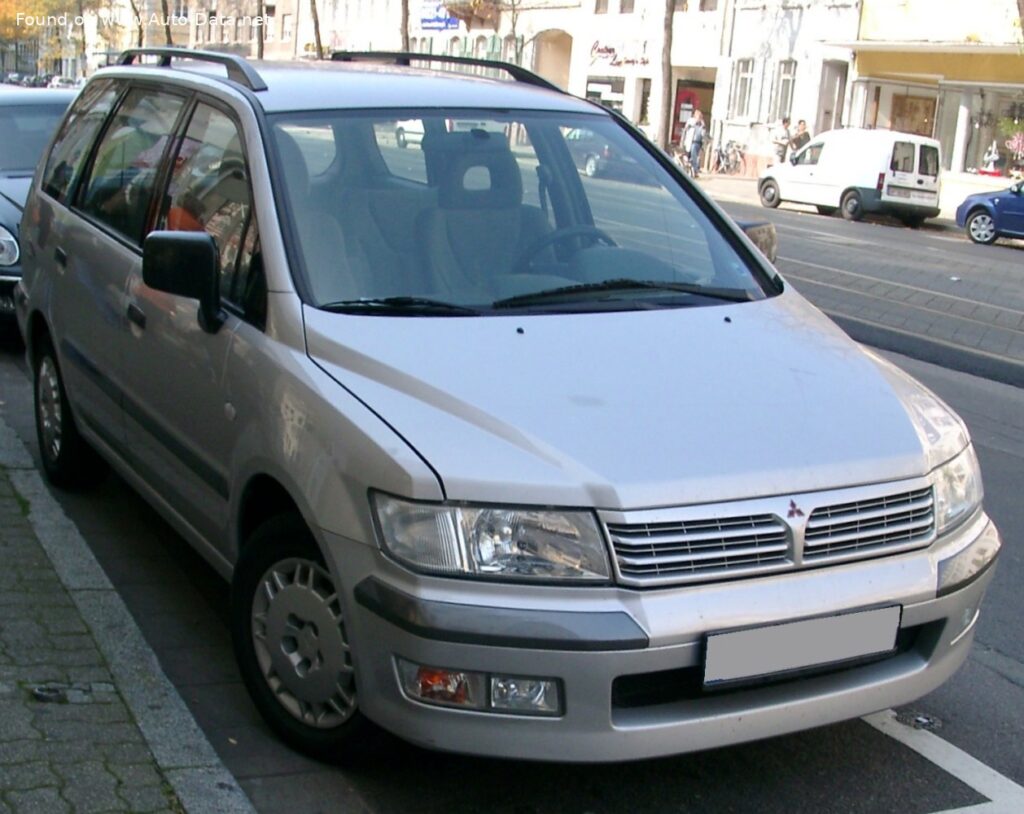
The Mitsubishi Space Wagon III 2.4 GDI (150 Hp), produced between 1998 and 2002, represents the third generation of Mitsubishi’s popular multi-purpose vehicle (MPV). While not widely sold in the United States, the Space Wagon held a significant position in the European and Asian markets as a practical and spacious family vehicle. It competed with other compact MPVs like the Renault Scenic, Citroën Xsara Picasso, and Toyota Picnic, offering a blend of affordability, versatility, and relatively efficient performance. The Space Wagon III aimed to improve upon its predecessors with enhanced styling, increased interior space, and the introduction of Mitsubishi’s GDI (Gasoline Direct Injection) technology.
Mitsubishi Space Wagon III: An Overview
The Space Wagon III was designed to cater to families needing a flexible and comfortable vehicle for both daily commutes and longer journeys. Its seven-seat configuration, combined with a relatively compact footprint, made it a popular choice for urban dwellers. The introduction of the 2.4-liter GDI engine was a key feature, promising improved fuel economy and power delivery compared to earlier models. The vehicle’s design focused on maximizing interior space and practicality, with features like sliding rear doors and a configurable seating arrangement.
Engine & Performance
The heart of the Space Wagon III 2.4 GDI is a 2.4-liter inline-four cylinder engine. This engine utilizes Mitsubishi’s Gasoline Direct Injection (GDI) technology, which directly injects fuel into the combustion chamber, allowing for more precise fuel control and improved combustion efficiency. This results in a power output of 150 horsepower at 5500 rpm and 225 Nm (165.95 lb.-ft.) of torque at 3500 rpm. The engine’s power-to-weight ratio is 10.1 kg/Hp, or 99.3 Hp/tonne, providing adequate performance for everyday driving. Acceleration from 0 to 100 km/h (0-62 mph) takes approximately 10 seconds, while 0-60 mph is achieved in around 9.5 seconds. The Space Wagon III has a maximum speed of 190 km/h (118.06 mph). The engine is transversely mounted at the front of the vehicle and is paired with a 5-speed manual transmission, driving the front wheels.
Design & Features
The Mitsubishi Space Wagon III is a five-door minivan with a seating capacity of seven passengers. Its design is characterized by a relatively boxy shape, maximizing interior space. Sliding rear doors provide easy access to the second and third-row seats, a feature particularly appreciated by families. The interior is designed with practicality in mind, featuring durable materials and a configurable seating arrangement. The second-row seats can be folded or removed to create more cargo space. Safety features for the era included ABS (Anti-lock Braking System) and hydraulic power steering. While not boasting the advanced safety technologies of modern vehicles, these features represented a significant step forward in vehicle safety during the late 1990s and early 2000s. The trunk space, with all seats in use, is 240 liters (8.48 cu. ft.), expanding considerably with the rear seats folded down. The vehicle’s dimensions are 4600 mm (181.1 in) in length, 1775 mm (69.88 in) in width, and 1650 mm (64.96 in) in height, with a wheelbase of 2780 mm (109.45 in).
Technical Specifications
| Brand | Mitsubishi |
| Model | Space Wagon |
| Generation | Space Wagon III |
| Type (Engine) | 2.4 GDI (150 Hp) |
| Start of production | 1998 |
| End of production | 2002 |
| Powertrain Architecture | Internal Combustion engine |
| Body type | Minivan |
| Seats | 7 |
| Doors | 5 |
| Fuel Type | Petrol (Gasoline) |
| Acceleration 0 – 100 km/h | 10 sec |
| Acceleration 0 – 62 mph | 10 sec |
| Acceleration 0 – 60 mph | 9.5 sec |
| Maximum speed | 190 km/h (118.06 mph) |
| Weight-to-power ratio | 10.1 kg/Hp |
| Weight-to-torque ratio | 6.7 kg/Nm |
| Power | 150 Hp @ 5500 rpm |
| Power per litre | 63.8 Hp/l |
| Torque | 225 Nm @ 3500 rpm (165.95 lb.-ft. @ 3500 rpm) |
| Engine layout | Front, Transverse |
| Engine displacement | 2351 cm3 (143.47 cu. in.) |
| Number of cylinders | 4 |
| Engine configuration | Inline |
| Cylinder Bore | 86.5 mm (3.41 in.) |
| Piston Stroke | 100 mm (3.94 in.) |
| Compression ratio | 11.5:1 |
| Number of valves per cylinder | 4 |
| Fuel injection system | Direct injection |
| Engine aspiration | Naturally aspirated engine |
| Valvetrain | OHC |
| Kerb Weight | 1510 kg (3328.98 lbs.) |
| Max. weight | 2180 kg (4806.08 lbs.) |
| Max load | 670 kg (1477.1 lbs.) |
| Trunk (boot) space – maximum | 240 l (8.48 cu. ft.) |
| Fuel tank capacity | 63 l (16.64 US gal | 13.86 UK gal) |
| Length | 4600 mm (181.1 in.) |
| Width | 1775 mm (69.88 in.) |
| Height | 1650 mm (64.96 in.) |
| Wheelbase | 2780 mm (109.45 in.) |
| Front track | 1500 mm (59.06 in.) |
| Rear (Back) track | 1535 mm (60.43 in.) |
| Drivetrain Architecture | The Internal combustion engine (ICE) drives the front wheels of the vehicle. |
| Drive wheel | Front wheel drive |
| Number of gears and type of gearbox | 5 gears, manual transmission |
| Front suspension | Coil spring |
| Rear suspension | Coil spring |
| Front brakes | Disc |
| Rear brakes | Disc |
| Assisting systems | ABS (Anti-lock braking system) |
| Power steering | Hydraulic Steering |
| Tires size | 205/65 R15 |
The Mitsubishi Space Wagon III 2.4 GDI, while not a common sight on American roads, offered a compelling package for families in Europe and Asia. Its spacious interior, efficient GDI engine, and practical features made it a popular choice in the compact MPV segment. It represents a significant evolution in Mitsubishi’s MPV offerings, showcasing the company’s commitment to innovation and practicality.