
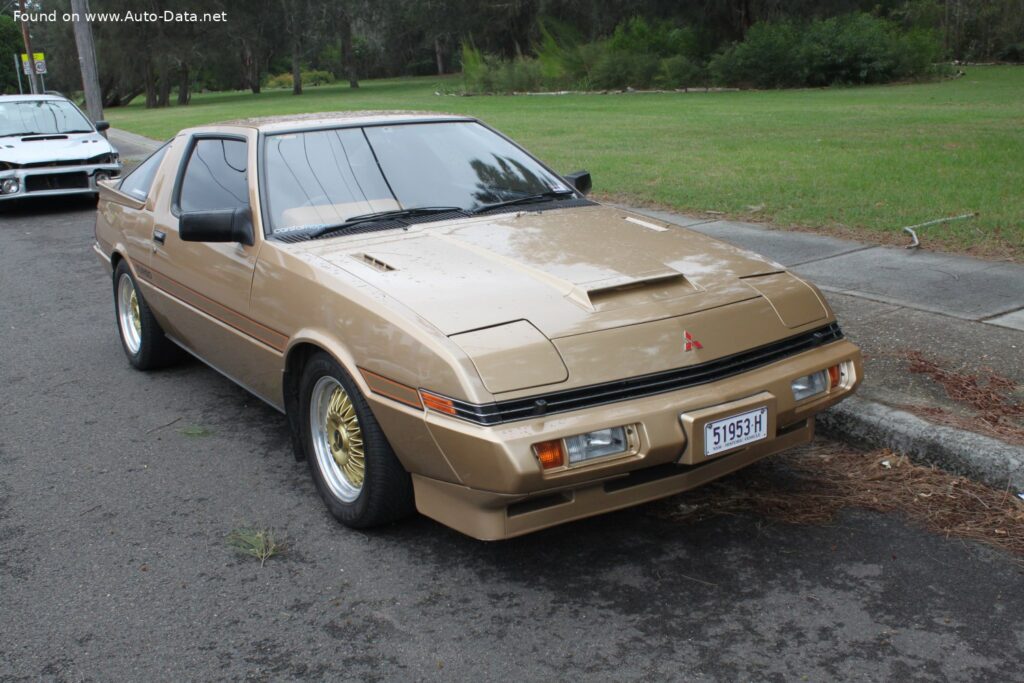
The Mitsubishi Starion, known as the Mitsubishi FTO in some markets, was a rear-wheel-drive sports coupe produced by Mitsubishi Motors from 1982 to 1989. The first generation, designated the A18_A, ran from 1982 to 1985 and represented Mitsubishi’s attempt to enter the highly competitive sports coupe segment, challenging established players like the Toyota Celica Supra and Nissan Z series. While not initially a huge sales success in the United States, the Starion gained a dedicated following for its turbocharged engine, sleek styling, and relatively affordable price point. It served as a technological showcase for Mitsubishi, incorporating features that would later appear on other models.
Mitsubishi Starion (A18_A): A First Generation Overview
The A18_A Starion was positioned as a performance-oriented coupe, offering a blend of style and speed. It was primarily marketed towards enthusiasts seeking a sporty driving experience. The car’s design drew inspiration from the Porsche 928, evident in its wedge-shaped profile and pop-up headlights. The Starion was a significant departure from Mitsubishi’s more utilitarian offerings, signaling the company’s ambition to compete in the global sports car market. It was never officially sold in the United Kingdom, but was available in other European markets.
Engine & Performance
The heart of the first-generation Starion was the 4G63-T 2.0-liter turbocharged inline-four engine. This engine, producing 170 horsepower at 5500 rpm and 245 Nm (180.7 lb-ft) of torque at 3500 rpm, provided brisk acceleration and a respectable top speed. The turbocharger significantly boosted performance, giving the Starion a competitive edge against naturally aspirated rivals. Power per liter was a notable 85.1 hp/l. The engine featured a single overhead camshaft (SOHC) valvetrain and a carburetor fuel injection system, which was typical for the era. Power was delivered to the rear wheels through a five-speed manual transmission. The weight-to-power ratio of 7 kg/Hp and weight-to-torque ratio of 4.9 kg/Nm contributed to its responsive handling. Fuel economy was rated at 7.3 l/100 km (32.2 US mpg) combined, and 9.6 l/100 km (24.5 US mpg) extra urban.
Design & Features
The Starion’s body was a two-door coupe with seating for five passengers, although rear seat space was limited. Its design emphasized aerodynamic efficiency, with a low-slung profile and a distinctive rear spoiler. The pop-up headlights were a defining styling feature, adding to the car’s sporty appearance. Inside, the Starion offered a relatively basic interior, focused on functionality rather than luxury. Standard features included power steering, ventilated disc brakes on all four wheels, and an anti-lock braking system (ABS), a relatively advanced feature for a car of its time. The McPherson strut suspension, both front and rear, provided a comfortable ride and competent handling. The car’s kerb weight of 1190 kg (2623.5 lbs) contributed to its agility. The fuel tank capacity was a generous 75 liters (19.81 US gal).
Technical Specifications
| Brand | Mitsubishi |
| Model | Starion |
| Generation | Starion (A18_A) |
| Type (Engine) | 2.0 Turbo ECi (A183A) (170 Hp) |
| Start of production | 1982 |
| End of production | 1985 |
| Powertrain Architecture | Internal Combustion engine |
| Body type | Coupe |
| Seats | 5 |
| Doors | 2 |
| Fuel consumption (economy) – extra urban | 9.6 l/100 km (24.5 US mpg, 29.4 UK mpg) |
| Fuel consumption (economy) – combined | 7.3 l/100 km (32.2 US mpg, 38.7 UK mpg) |
| Fuel Type | Petrol (Gasoline) |
| Weight-to-power ratio | 7 kg/Hp |
| Weight-to-torque ratio | 4.9 kg/Nm |
| Power | 170 Hp @ 5500 rpm |
| Power per litre | 85.1 Hp/l |
| Torque | 245 Nm @ 3500 rpm (180.7 lb.-ft. @ 3500 rpm) |
| Engine layout | Front, Longitudinal |
| Engine Model/Code | 4G63-T |
| Engine displacement | 1997 cm3 (121.86 cu. in.) |
| Number of cylinders | 4 |
| Engine configuration | Inline |
| Cylinder Bore | 85 mm (3.35 in.) |
| Piston Stroke | 88 mm (3.46 in.) |
| Compression ratio | 7.6:1 |
| Number of valves per cylinder | 2 |
| Fuel injection system | Carburettor |
| Engine aspiration | Turbocharger |
| Valvetrain | SOHC |
| Engine oil capacity | 4 l (4.23 US qt | 3.52 UK qt) |
| Coolant | 8.65 l (9.14 US qt | 7.61 UK qt) |
| Kerb Weight | 1190 kg (2623.5 lbs.) |
| Max. weight | 1650 kg (3637.63 lbs.) |
| Max load | 460 kg (1014.13 lbs.) |
| Fuel tank capacity | 75 l (19.81 US gal | 16.5 UK gal) |
| Permitted trailer load with brakes (12%) | 925 kg (2039.28 lbs.) |
| Permitted trailer load without brakes | 600 kg (1322.77 lbs.) |
| Permitted towbar download | 75 kg (165.35 lbs.) |
| Length | 4424 mm (174.17 in.) |
| Width | 1705 mm (67.13 in.) |
| Height | 1315 mm (51.77 in.) |
| Wheelbase | 2435 mm (95.87 in.) |
| Front track | 1385 mm (54.53 in.) |
| Rear (Back) track | 1395 mm (54.92 in.) |
| Ride height (ground clearance) | 155 mm (6.1 in.) |
| Minimum turning circle (turning diameter) | 9.6 m (31.5 ft.) |
| Drivetrain Architecture | Rear wheel drive |
| Number of gears and type of gearbox | 5 gears, manual transmission |
| Front suspension | Independent, type McPherson with coil spring and anti-roll bar |
| Rear suspension | McPherson, Transverse stabilizer |
| Front brakes | Ventilated discs, 255 mm |
| Rear brakes | Ventilated discs, 247 mm |
| Assisting systems | ABS (Anti-lock braking system) |
| Steering type | Cone worm with recirculation balls |
| Power steering | Hydraulic Steering |
| Tires size | Front wheel tires: 195/70 R14 Rear wheel tires: 195/70 R14 |
| Wheel rims size | Front wheel rims: 6J x 14 Rear wheel rims: 6J x 14 |
The Mitsubishi Starion A18_A, while not a runaway success, laid the groundwork for future Mitsubishi performance cars. It demonstrated the company’s engineering capabilities and its willingness to compete in the global sports car market. The model’s turbocharged engine and sporty styling have earned it a cult following among enthusiasts, and it remains a sought-after classic car today.
