
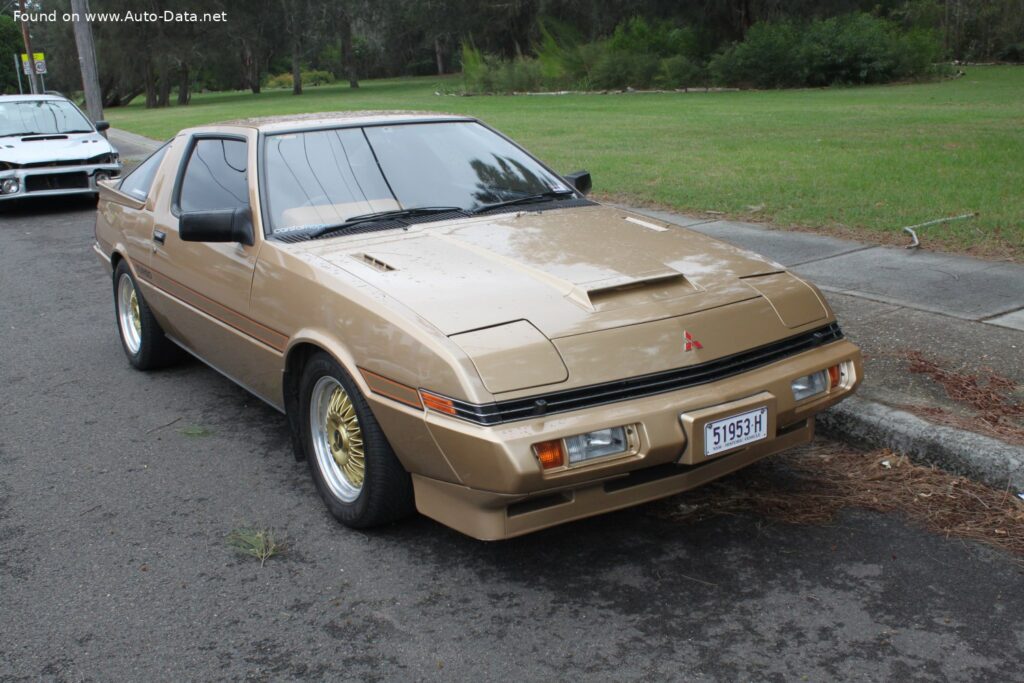
The Mitsubishi Starion (A18_A) is a rear-wheel-drive sports coupe produced by Mitsubishi Motors between 1982 and 1990. While never officially a large seller in the United States, the Starion gained a dedicated following for its turbocharged performance and distinctive styling. The model detailed here represents the later iterations of the Starion, specifically those produced between 1987 and 1990, featuring the 2.6-liter turbocharged ECi engine. This generation aimed to refine the original Starion’s formula, offering improved performance and a more sophisticated driving experience within the affordable sports car segment.
Mitsubishi Starion (A18_A): A Legacy of Turbocharged Performance
The Starion was Mitsubishi’s answer to popular sports coupes like the Toyota Celica Supra and Nissan Z series. Initially conceived as a competitor in the Japanese domestic market (JDM), the Starion was also exported to various countries, including the United States, Canada, Australia, and Europe. It quickly became known for its potent turbocharged engine and relatively affordable price point. The A18_A designation refers to the second generation of the Starion, which underwent significant revisions in styling and mechanical components compared to the original model. The 1987-1990 models, equipped with the 2.6-liter turbocharged engine, represent the peak of the Starion’s development.
Engine & Performance
The heart of the 1987-1990 Mitsubishi Starion is the G54B 2.6-liter inline-four cylinder engine, equipped with a turbocharger and multi-port fuel injection. This configuration produces 155 horsepower and 284 Nm (209.47 lb.-ft.) of torque at 2500 rpm. The engine’s longitudinal front-engine layout contributes to a balanced weight distribution, enhancing handling characteristics. Power is delivered to the rear wheels via a five-speed manual transmission. Performance figures include a 0-60 mph acceleration time of approximately 7.8 seconds and a top speed of 215 km/h (133.59 mph). The turbocharger provides a noticeable boost in power, making the Starion a surprisingly quick vehicle for its time. The engine’s power-to-weight ratio of 8.9 kg/Hp and torque-to-weight ratio of 4.9 kg/Nm further highlight its performance capabilities.
Design & Features
The Starion (A18_A) boasts a sleek, coupe body style with two doors and seating for four passengers. The design incorporates a low-slung profile, pop-up headlights (a signature feature of the era), and a distinctive rear spoiler. The interior, while functional, prioritizes a driver-focused experience. Standard features for the 1987-1990 models included ventilated front disc brakes, disc brakes in the rear, and an Anti-lock Braking System (ABS) for improved safety. The suspension system utilizes an independent McPherson strut setup in the front and a McPherson setup with a transverse stabilizer in the rear, providing a comfortable yet sporty ride. Power steering was also standard. The vehicle’s dimensions are 4430 mm (174.41 in) in length, 1745 mm (68.7 in) in width, and 1315 mm (51.77 in) in height, with a wheelbase of 2435 mm (95.87 in). The drag coefficient of 0.37 contributes to its aerodynamic efficiency.
Technical Specifications
| Brand | Mitsubishi |
| Model | Starion |
| Generation | Starion (A18_A) |
| Type (Engine) | 2.6 Turbo ECi (A187A) (155 Hp) |
| Start of production | 1987 |
| End of production | 1990 |
| Powertrain Architecture | Internal Combustion engine |
| Body type | Coupe |
| Seats | 4 |
| Doors | 2 |
| Fuel consumption (urban) | 13.6 l/100 km (17.3 US mpg / 20.8 UK mpg) |
| Fuel consumption (extra urban) | 8 l/100 km (29.4 US mpg / 35.3 UK mpg) |
| Fuel Type | Petrol (Gasoline) |
| Acceleration 0 – 100 km/h | 8.2 sec |
| Acceleration 0 – 62 mph | 8.2 sec |
| Acceleration 0 – 60 mph | 7.8 sec |
| Maximum speed | 215 km/h (133.59 mph) |
| Weight-to-power ratio | 8.9 kg/Hp |
| Weight-to-torque ratio | 4.9 kg/Nm |
| Power | 155 Hp |
| Power per litre | 60.7 Hp/l |
| Torque | 284 Nm @ 2500 rpm (209.47 lb.-ft. @ 2500 rpm) |
| Engine layout | Front, Longitudinal |
| Engine Model/Code | G54B |
| Engine displacement | 2555 cm3 (155.92 cu. in.) |
| Number of cylinders | 4 |
| Engine configuration | Inline |
| Cylinder Bore | 91.1 mm (3.59 in.) |
| Piston Stroke | 98 mm (3.86 in.) |
| Compression ratio | 7:1 |
| Number of valves per cylinder | 2 |
| Fuel injection system | Multi-port manifold injection |
| Engine aspiration | Turbocharger |
| Valvetrain | SOHC |
| Engine oil capacity | 4.2 l (4.44 US qt | 3.7 UK qt) |
| Kerb Weight | 1380 kg (3042.38 lbs.) |
| Max. weight | 1730 kg (3814 lbs.) |
| Max load | 350 kg (771.62 lbs.) |
| Fuel tank capacity | 75 l (19.81 US gal | 16.5 UK gal) |
| Max. roof load | 50 kg (110.23 lbs.) |
| Permitted trailer load with brakes (12%) | 1200 kg (2645.55 lbs.) |
| Permitted trailer load without brakes | 750 kg (1653.47 lbs.) |
| Permitted towbar download | 75 kg (165.35 lbs.) |
| Length | 4430 mm (174.41 in.) |
| Width | 1745 mm (68.7 in.) |
| Height | 1315 mm (51.77 in.) |
| Wheelbase | 2435 mm (95.87 in.) |
| Front track | 1470 mm (57.87 in.) |
| Rear track | 1456 mm (57.32 in.) |
| Drag coefficient (Cd) | 0.37 |
| Drive wheel | Rear wheel drive |
| Number of gears and type of gearbox | 5 gears, manual transmission |
| Front suspension | Independent, type McPherson with coil spring and anti-roll bar |
| Rear suspension | McPherson, Transverse stabilizer |
| Front brakes | Ventilated discs |
| Rear brakes | Disc |
| Assisting systems | ABS (Anti-lock braking system) |
| Steering type | Cone worm with recirculation balls |
| Power steering | Hydraulic Steering |
| Front tires | 205/55 R16 |
| Rear tires | 225/50 R16 |
| Front wheel rims | 7J x 16 |
| Rear wheel rims | 8J x 16 |
Despite its relatively short production run, the Mitsubishi Starion (A18_A) remains a sought-after vehicle among enthusiasts. Its combination of turbocharged performance, rear-wheel drive dynamics, and distinctive styling has cemented its place as a memorable sports coupe of the 1980s. While not as widely recognized as some of its competitors, the Starion offers a unique and engaging driving experience that continues to appeal to those seeking a classic turbocharged sports car.
