
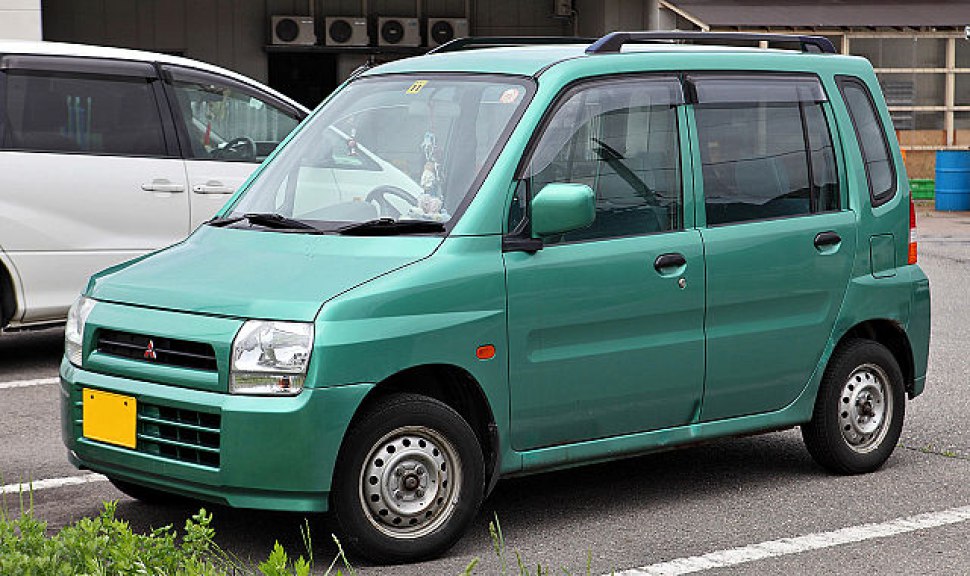
The Mitsubishi Toppo 657 B, produced between 1990 and 1999, represents a significant entry in the Japanese Kei car class, though it wasn’t directly marketed in the United States. The Toppo, meaning “top” in Japanese, was intended to be a practical and affordable urban vehicle, fitting within the stringent size and engine regulations for Kei cars. This meant a focus on maximizing interior space within a small footprint, making it popular in densely populated Japanese cities. While not sold in the US, understanding the Toppo provides insight into the innovative engineering and market demands of the Japanese automotive industry during the 1990s. It served as a competitor to models like the Suzuki Alto and Daihatsu Mira, offering a budget-friendly transportation solution.
Mitsubishi Toppo 657 B: A Kei Car Overview
The Toppo 657 B is a three-door hatchback designed to accommodate five passengers, a remarkable feat considering its diminutive size. It was a key model in Mitsubishi’s lineup, aimed at first-time car buyers, commuters, and families needing a second vehicle for city driving. The “657” designation refers to the engine displacement, a crucial factor in the Kei car classification. The Toppo’s success stemmed from its efficient use of space, relatively low running costs, and ease of maneuverability in tight urban environments. It was a staple of Japanese roads for nearly a decade, undergoing minor revisions during its production run but maintaining its core design philosophy.
Engine & Performance
The heart of the Mitsubishi Toppo 657 B is a 657cc inline three-cylinder petrol engine. This engine, producing 40 horsepower at 6000 rpm and 51 Nm (37.62 lb-ft) of torque at 4000 rpm, was specifically designed to meet Kei car regulations. Despite its small displacement, the engine offered a power-to-weight ratio of 59.7 horsepower per tonne, making the Toppo surprisingly nimble. The engine’s power per liter was a respectable 60.9 hp/l. Power is delivered to the front wheels via a four-speed manual transmission. The Toppo’s weight-to-power ratio of 16.8 kg/Hp further contributed to its lively driving experience. While not built for outright speed, the engine provided sufficient power for navigating city streets and short highway trips. The engine utilized a carburetor fuel injection system and an Overhead Camshaft (OHC) valvetrain, typical for vehicles of this era and price point. The engine layout was front, transverse, optimizing space within the small engine bay.
Design & Features
The Mitsubishi Toppo 657 B’s design prioritized practicality and space efficiency. Its three-door hatchback configuration allowed for relatively easy access to the rear seats, while the compact dimensions made parking and maneuvering in congested areas a breeze. The vehicle’s exterior styling was simple and functional, reflecting its budget-oriented positioning. Inside, the Toppo offered a surprisingly spacious cabin for its size, capable of comfortably seating five adults, although rear legroom was limited. Features were basic but included essential elements like front disc brakes and rear drum brakes, along with an Anti-lock Braking System (ABS) for improved safety. The steering system employed a rack and pinion setup, providing responsive handling. The Toppo rode on 135/80 R12 S tires. The interior was designed with durability and ease of cleaning in mind, utilizing hard-wearing materials. While not luxurious, the Toppo provided a functional and reliable transportation solution.
Technical Specifications
| Brand | Mitsubishi |
| Model | Toppo |
| Generation | Toppo |
| Type (Engine) | 657 B (40 Hp) |
| Start of production | 1990 year |
| End of production | 1999 year |
| Powertrain Architecture | Internal Combustion engine |
| Body type | Hatchback |
| Seats | 5 |
| Doors | 3 |
| Fuel Type | Petrol (Gasoline) |
| Weight-to-power ratio | 16.8 kg/Hp |
| Weight-to-torque ratio | 13.1 kg/Nm |
| Power | 40 Hp @ 6000 rpm |
| Power per litre | 60.9 Hp/l |
| Torque | 51 Nm @ 4000 rpm |
| Torque (lb-ft) | 37.62 lb.-ft. @ 4000 rpm |
| Engine layout | Front, Transverse |
| Engine displacement | 657 cm3 |
| Engine displacement (cu. in.) | 40.09 cu. in. |
| Number of cylinders | 3 |
| Engine configuration | Inline |
| Cylinder Bore | 65 mm |
| Cylinder Bore (in.) | 2.56 in. |
| Piston Stroke | 66 mm |
| Piston Stroke (in.) | 2.6 in. |
| Compression ratio | 9.8:1 |
| Number of valves per cylinder | 2 |
| Fuel injection system | Carburettor |
| Engine aspiration | Naturally aspirated engine |
| Valvetrain | OHC |
| Kerb Weight | 670 kg |
| Kerb Weight (lbs.) | 1477.1 lbs. |
| Fuel tank capacity | 32 l |
| Fuel tank capacity (US gal) | 8.45 US gal |
| Fuel tank capacity (UK gal) | 7.04 UK gal |
| Length | 3295 mm |
| Length (in.) | 129.72 in. |
| Width | 1395 mm |
| Width (in.) | 54.92 in. |
| Height | 1765 mm |
| Height (in.) | 69.49 in. |
| Wheelbase | 2260 mm |
| Wheelbase (in.) | 88.98 in. |
| Front track | 1215 mm |
| Front track (in.) | 47.83 in. |
| Rear track | 1215 mm |
| Rear track (in.) | 47.83 in. |
| Drivetrain Architecture | The Internal combustion engine (ICE) drives the front wheels of the vehicle. |
| Drive wheel | Front wheel drive |
| Number of gears | 4 gears |
| Type of gearbox | manual transmission |
| Front suspension | Spring Strut |
| Rear suspension | Coil spring |
| Front brakes | Disc |
| Rear brakes | Drum |
| Assisting systems | ABS (Anti-lock braking system) |
| Steering type | Steering rack and pinion |
| Tires size | 135/80 R12 S |
The Mitsubishi Toppo 657 B, while never officially available in the United States, remains a fascinating example of Japanese automotive engineering focused on efficiency and practicality. It exemplifies the Kei car philosophy, demonstrating how to maximize utility within a minimal footprint. Its enduring popularity in Japan speaks to its reliability and suitability for urban driving conditions.
