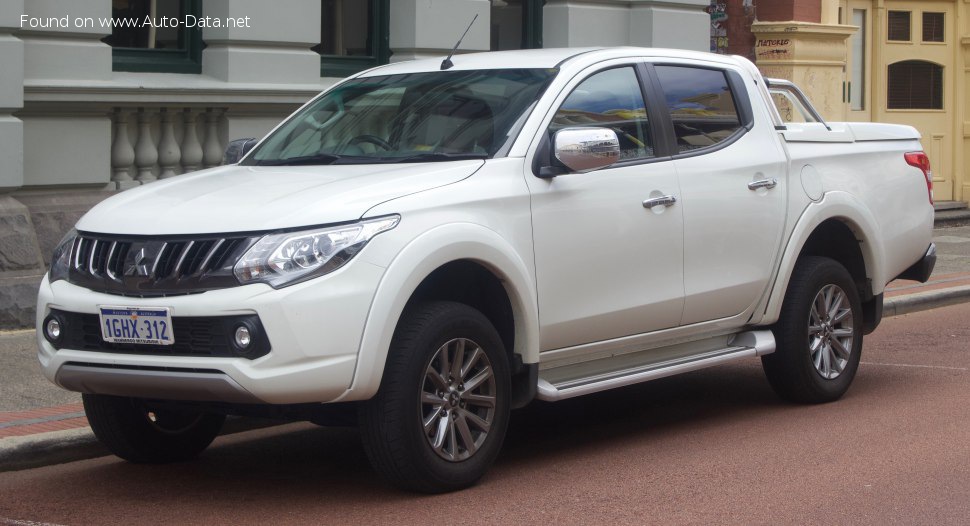
The Mitsubishi Triton V Double Cab Chassis (facelift 2019) represents a significant iteration of Mitsubishi’s globally popular pickup truck. While not widely sold in the United States, the Triton – known as the Mitsubishi L200 in many international markets – is a mainstay in Asia, Australia, Europe, and Latin America, prized for its robust build, practicality, and off-road capability. This fifth-generation model, specifically the 2019 facelift, brought updated styling, enhanced safety features, and refinements to the powertrain, solidifying its position as a competitive workhorse in the one-tonne pickup segment.
Mitsubishi Triton V Double Cab Chassis (facelift 2019)
The Triton’s appeal lies in its versatility. It caters to a broad spectrum of users, from commercial fleets requiring a dependable work vehicle to individuals seeking a rugged and capable truck for both work and leisure. The Double Cab configuration offers seating for five passengers, making it a practical choice for families, while the chassis variant provides a foundation for specialized bodywork or commercial applications. The 2019 facelift focused on improving the overall package, addressing customer feedback and aligning the Triton with contemporary market demands.
Engine & Performance
Powering the 2019 Mitsubishi Triton V Double Cab Chassis is a 2.4-liter (2442 cm3) inline-four cylinder diesel engine, designated the 4N15. This engine produces 181 horsepower at 3500 rpm and 430 Newton-meters (317.15 lb.-ft.) of torque at 2500 rpm. The engine utilizes a turbocharger with an intercooler to enhance performance and efficiency. A diesel commonrail fuel injection system ensures precise fuel delivery, contributing to both power output and reduced emissions. The engine also incorporates Mitsubishi’s MIVEC (Mitsubishi Innovative Valve timing Electronic Control) technology, optimizing valve timing for improved performance across the rev range. The power is delivered to all four wheels via a six-speed automatic transmission, providing smooth and efficient gear changes. The weight-to-power ratio stands at 10 kg/Hp, and 99.8 Hp/tonne, while the weight-to-torque ratio is 4.2 kg/Nm, or 237.2 Nm/tonne. Fuel consumption is rated at 8.6 liters per 100 kilometers (27.4 US mpg, 32.8 UK mpg, 11.6 km/l), with CO2 emissions of 225 g/km.
Design & Features
The Triton V Double Cab Chassis is a traditional pickup truck in terms of body style, featuring a four-door configuration and a separate chassis. The 2019 facelift brought subtle but noticeable changes to the exterior, including a revised front grille, updated headlights, and redesigned bumpers. These changes aimed to give the Triton a more modern and aggressive appearance. Inside, the cabin offers a functional and durable environment, designed to withstand the rigors of daily use. Key features include comfortable seating for five, a user-friendly infotainment system (specifications vary by market), and a range of safety features. The chassis configuration allows for customization, with options for flatbeds, tipper bodies, or other specialized equipment. The Triton boasts a ground clearance of 205 mm (8.07 in), an approach angle of 30°, and a ramp-over angle of 25°, enhancing its off-road capability. Practicality is a key strength, with a maximum payload capacity of 1087 kg (2396.42 lbs) and a maximum towing capacity of 3100 kg (6834.33 lbs) with brakes, and 750 kg (1653.47 lbs) without brakes.
Technical Specifications
| Brand | Mitsubishi |
| Model | Triton |
| Generation | Triton V Double Cab Chassis (facelift 2019) |
| Type (Engine) | 2.4L D4 (181 Hp) 4WD Automatic |
| Start of production | 2019 |
| End of production | 2023 |
| Powertrain Architecture | Internal Combustion engine |
| Body type | Pick-up |
| Seats | 5 |
| Doors | 4 |
| Fuel consumption (combined) | 8.6 l/100 km (27.4 US mpg, 32.8 UK mpg, 11.6 km/l) |
| CO2 emissions | 225 g/km |
| Fuel Type | Diesel |
| Weight-to-power ratio | 10 kg/Hp |
| Weight-to-torque ratio | 4.2 kg/Nm |
| Power | 181 Hp @ 3500 rpm |
| Torque | 430 Nm @ 2500 rpm (317.15 lb.-ft. @ 2500 rpm) |
| Engine layout | Front, Longitudinal |
| Engine Model/Code | 4N15 |
| Engine displacement | 2442 cm3 (149.02 cu. in.) |
| Number of cylinders | 4 |
| Engine configuration | Inline |
| Cylinder Bore | 86 mm (3.39 in.) |
| Piston Stroke | 105.1 mm (4.14 in.) |
| Number of valves per cylinder | 4 |
| Fuel injection system | Diesel Commonrail |
| Engine aspiration | Turbocharger, Intercooler |
| Valvetrain | MIVEC |
| Engine oil capacity | 6.7 l (7.08 US qt | 5.9 UK qt) |
| Coolant capacity | 7.7 l (8.14 US qt | 6.78 UK qt) |
| Kerb Weight | 1813 kg (3996.98 lbs.) |
| Max. weight | 2900 kg (6393.41 lbs.) |
| Max load | 1087 kg (2396.42 lbs.) |
| Fuel tank capacity | 75 l (19.81 US gal | 16.5 UK gal) |
| Permitted trailer load with brakes (12%) | 3100 kg (6834.33 lbs.) |
| Permitted trailer load without brakes | 750 kg (1653.47 lbs.) |
| Permitted towbar download | 310 kg (683.43 lbs.) |
| Width | 1815 mm (71.46 in.) |
| Height | 1780 mm (70.08 in.) |
| Wheelbase | 3000 mm (118.11 in.) |
| Ride height (ground clearance) | 205 mm (8.07 in.) |
| Drive wheel | All wheel drive (4×4) |
| Number of gears and type of gearbox | 6 gears, automatic transmission |
| Front suspension | Double wishbone |
| Rear suspension | Leaf spring |
| Front brakes | Ventilated discs, 294 mm |
| Rear brakes | Drum |
| Assisting systems | ABS (Anti-lock braking system) |
| Steering type | Steering rack and pinion |
| Power steering | Electric Steering |
| Tires size | 245/70 R16 111S |
| Wheel rims size | 7J x 16 |
The Mitsubishi Triton V Double Cab Chassis (facelift 2019) continues to be a popular choice in markets where robust, reliable, and versatile pickup trucks are in high demand. Its blend of practicality, capability, and affordability ensures its continued relevance in a competitive segment.