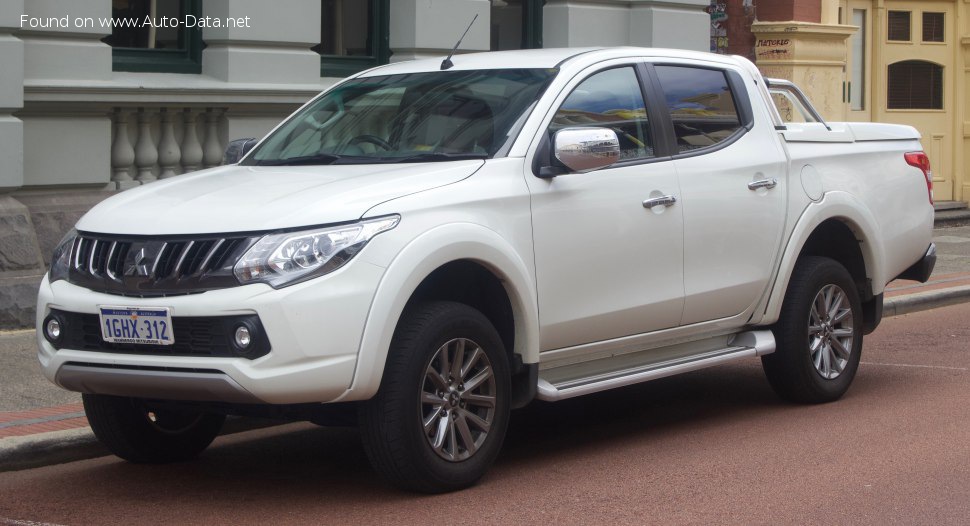
The Mitsubishi Triton V Double Cab Pick-Up, specifically the facelifted version introduced in 2019, represents a significant iteration of Mitsubishi’s globally popular mid-size pickup truck. While not widely sold in the United States – Mitsubishi discontinued sales of passenger vehicles in the US in 2006 – the Triton (sold as the Mitsubishi Warrior in Australia and New Zealand, and previously as the Dodge Ram 50 in North America) is a mainstay in markets like Asia, Europe, Africa, and Latin America. The 2019 facelift brought styling updates, enhanced safety features, and refinements to the 2.4-liter diesel engine, solidifying its position as a versatile workhorse and family vehicle. This generation, known for its robust build and practical features, caters to buyers seeking a capable and affordable pickup truck.
Mitsubishi Triton V Double Cab Pick-Up (Facelift 2019) Overview
The Triton V Double Cab Pick-Up, produced from 2019 to 2023, is a four-door, five-seat pickup truck designed to balance commercial utility with passenger comfort. The facelifted model builds upon the strengths of the fifth-generation Triton, offering improved aesthetics and technology. It primarily competes with other mid-size pickups like the Toyota Hilux, Nissan Navara (Frontier in the US), and Ford Ranger, offering a compelling alternative in regions where these vehicles are popular. The 2.4L D4 engine variant, discussed here, is a common configuration, prioritizing fuel efficiency and torque for both on- and off-road applications.
Engine & Performance
The heart of the 2019 Mitsubishi Triton V Double Cab Pick-Up is the 4N15 2.4-liter inline-four cylinder diesel engine. This engine produces 181 horsepower at 3500 rpm and 430 Newton-meters (317.15 lb-ft) of torque at 2500 rpm. The engine utilizes a turbocharger with an intercooler to enhance power output and efficiency. A diesel commonrail fuel injection system ensures precise fuel delivery, contributing to both performance and reduced emissions. The engine’s longitudinal front-engine layout optimizes weight distribution. The power-to-weight ratio stands at 10.7 kg/Hp, while the torque-to-weight ratio is 4.5 kg/Nm, indicating a responsive and capable powertrain. The engine is paired with a six-speed manual transmission, delivering power to all four wheels via an all-wheel-drive (4×4) system. This configuration provides excellent traction and off-road capability. Fuel economy is rated at 7.9 liters per 100 kilometers (29.8 US mpg), and CO2 emissions are 208 g/km.
Design & Features
The Mitsubishi Triton V Double Cab Pick-Up boasts a traditional pickup truck body style with a double-cab configuration, offering ample space for passengers in both rows. The 2019 facelift included revisions to the front fascia, featuring a redesigned grille, headlights, and bumper, giving the truck a more modern and aggressive appearance. The interior focuses on practicality and durability, with hard-wearing materials and a functional layout. Key features include a comfortable cabin, adequate storage compartments, and a user-friendly infotainment system (specifications vary by market). Safety features, enhanced in the facelifted model, typically include ABS (Anti-lock Braking System) and multiple airbags. The truck’s dimensions – 5305 mm (208.86 in) in length, 1815 mm (71.46 in) in width, and 1780 mm (70.08 in) in height – provide a substantial presence on the road. Ground clearance is a respectable 205 mm (8.07 in), contributing to its off-road prowess. Approach, departure, and ramp-over angles of 30-31°, 22-23°, and 24-25° respectively, further enhance its off-road capabilities. The Triton is designed to be a versatile vehicle, capable of handling both daily commuting and demanding work tasks.
Technical Specifications
| Brand | Mitsubishi |
| Model | Triton |
| Generation | Triton V Double Cab Pick Up (facelift 2019) |
| Type (Engine) | 2.4L D4 (181 Hp) 4WD |
| Start of production | 2019 |
| End of production | 2023 |
| Powertrain Architecture | Internal Combustion engine |
| Body type | Pick-up |
| Seats | 5 |
| Doors | 4 |
| Fuel consumption (combined) | 7.9 l/100 km (29.8 US mpg, 35.8 UK mpg, 12.7 km/l) |
| CO2 emissions | 208 g/km |
| Fuel Type | Diesel |
| Weight-to-power ratio | 10.7 kg/Hp |
| Weight-to-torque ratio | 4.5 kg/Nm |
| Power | 181 Hp @ 3500 rpm |
| Torque | 430 Nm @ 2500 rpm (317.15 lb.-ft. @ 2500 rpm) |
| Engine layout | Front, Longitudinal |
| Engine Model/Code | 4N15 |
| Engine displacement | 2442 cm3 (149.02 cu. in.) |
| Number of cylinders | 4 |
| Engine configuration | Inline |
| Cylinder Bore | 86 mm (3.39 in.) |
| Piston Stroke | 105.1 mm (4.14 in.) |
| Number of valves per cylinder | 4 |
| Fuel injection system | Diesel Commonrail |
| Engine aspiration | Turbocharger, Intercooler |
| Valvetrain | MIVEC |
| Engine oil capacity | 6.7 l (7.08 US qt | 5.9 UK qt) |
| Coolant | 7.7 l (8.14 US qt | 6.78 UK qt) |
| Kerb Weight | 1944-1982 kg (4285.79 – 4369.56 lbs.) |
| Max. weight | 2900 kg (6393.41 lbs.) |
| Max load | 918-956 kg (2023.84 – 2107.62 lbs.) |
| Fuel tank capacity | 75 l (19.81 US gal | 16.5 UK gal) |
| Permitted trailer load with brakes (12%) | 3100 kg (6834.33 lbs.) |
| Permitted trailer load without brakes | 750 kg (1653.47 lbs.) |
| Permitted towbar download | 310 kg (683.43 lbs.) |
| Length | 5305 mm (208.86 in.) |
| Width | 1815 mm (71.46 in.) |
| Height | 1780 mm (70.08 in.) |
| Wheelbase | 3000 mm (118.11 in.) |
| Ride height (ground clearance) | 205 mm (8.07 in.) |
| Drive wheel | All wheel drive (4×4) |
| Number of gears and type of gearbox | 6 gears, manual transmission |
| Front suspension | Double wishbone |
| Rear suspension | Leaf spring |
| Front brakes | Ventilated discs, 294-320 mm |
| Rear brakes | Drum |
| Assisting systems | ABS (Anti-lock braking system) |
| Steering type | Steering rack and pinion |
| Power steering | Electric Steering |
| Tires size | 245/70 R16 111S; 265/60 R18 110H |
| Wheel rims size | 7J x 16; 7.5J x 18 |