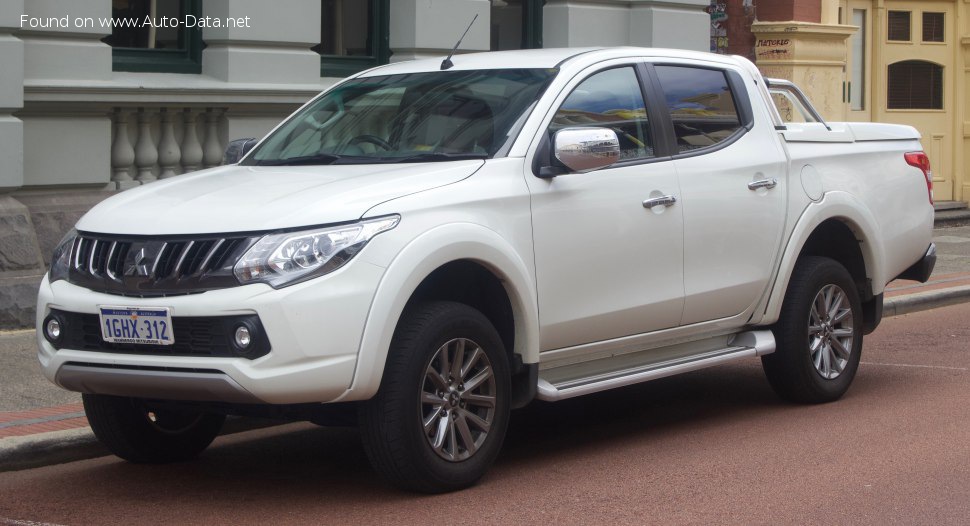
The Mitsubishi Triton V Single Cab Chassis (facelift 2019) represents a work-focused iteration of Mitsubishi’s globally recognized pickup truck. While not widely sold in the United States, the Triton – known as the Mitsubishi L200 in many international markets – has been a mainstay in the Asia-Pacific region, Europe, and Latin America since its introduction in 1978. The fifth-generation Triton, launched in 2015 and receiving a significant facelift in 2019, prioritizes durability, practicality, and affordability, catering to commercial users and those requiring a robust vehicle for demanding tasks. This particular variant, the Single Cab Chassis, is designed for maximum payload capacity and customization, often serving as a base for specialized work vehicles.
Mitsubishi Triton V Single Cab Chassis (facelift 2019): Overview
The 2019 facelift brought updated styling, enhanced safety features, and refinements to the 2.4-liter diesel engine. The Single Cab configuration, with its two doors and two seats, emphasizes utility over passenger comfort. It’s a vehicle built for work, offering a stripped-down, functional approach to the pickup truck segment. The Triton V competes with other compact/mid-size pickups like the Toyota Hilux, Isuzu D-Max, and Nissan Navara in markets where it is offered. Its appeal lies in its robust construction, reliable diesel powertrain, and competitive pricing.
Engine & Performance
Powering the Mitsubishi Triton V Single Cab Chassis (facelift 2019) is the 4N15 2.4-liter inline-four cylinder diesel engine. This engine produces 181 horsepower at 3500 rpm and 430 Newton-meters (317.15 lb.-ft.) of torque at 2500 rpm. The engine utilizes a turbocharger with an intercooler to enhance performance and efficiency. A diesel commonrail fuel injection system ensures precise fuel delivery for optimal combustion. The engine’s longitudinal front-engine layout contributes to a balanced weight distribution. The power-to-weight ratio is 8.7 kg/Hp, and the torque-to-weight ratio is 3.7 kg/Nm, indicating a capable work vehicle. The engine is mated to a 6-speed manual transmission, delivering power to the rear wheels. Fuel economy is rated at 7.8 liters per 100 kilometers (30.2 US mpg), with CO2 emissions of 204 g/km.
Design & Features
The Triton V Single Cab Chassis is a traditional pickup truck in its design. The single cab configuration provides a dedicated cargo bed, maximizing the vehicle’s hauling capacity. The chassis cab design allows for customization, with owners frequently adding specialized bodies or equipment to suit their specific needs. The exterior styling of the 2019 facelift includes a revised front grille, updated headlights, and a more modern bumper. The interior is functional and durable, prioritizing practicality over luxury. Safety features, while not as extensive as in modern passenger vehicles, include an Anti-lock Braking System (ABS). The vehicle’s ride height provides 200 mm (7.87 inches) of ground clearance, enhancing its off-road capability. Approach, ramp-over, and departure angles of 30°, 25°, and a respectable departure angle respectively, further contribute to its ability to tackle challenging terrain. The vehicle’s dimensions are 1815 mm (71.46 in) wide and 1775 mm (69.88 in) high, with a wheelbase of 3000 mm (118.11 in).
Technical Specifications
| Brand | Mitsubishi |
| Model | Triton |
| Generation | Triton V Single Cab Chassis (facelift 2019) |
| Type (Engine) | 2.4L D4 (181 Hp) |
| Start of production | 2019 |
| End of production | 2023 |
| Powertrain Architecture | Internal Combustion engine |
| Body type | Pick-up |
| Seats | 2 |
| Doors | 2 |
| Fuel consumption (combined) | 7.8 l/100 km (30.2 US mpg, 36.2 UK mpg, 12.8 km/l) |
| CO2 emissions | 204 g/km |
| Fuel Type | Diesel |
| Weight-to-power ratio | 8.7 kg/Hp |
| Weight-to-torque ratio | 3.7 kg/Nm |
| Power | 181 Hp @ 3500 rpm |
| Power per litre | 74.1 Hp/l |
| Torque | 430 Nm @ 2500 rpm (317.15 lb.-ft. @ 2500 rpm) |
| Engine layout | Front, Longitudinal |
| Engine Model/Code | 4N15 |
| Engine displacement | 2442 cm3 (149.02 cu. in.) |
| Number of cylinders | 4 |
| Engine configuration | Inline |
| Cylinder Bore | 86 mm (3.39 in.) |
| Piston Stroke | 105.1 mm (4.14 in.) |
| Number of valves per cylinder | 4 |
| Fuel injection system | Diesel Commonrail |
| Engine aspiration | Turbocharger, Intercooler |
| Engine oil capacity | 6.7 l (7.08 US qt | 5.9 UK qt) |
| Coolant | 7.7 l (8.14 US qt | 6.78 UK qt) |
| Kerb Weight | 1571 kg (3463.46 lbs.) |
| Max. weight | 2720 kg (5996.57 lbs.) |
| Max load | 1149 kg (2533.11 lbs.) |
| Permitted trailer load with brakes (12%) | 2500 kg (5511.56 lbs.) |
| Permitted trailer load without brakes | 750 kg (1653.47 lbs.) |
| Width | 1815 mm (71.46 in.) |
| Height | 1775 mm (69.88 in.) |
| Wheelbase | 3000 mm (118.11 in.) |
| Ride height (ground clearance) | 200 mm (7.87 in.) |
| Drive wheel | Rear wheel drive |
| Number of gears and type of gearbox | 6 gears, manual transmission |
| Front suspension | Double wishbone |
| Rear suspension | Leaf spring |
| Front brakes | Ventilated discs, 294 mm |
| Rear brakes | Drum |
| Assisting systems | ABS (Anti-lock braking system) |
| Steering type | Steering rack and pinion |
| Power steering | Electric Steering |
| Wheel rims size | 6J x 16 |
The Mitsubishi Triton V Single Cab Chassis (facelift 2019) remains a popular choice in markets where a durable, affordable, and capable pickup truck is required. Its focus on practicality and reliability, combined with its customizable chassis cab design, makes it a versatile tool for a wide range of applications.