
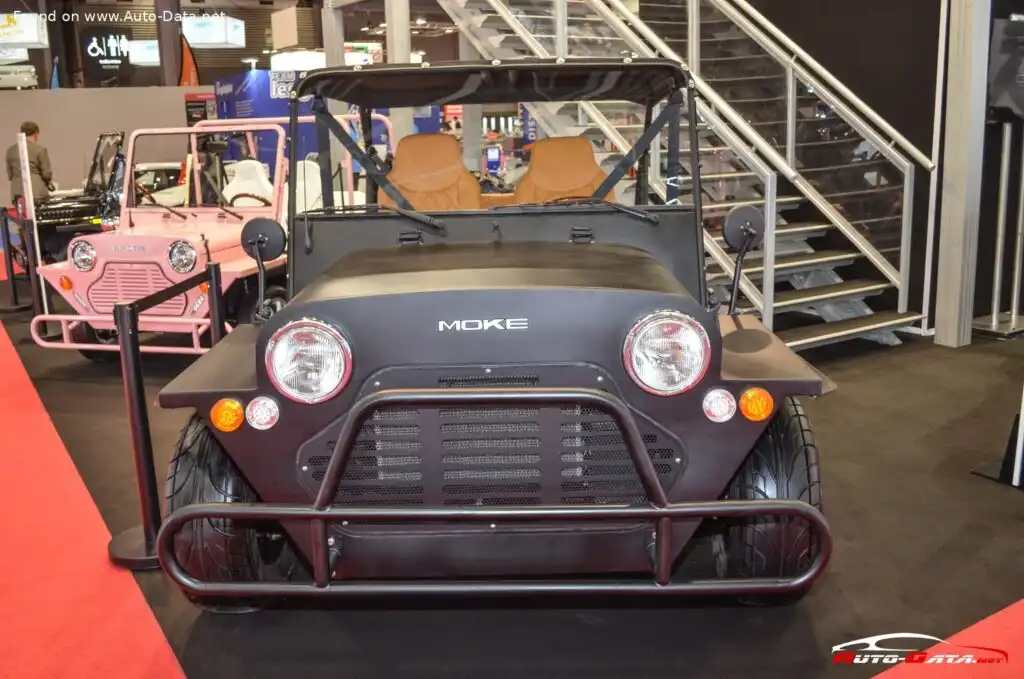
The Moke Electric, specifically the 12 kWh (20 hp) Automatic variant introduced in 2022 for the US market, represents a modern reimagining of the iconic British Mini Moke. While historically known for its simple, utilitarian design and off-road capability, the Moke has undergone several iterations, with the Electric model marking a significant shift towards sustainable transportation. This particular version is classified as a quadricycle, designed for low-speed, short-distance urban driving, and aims to capture the Moke’s original spirit of fun and open-air motoring in an environmentally conscious package. It occupies a unique niche, bridging the gap between golf carts and traditional automobiles.
Technical Specifications
| Brand | Moke |
| Model | Electric |
| Generation | Electric |
| Type (Engine) | 12 kWh (20 Hp) Automatic (USA) |
| Start of production | 2022 |
| Powertrain Architecture | BEV (Electric Vehicle) |
| Body type | Quadricycle |
| Seats | 4 |
| Fuel Type | Electricity |
| Maximum speed | 40 km/h (24.85 mph) |
| Weight-to-power ratio | 52.5 kg/Hp, 19 Hp/tonne |
| Weight-to-torque ratio | 11.1 kg/Nm, 90.5 Nm/tonne |
| Gross battery capacity | 12 kWh |
| Battery technology | Lead-Acid |
| Battery weight | 77 kg (169.76 lbs.) |
| All-electric range | 64.4 km (40.02 mi) |
| Electric motor | 1 |
| Electric motor power | 20 Hp @ 6800 rpm |
| Electric motor Torque | 95 Nm (70.07 lb.-ft.) |
| Electric motor model/code | EMC-95A |
| Electric motor type | Asynchronous |
| System power | 20 Hp |
| System torque | 95 Nm (70.07 lb.-ft.) |
| Kerb Weight | 1050 kg (2314.85 lbs.) |
| Trunk (boot) space – minimum | 25 l (0.88 cu. ft.) |
| Length | 3327 mm (130.98 in.) |
| Width | 1651 mm (65 in.) |
| Height | 1549 mm (60.98 in.) |
| Wheelbase | 2261 mm (89.02 in.) |
| Front track | 1499 mm (59.02 in.) |
| Rear (Back) track | 1270 mm (50 in.) |
| Drivetrain Architecture | One electric motor drives the front wheels. |
| Drive wheel | Front wheel drive |
| Front suspension | Independent type McPherson |
| Rear suspension | Trailing arm |
| Front brakes | Disc |
| Rear brakes | Drum |
| Tires size | 175/60 R14 |
Powertrain & Engine Architecture
The Moke Electric utilizes a fully electric powertrain, foregoing the internal combustion engine entirely. The heart of the system is a 12 kWh battery pack utilizing lead-acid technology. While lead-acid batteries are heavier and less energy-dense than lithium-ion alternatives, they represent a cost-effective solution for this low-speed, limited-range vehicle. The electric motor, designated EMC-95A, is an asynchronous type, producing a peak output of 20 horsepower at 6800 rpm and 95 Nm (70.07 lb.-ft.) of torque. Power is delivered to the front wheels via an automatic transmission, simplifying operation for the target demographic. The system power and torque remain consistent with the motor output, indicating a direct drive or minimal gearing reduction.
Driving Characteristics
The 20 hp output and automatic transmission of the Moke Electric prioritize ease of use over outright performance. Acceleration is modest, geared towards navigating urban environments rather than highway cruising. The limited top speed of 40 km/h (24.85 mph) reflects its classification as a quadricycle and its intended use case. The automatic transmission provides smooth, seamless power delivery, making it accessible to drivers of all skill levels. Compared to potential future higher-performance electric Moke variants, this 12 kWh model emphasizes efficiency and simplicity. The relatively low weight of 1050 kg (2314.85 lbs.) helps to mitigate the limited power output, providing adequate responsiveness for city driving.
Equipment & Trim Levels
The Moke Electric, in its base configuration, is relatively spartan, reflecting its utilitarian roots. Standard features typically include basic instrumentation, a steering wheel, and four seats. The interior is designed to be easily washable, with durable materials chosen for practicality. The open-air design, a hallmark of the Moke, is maintained, with a folding soft top available as an option. Trim levels are limited, with customization options focusing on exterior colors and accessory packages. Available extras might include upgraded audio systems, different wheel designs, and enhanced weather protection.
Chassis & Braking
The Moke Electric’s chassis is a modified version of the original Moke platform, adapted to accommodate the electric powertrain and battery pack. The front suspension utilizes an independent McPherson strut setup, providing a reasonable level of ride comfort. The rear suspension employs a trailing arm design, prioritizing simplicity and durability. The braking system features disc brakes on the front wheels and drum brakes on the rear, a cost-saving measure appropriate for the vehicle’s intended speed and weight class. The 175/60 R14 tires provide adequate grip for typical urban driving conditions.
Market Reception & Comparison
The Moke Electric has been generally well-received as a novelty vehicle and a fun, eco-friendly alternative for short-distance transportation. Critics have praised its retro styling and ease of use, but have also noted the limitations of its range and performance. Compared to other electric vehicles, the Moke Electric occupies a unique position, lacking the range and features of mainstream EVs but offering a distinctive driving experience. Within the Moke lineup, this Electric variant represents a departure from the traditional gasoline-powered models, appealing to a different demographic focused on sustainability and urban mobility. Its price point positions it as a premium option compared to golf carts, but significantly less expensive than most full-sized electric cars.
Legacy
The long-term reliability of the Moke Electric powertrain remains to be fully established, as it is a relatively new vehicle. However, the simplicity of the electric drivetrain suggests a potentially low maintenance burden. The lead-acid battery pack is a potential point of concern, as it has a limited lifespan and requires regular maintenance. In the used car market, the Moke Electric is likely to appeal to collectors and enthusiasts seeking a unique and environmentally friendly vehicle. Its iconic styling and limited production numbers could contribute to its value appreciation over time. The success of this initial electric Moke variant will likely pave the way for future iterations with improved battery technology and increased performance.
