
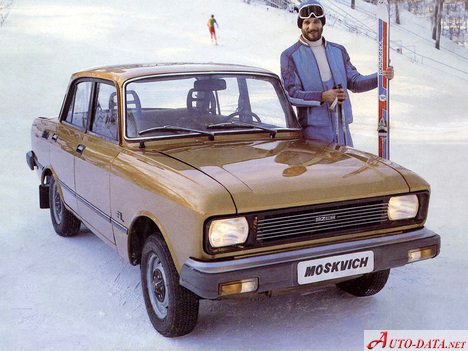
The Moskvich 2140 is a compact sedan produced by the Soviet automobile manufacturer AZLK (Avtozavod imeni Lenina, or Lenin Automotive Plant) from 1976 to 1988. Representing a significant modernization of the earlier Moskvich 1760 series, the 2140 aimed to provide a more comfortable and reliable vehicle for the Soviet populace. While never officially exported to the United States, the Moskvich 2140 was a common sight on the roads of Eastern Europe and the Soviet Union, fulfilling the need for affordable personal transportation. It’s a notable example of Soviet automotive engineering, reflecting the design trends and technological capabilities of the era.
Moskvich 2140: A Soviet Automotive Icon
The Moskvich 2140 emerged during a period of gradual modernization within the Soviet automotive industry. It built upon the foundation laid by the Moskvich 1760, addressing many of its shortcomings with updated styling, improved mechanical components, and a more refined interior. The 2140 was intended to be a practical and durable vehicle, capable of withstanding the harsh conditions often encountered in the Soviet Union. It served as a workhorse for families and individuals alike, providing a relatively affordable means of personal mobility. The car’s design, while influenced by Western automotive trends, retained a distinctly Soviet aesthetic, characterized by its boxy shape and functional approach.
Engine & Performance
The Moskvich 2140 was powered by the UZA M-412 inline-four cylinder engine, displacing 1.5 liters (1479 cm3 or 90.25 cu. in.). This engine produced 75 horsepower at 5800 rpm and 108 Nm (79.66 lb.-ft.) of torque at 3800 rpm. While not a performance powerhouse, the engine provided adequate power for everyday driving. The engine featured a carburettor fuel injection system and a compression ratio of 8.8:1. Power per litre was rated at 50.7 Hp/l. The engine was mounted longitudinally in the front of the vehicle. Power was delivered to the rear wheels via a four-speed manual transmission. Acceleration from 0 to 100 km/h (0-62 mph) took approximately 19 seconds, and 0 to 60 mph was achieved in around 18.1 seconds. The Moskvich 2140 had a maximum speed of 140 km/h (86.99 mph). The weight-to-power ratio was 14.4 kg/Hp, and the weight-to-torque ratio was 10 kg/Nm.
Design & Features
The Moskvich 2140 is a four-door, five-seat sedan. Its body style is characterized by a boxy silhouette, typical of automotive designs from the 1970s and 1980s. The car’s exterior featured relatively simple styling, with a focus on practicality rather than aesthetics. Chrome trim was used sparingly, and the overall design was functional and understated. Inside, the 2140 offered a basic but comfortable interior. The seats were upholstered in durable fabric, and the dashboard featured a simple layout with essential gauges and controls. Safety features were limited by the standards of the time, but the car did include disc brakes on the front wheels and drum brakes on the rear. Suspension consisted of a double wishbone setup at the front and a rigid axle suspension at the rear. The car’s dimensions were 4250 mm (167.32 in.) in length, 1550 mm (61.02 in.) in width, and 1480 mm (58.27 in.) in height, with a wheelbase of 2400 mm (94.49 in.).
Technical Specifications
| Brand | Moskvich |
| Model | 2140 |
| Generation | 2140 |
| Type (Engine) | 1.5 (75 Hp) |
| Start of production | 1976 |
| End of production | 1988 |
| Powertrain Architecture | Internal Combustion engine |
| Body type | Sedan |
| Seats | 5 |
| Doors | 4 |
| Fuel consumption (extra urban) | 7.4 l/100 km (31.8 US mpg, 38.2 UK mpg, 13.5 km/l) |
| Fuel consumption (combined) | 10.2 l/100 km (23.1 US mpg, 27.7 UK mpg, 9.8 km/l) |
| Fuel Type | Petrol (Gasoline) |
| Acceleration 0 – 100 km/h | 19 sec |
| Acceleration 0 – 62 mph | 19 sec |
| Acceleration 0 – 60 mph | 18.1 sec |
| Maximum speed | 140 km/h (86.99 mph) |
| Weight-to-power ratio | 14.4 kg/Hp |
| Weight-to-torque ratio | 10 kg/Nm |
| Power | 75 Hp @ 5800 rpm |
| Power per litre | 50.7 Hp/l |
| Torque | 108 Nm @ 3800 rpm (79.66 lb.-ft. @ 3800 rpm) |
| Engine layout | Front, Longitudinal |
| Engine Model/Code | UZA M-412 |
| Engine displacement | 1479 cm3 (90.25 cu. in.) |
| Number of cylinders | 4 |
| Engine configuration | Inline |
| Cylinder Bore | 82 mm (3.23 in.) |
| Piston Stroke | 70 mm (2.76 in.) |
| Compression ratio | 8.8:1 |
| Number of valves per cylinder | 2 |
| Fuel injection system | Carburettor |
| Engine aspiration | Naturally aspirated |
| Kerb Weight | 1080 kg (2380.99 lbs.) |
| Fuel tank capacity | 46 l (12.15 US gal, 10.12 UK gal) |
| Length | 4250 mm (167.32 in.) |
| Width | 1550 mm (61.02 in.) |
| Height | 1480 mm (58.27 in.) |
| Wheelbase | 2400 mm (94.49 in.) |
| Front track | 1270 mm (50 in.) |
| Rear track | 1270 mm (50 in.) |
| Drivetrain Architecture | Rear wheel drive |
| Number of gears | 4 |
| Gearbox type | Manual transmission |
| Front suspension | Double wishbone |
| Rear suspension | Rigid axle suspension |
| Front brakes | Disc |
| Rear brakes | Drum |
| Steering type | Worm-reduction unit |
| Tires size | 165/80 R13 |
The Moskvich 2140, while not a technologically advanced vehicle by Western standards, played a crucial role in providing personal transportation to millions of people in the Soviet Union and Eastern Europe. Its durability, affordability, and relative simplicity made it a popular choice for families and individuals seeking a reliable means of getting around. Today, the Moskvich 2140 is a cherished classic among automotive enthusiasts, representing a unique chapter in automotive history.
