
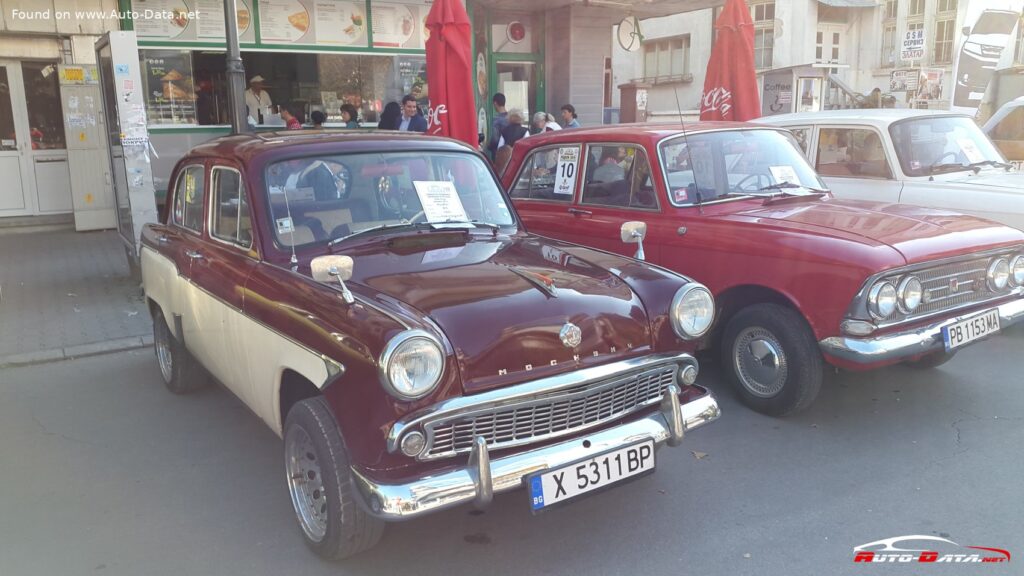
The Moskvich 403 was a Soviet-built automobile that represented a significant step forward in post-war automotive design for the Eastern Bloc. Produced from 1962 to 1965, it was a popular choice for both private ownership and as a taxi or service vehicle within the Soviet Union and its satellite states. While never officially exported to the United States, the 403 provides a fascinating glimpse into the engineering and aesthetic priorities of the era, and its impact on personal mobility in a region undergoing rapid social and economic change. The 403, powered by a 1.4-liter engine producing 45 horsepower, aimed to provide a reliable and relatively modern transportation option for the burgeoning Soviet middle class.
Moskvich 403: A Soviet Automotive Landmark
The Moskvich 403 was part of the broader Moskvich lineage, a brand originating in 1938 with the KIM-10. Following World War II, the Moskvich plant underwent modernization, heavily influenced by Ford designs. The 403 represented a departure from earlier models, featuring a more streamlined body and improved mechanical components. It was intended to be a comfortable and practical vehicle, suitable for both urban and rural environments. The car’s design reflected the aesthetic trends of the early 1960s, with a focus on functional elegance rather than overt luxury. It filled a crucial niche in the Soviet automotive market, offering a step up from utilitarian models like the Zaporozhets, while remaining more affordable than the limited-production Volga.
Engine & Performance
The heart of the Moskvich 403 was its 1360cc (82.99 cubic inch) inline-four cylinder engine. This naturally aspirated engine produced 45 horsepower at 4500 rpm and 88 Nm (64.91 lb-ft) of torque at 2600 rpm. While these figures may seem modest by modern standards, they were competitive for vehicles in its class and price range during the early 1960s. The engine featured a 7:1 compression ratio and utilized a carburetor fuel injection system. Power per liter was rated at 33.1 hp/l. The engine was mounted longitudinally in the front of the vehicle, driving the rear wheels through a four-speed manual transmission. The 403 achieved a maximum speed of 115 km/h (71.46 mph). Fuel economy figures were approximately 8 liters per 100 kilometers (29.4 US mpg or 35.3 UK mpg) on a combined cycle, with 10 l/100 km (23.5 US mpg) in urban conditions and 6.5 l/100 km (36.2 US mpg) on the open road. The weight-to-power ratio was 20 kg/Hp, and the weight-to-torque ratio was 10.2 kg/Nm.
Design & Features
The Moskvich 403 was a four-door sedan with a body length of 4040 mm (159.06 inches), a width of 1540 mm (60.63 inches), and a height of 1600 mm (62.99 inches). It had a wheelbase of 2380 mm (93.7 inches) and a curb weight of 900 kg (1984.16 lbs). The car could accommodate four passengers and offered a reasonable amount of luggage space for its time. The exterior styling was characterized by rounded lines, a prominent grille, and relatively large windows. Interior appointments were basic but functional, with cloth upholstery and simple instrumentation. Safety features were limited by the standards of the era, consisting primarily of drum brakes on all four wheels and a robust chassis construction. The suspension system employed coil springs and double wishbones at the front, and a rigid axle with leaf springs at the rear. The steering system was a cone worm type with recirculation balls. The vehicle was equipped with 145/80 R15 tires mounted on 4.5K x 15 inch wheel rims.
Technical Specifications
| Brand | Moskvich |
| Model | 403 |
| Generation | 403 |
| Type (Engine) | 1.4 (45 Hp) |
| Start of production | 1962 |
| End of production | 1965 |
| Powertrain Architecture | Internal Combustion engine |
| Body type | Sedan |
| Seats | 4 |
| Doors | 4 |
| Fuel consumption (urban) | 10 l/100 km (23.5 US mpg) |
| Fuel consumption (extra urban) | 6.5 l/100 km (36.2 US mpg) |
| Fuel consumption (combined) | 8 l/100 km (29.4 US mpg) |
| Fuel Type | Petrol (Gasoline) |
| Maximum speed | 115 km/h (71.46 mph) |
| Weight-to-power ratio | 20 kg/Hp |
| Weight-to-torque ratio | 10.2 kg/Nm |
| Power | 45 Hp @ 4500 rpm |
| Power per litre | 33.1 Hp/l |
| Torque | 88 Nm @ 2600 rpm (64.91 lb.-ft. @ 2600 rpm) |
| Engine layout | Front, Longitudinal |
| Engine displacement | 1360 cm3 (82.99 cu. in.) |
| Number of cylinders | 4 |
| Engine configuration | Inline |
| Cylinder Bore | 76 mm (2.99 in.) |
| Piston Stroke | 75 mm (2.95 in.) |
| Compression ratio | 7:1 |
| Number of valves per cylinder | 2 |
| Fuel injection system | Carburettor |
| Engine aspiration | Naturally aspirated |
| Kerb Weight | 900 kg (1984.16 lbs.) |
| Max. weight | 1280 kg (2821.92 lbs.) |
| Max load | 380 kg (837.76 lbs.) |
| Fuel tank capacity | 35 l (9.25 US gal | 7.7 UK gal) |
| Length | 4040 mm (159.06 in.) |
| Width | 1540 mm (60.63 in.) |
| Height | 1600 mm (62.99 in.) |
| Wheelbase | 2380 mm (93.7 in.) |
| Front track | 1225 mm (48.23 in.) |
| Rear track | 1220 mm (48.03 in.) |
| Drivetrain Architecture | Rear wheel drive |
| Number of gears | 4 gears, manual transmission |
| Front suspension | Coil spring, Double wishbone |
| Rear suspension | Rigid axle suspension, Leaf spring |
| Front brakes | Drum |
| Rear brakes | Drum |
| Steering type | Cone worm with recirculation balls |
| Tires size | 145/80 R15 |
| Wheel rims size | 4.5K x 15 |
The Moskvich 403, while not a technological marvel, represented a significant achievement for the Soviet automotive industry. It provided a reliable and affordable means of transportation for millions of people, and its design influenced subsequent Moskvich models. Today, the 403 is a sought-after classic car among collectors and enthusiasts, offering a unique window into a bygone era of automotive history.
