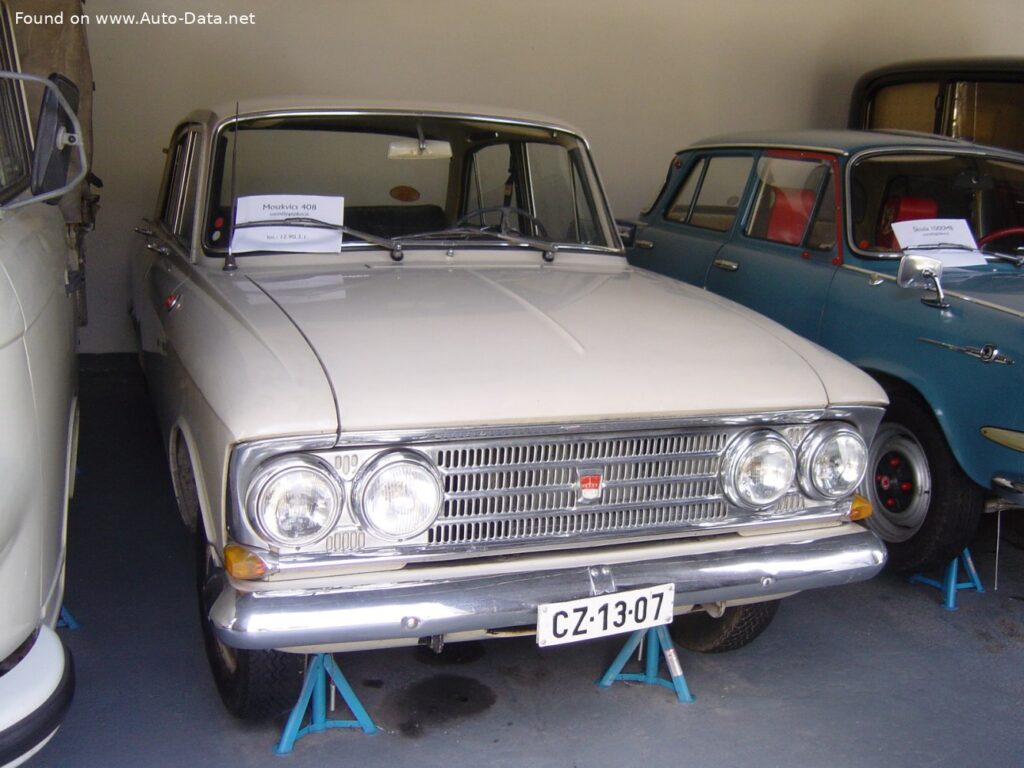
The Moskvich 408 was a Soviet-built sedan produced from 1964 to 1969, representing a significant step forward in Soviet automotive design and a popular choice for families and government use. While largely unknown in the United States, the 408 was a mainstay of Eastern European roads and a symbol of the Soviet Union’s industrial capabilities. It was intended to modernize the Moskvich lineup, offering improved comfort, styling, and mechanical refinement compared to its predecessors. The 408, powered by a 1.4-liter engine producing 50 horsepower, occupied the compact family car segment, competing with vehicles like the Škoda Octavia and the Volga M-21 in its domestic market.
Moskvich 408: A Soviet Automotive Landmark
The Moskvich 408 was more than just a car; it was a reflection of the Soviet Union’s aspirations for a modern, accessible automobile. Developed as a replacement for the aging Moskvich 407, the 408 featured a more contemporary design, influenced by European styling trends of the early 1960s. Its production coincided with a period of relative economic stability in the USSR, allowing for increased investment in consumer goods, including automobiles. The 408 was intended to be a reliable and practical vehicle for everyday use, and its relatively simple construction made it relatively easy to maintain, a crucial factor in the Soviet context.
Engine & Performance
The heart of the Moskvich 408 was the AZLK-408, a 1.4-liter (82.87 cubic inches) inline-four cylinder engine. This engine, producing 50 horsepower at 4750 rpm and 92 Nm (67.86 lb-ft) of torque at 2750 rpm, was a significant upgrade over the engines found in earlier Moskvich models. While not a performance car by Western standards, the 408 offered adequate power for its intended purpose. The engine featured a 7:1 compression ratio and utilized a carburetor fuel injection system. The engine’s power-to-weight ratio was 50.5 horsepower per tonne, and its power per liter was 36.8 hp/l. Acceleration from 0 to 100 km/h (0-62 mph) took approximately 29 seconds, and 0 to 60 mph was achieved in around 27.6 seconds. The top speed was limited to 120 km/h (74.56 mph). Fuel consumption was rated at 8.5 liters per 100 kilometers (27.7 US mpg) combined, with 10 l/100 km (23.5 US mpg) in urban conditions and 7 l/100 km (33.6 US mpg) on the open road.
Design & Features
The Moskvich 408 was a four-door sedan with a relatively spacious interior for its size, accommodating five passengers. Its body-on-frame construction was typical for the era, providing a robust and durable platform. The exterior styling, while not groundbreaking, was clean and functional, with a distinct Soviet aesthetic. The car featured a longitudinal front-engine layout and rear-wheel drive. Suspension consisted of a double wishbone setup at the front and a leaf spring arrangement at the rear. Braking was handled by drum brakes on all four wheels. Interior features were basic but functional, reflecting the car’s utilitarian purpose. The trunk offered a minimum capacity of 372 liters (13.14 cubic feet). Safety features were limited by the standards of the time, with minimal crash protection. The fuel tank held 46 liters (12.15 US gallons).
Technical Specifications
| Brand | Moskvich |
| Model | 408 |
| Generation | 408 |
| Type (Engine) | 1.4 (50 Hp) |
| Start of production | 1964 |
| End of production | 1969 |
| Powertrain Architecture | Internal Combustion engine |
| Body type | Sedan |
| Seats | 5 |
| Doors | 4 |
| Fuel consumption (urban) | 10 l/100 km (23.5 US mpg) |
| Fuel consumption (extra urban) | 7 l/100 km (33.6 US mpg) |
| Fuel consumption (combined) | 8.5 l/100 km (27.7 US mpg) |
| Fuel Type | Petrol (Gasoline) |
| Acceleration 0 – 100 km/h | 29 sec |
| Acceleration 0 – 62 mph | 29 sec |
| Acceleration 0 – 60 mph | 27.6 sec |
| Maximum speed | 120 km/h (74.56 mph) |
| Weight-to-power ratio | 19.8 kg/Hp |
| Weight-to-torque ratio | 10.8 kg/Nm |
| Power | 50 Hp @ 4750 rpm |
| Torque | 92 Nm @ 2750 rpm (67.86 lb.-ft. @ 2750 rpm) |
| Engine layout | Front, Longitudinal |
| Engine Model/Code | AZLK-408 |
| Engine displacement | 1358 cm3 (82.87 cu. in.) |
| Number of cylinders | 4 |
| Engine configuration | Inline |
| Cylinder Bore | 76 mm (2.99 in.) |
| Piston Stroke | 75 mm (2.95 in.) |
| Compression ratio | 7:1 |
| Number of valves per cylinder | 2 |
| Fuel injection system | Carburettor |
| Engine aspiration | Naturally aspirated |
| Kerb Weight | 990 kg (2182.58 lbs.) |
| Max. weight | 1330 kg (2932.15 lbs.) |
| Max load | 340 kg (749.57 lbs.) |
| Trunk (boot) space | 372 l (13.14 cu. ft.) |
| Fuel tank capacity | 46 l (12.15 US gal | 10.12 UK gal) |
| Length | 4090 mm (161.02 in.) |
| Width | 1550 mm (61.02 in.) |
| Height | 1480 mm (58.27 in.) |
| Wheelbase | 2400 mm (94.49 in.) |
| Front track | 1237 mm (48.7 in.) |
| Rear track | 1277 mm (50.28 in.) |
| Drivetrain Architecture | Rear wheel drive |
| Number of gears | 4 gears, manual transmission |
| Front suspension | Double wishbone |
| Rear suspension | Leaf spring |
| Front brakes | Drum |
| Rear brakes | Drum |
The Moskvich 408, while not a technological marvel, played a crucial role in the motorization of the Soviet Union. It provided affordable and reliable transportation for millions of citizens and served as a symbol of Soviet engineering prowess. Though largely forgotten in the West, the 408 remains a significant piece of automotive history, representing a unique chapter in the global story of the automobile.