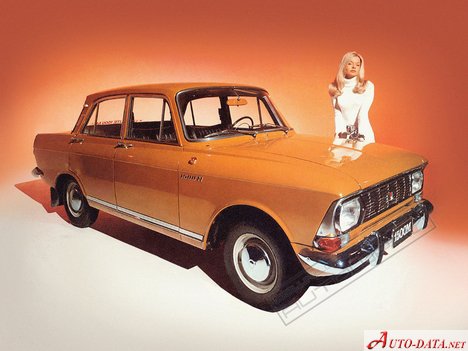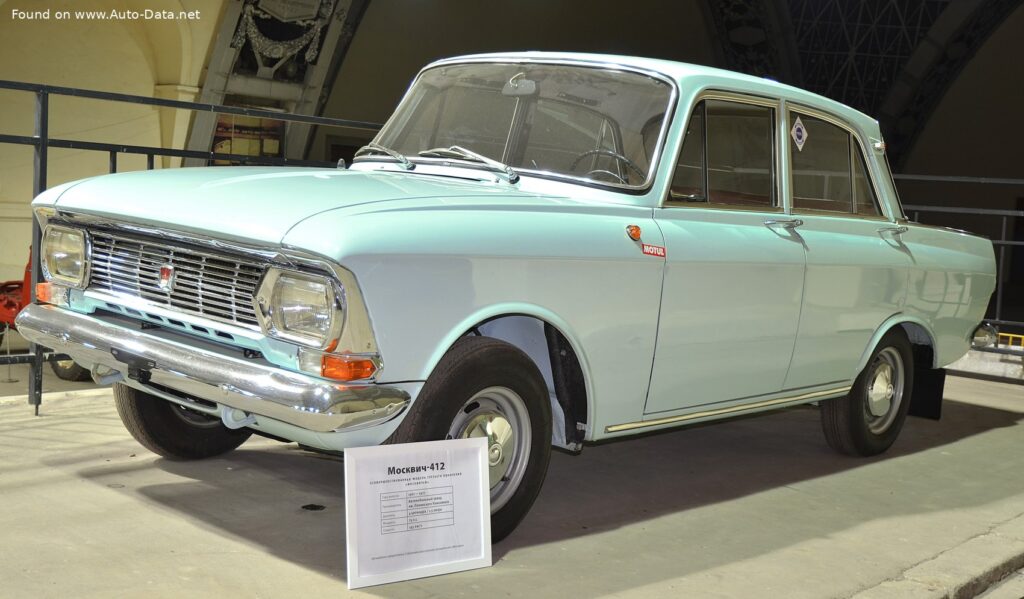
The Moskvich 412 was a Soviet-built automobile, produced from 1967 to 1969. Representing a significant modernization of the earlier Moskvich 408, the 412 aimed to provide a more contemporary and comfortable vehicle for the Soviet populace. While never officially exported to the United States, the Moskvich 412 played a crucial role in personal transportation within the Eastern Bloc and found its way into various other markets, particularly in Europe, where it offered an affordable alternative to Western European vehicles. The 412, with its 1.5-liter engine producing 75 horsepower, was a staple of Soviet roads for a brief but important period, embodying the automotive aspirations of the era.
Moskvich 412: A Soviet Automotive Evolution
The Moskvich 412 marked a departure from the more rounded styling of its predecessor, adopting a more angular and modern aesthetic influenced by contemporary Western designs. It was intended to address criticisms leveled at the 408 regarding its dated appearance and limited features. The 412 retained the basic mechanical layout of the 408 – a longitudinally-mounted inline-four engine driving the rear wheels – but incorporated numerous improvements to enhance reliability, performance, and passenger comfort. The car’s production run was relatively short, superseded by further developments within the Moskvich range, but it remains a recognizable symbol of Soviet automotive engineering.
Engine & Performance
The heart of the Moskvich 412 was its 1.5-liter (1479 cm3 or 90.25 cu. in.) inline-four cylinder engine, designated the UZA M-412. This naturally aspirated engine produced 75 horsepower at 5800 rpm and 108 Nm (79.66 lb.-ft.) of torque at 3800 rpm. While not a powerhouse by modern standards, this output was considered adequate for the vehicle’s weight and intended purpose. The engine featured a compression ratio of 8.8:1 and utilized a carburetor fuel injection system. Performance figures reflected the car’s modest power, with a 0-60 mph (0-96 km/h) acceleration time of approximately 18.1 seconds and a top speed of 140 km/h (86.99 mph). The weight-to-power ratio was 13.9 kg/Hp, and the weight-to-torque ratio was 9.7 kg/Nm. Fuel economy was rated at 11.3 l/100 km (20.8 US mpg) combined, and 8 l/100 km (29.4 US mpg) extra urban.
Design & Features
The Moskvich 412 was a four-door sedan, offering seating for five passengers. Its body style was characterized by straight lines, a relatively low roofline, and a prominent grille. Compared to the 408, the 412 featured a more spacious interior and improved ventilation. While not lavishly equipped by Western standards, the 412 offered features considered essential for the time, such as a heater and basic instrumentation. Safety features were rudimentary, typical of vehicles from the late 1960s, consisting primarily of basic seatbelts. The car’s suspension system utilized a conventional leaf spring setup at the rear and independent coil springs at the front, providing a reasonably comfortable ride on the often-poor road surfaces prevalent in the Soviet Union. The fuel tank capacity was 46 liters (12.15 US gal).
Technical Specifications
| Brand | Moskvich |
| Model | 412 |
| Generation | 412 |
| Type (Engine) | 1.5 (75 Hp) |
| Start of production | 1967 |
| End of production | 1969 |
| Powertrain Architecture | Internal Combustion engine |
| Body type | Sedan |
| Fuel consumption (economy) – extra urban | 8 l/100 km (29.4 US mpg, 35.3 UK mpg, 12.5 km/l) |
| Fuel consumption (economy) – combined | 11.3 l/100 km (20.8 US mpg, 25 UK mpg, 8.8 km/l) |
| Fuel Type | Petrol (Gasoline) |
| Acceleration 0 – 100 km/h | 19 sec |
| Acceleration 0 – 62 mph | 19 sec |
| Acceleration 0 – 60 mph | 18.1 sec |
| Maximum speed | 140 km/h (86.99 mph) |
| Weight-to-power ratio | 13.9 kg/Hp, 71.8 Hp/tonne |
| Weight-to-torque ratio | 9.7 kg/Nm, 103.3 Nm/tonne |
| Power | 75 Hp @ 5800 rpm |
| Power per litre | 50.7 Hp/l |
| Torque | 108 Nm @ 3800 rpm (79.66 lb.-ft. @ 3800 rpm) |
| Engine layout | Front, Longitudinal |
| Engine Model/Code | UZA M-412 |
| Engine displacement | 1479 cm3 (90.25 cu. in.) |
| Number of cylinders | 4 |
| Engine configuration | Inline |
| Cylinder Bore | 82 mm (3.23 in.) |
| Piston Stroke | 70 mm (2.76 in.) |
| Compression ratio | 8.8:1 |
| Number of valves per cylinder | 2 |
| Fuel injection system | Carburettor |
| Engine aspiration | Naturally aspirated engine |
| Kerb Weight | 1045 kg (2303.83 lbs.) |
| Fuel tank capacity | 46 l (12.15 US gal | 10.12 UK gal) |
| Length | 4250 mm (167.32 in.) |
| Width | 1550 mm (61.02 in.) |
| Height | 1480 mm (58.27 in.) |
| Drivetrain Architecture | The Internal combustion engine (ICE) drives the rear wheels of the vehicle. |
| Drive wheel | Rear wheel drive |
| Number of gears and type of gearbox | 4 gears, manual transmission |
The Moskvich 412, though short-lived, represents an important step in the evolution of Soviet automotive design and engineering. It provided a more modern and comfortable alternative to earlier models, and while it never achieved widespread recognition in the West, it served as a reliable and affordable vehicle for millions of people within the Soviet Union and its sphere of influence. Its legacy continues as a collectible classic, offering a glimpse into a bygone era of automotive history.